Lower Helix Piercing
Complete Guide 2026
The lobe-adjacent cartilage placement that bridges your rim and lobe stack — placement, honest pain level, 6–9 month healing, jewelry options, and full 2026 cost breakdown.

Lower Helix Piercing: The Complete 2026 Guide
Jump to a section:
What Is a Lower Helix Piercing?
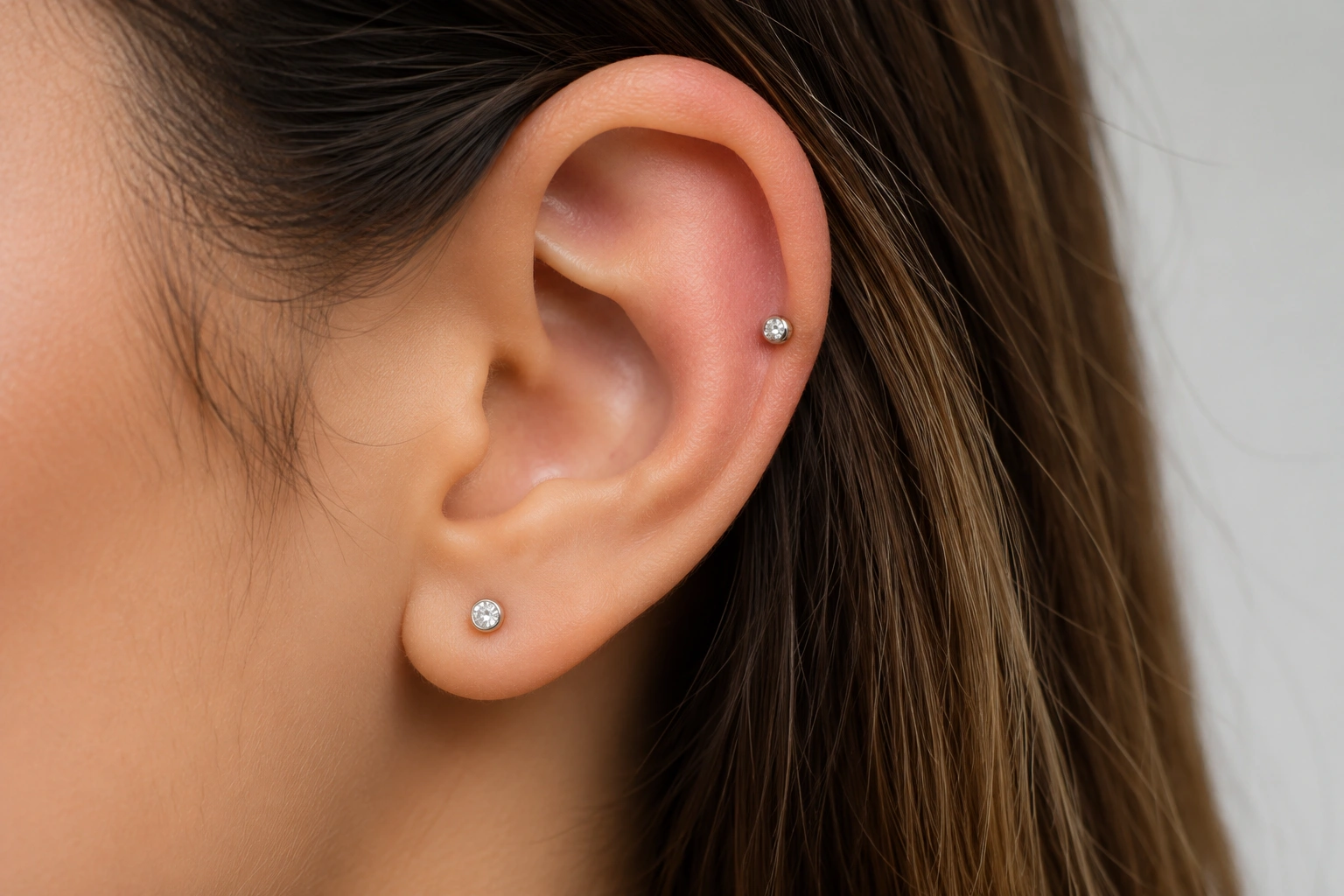
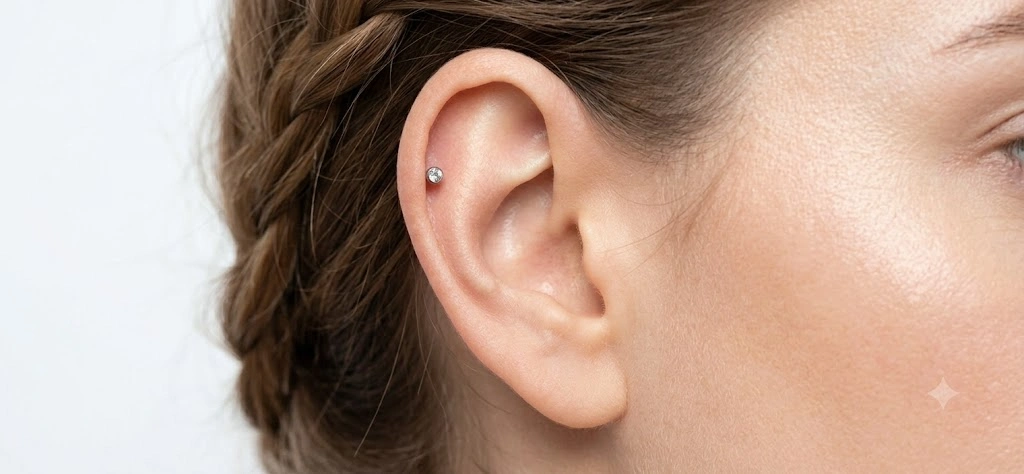
A lower helix piercing is placed in the bottom third of the outer helix cartilage rim — the section closest to the earlobe where the curved rim begins its descent toward the lobe. It occupies the transition zone between the mid-helix and the soft tissue of the lobe, giving it a uniquely transitional character: it is clearly a cartilage piercing, yet it sits close enough to the lobe to visually bridge rim and lobe jewelry in an ear stack.
The lower helix is one of the most versatile and underrated positions on the ear. Because it sits at the rim’s lower curve, it naturally connects with lobe piercings below it and mid or upper helix piercings above — making it an essential anchor point for anyone building a cohesive curated ear. A well-placed lower helix stud draws the eye smoothly from lobe to rim, creating a sense of continuity that turns individual piercings into a unified composition.
In recent years, the lower helix has gained considerable traction in curated ear culture precisely because of this connective quality. It fills what stylists call the “gap zone” — the visual space between the lobe and the middle of the helix that, when left empty, can make even a well-planned ear stack feel incomplete. A single lower helix stud resolves that gap instantly.
Unlike the forward helix (which sits near the temple) or the hidden helix (which tucks into the inner fold), the lower helix is straightforwardly accessible — on the outer rim, clearly visible, easy to style, and compatible with a wide range of jewelry. It is an excellent first cartilage piercing and an equally excellent addition to an existing collection.
- Location: Bottom third of the outer helix cartilage rim
- Visibility: Fully visible, outward-facing
- Pain: 4 / 10
- Healing: 6–9 months
- Initial Jewelry: Flat-back labret stud (titanium)
- Cost (US): $40–$85
- Anatomy dependent: Very low — most ears qualify easily
Placement — Finding the Lower Helix Sweet Spot
The lower helix occupies the bottom third of the outer helix rim — the curved section where the cartilage begins to taper toward the lobe. On most ears, this zone begins roughly level with the base of the antihelix and ends where cartilage gives way to the soft tissue of the earlobe. Visually, it sits noticeably lower than a standard mid-helix placement and clearly above the lobe.
How Piercers Determine Exact Placement
Because “lower helix” describes a zone rather than a single fixed point, your piercer will assess several factors to find the optimal placement within that zone:
- Cartilage thickness: The lower helix rim tends to be thinner than the upper or mid sections — your piercer will find the spot with sufficient thickness for comfortable healing
- Distance from the lobe: Enough clearance from the lobe edge to avoid tissue overlap, typically at least 6–8mm
- Existing lobe piercings: A high lobe piercing very close to the cartilage line may influence lower helix placement
- Stack planning: If you plan to add a mid-helix above, your piercer will factor spacing from the outset
Lower Helix Position Comparison
| Position | Location on Ear | Visual Role in Stack |
|---|---|---|
| Upper Helix | Top third of rim | Crown — anchors the top of the stack |
| Mid Helix | Centre of rim | Focal point — visual centre of gravity |
| Lower Helix | Bottom third of rim | Bridge — connects rim to lobe |
| Lobe (3rd) | Upper lobe area | Transition — near cartilage line |
Building a Stack Around the Lower Helix
The lower helix is a natural starting point for a bottom-up curated ear. Common and visually effective combinations:
- Lower helix + lobe stack: The most natural pairing — the lower helix sits just above a row of lobe studs, creating a seamless transition from soft tissue to cartilage
- Lower + mid helix: Two rim points create a clean, restrained stack that works for professional and casual environments
- Lower + mid + upper helix: The classic triple rim stack — lower helix is essential as the base of this arrangement
- Lower helix + tragus: The lower helix and tragus face each other from opposite sides of the lower ear, creating a framing effect
Tell your piercer your stack intentions at the lower helix appointment. Placing the lower helix with future additions in mind — particularly spacing from a planned mid-helix — ensures the finished stack looks intentional rather than improvised.
Pain Level — What Does It Actually Feel Like?
The lower helix rates a consistent 4 out of 10 on a realistic pain scale. It is one of the gentler cartilage piercings — slightly more intense than a lobe but well within the comfort range of most first-time cartilage clients. The lower rim cartilage is typically thinner than upper or mid sections, which means the needle meets less resistance and the pass is usually very quick.
Pain Scale: 4 out of 10
The Piercing Moment
Most people describe the lower helix needle pass as a sharp, brief pinch — lasting no more than 1–2 seconds. Because the lower cartilage is thinner than upper sections, many people find it slightly faster and less pressurized than a standard mid-helix. The jewelry insertion may feel slightly more noticeable than the needle itself — a common experience across all helix placements.
After the Piercing
A mild throbbing ache for the first 2–4 hours is normal. Tenderness when the area is touched or knocked continues for the first week. The lower helix location — close to the lobe — means it may be more susceptible to knocks from earrings being put in adjacent lobe piercings. Be mindful of this during healing.
Honest Pain Comparison
| Piercing Type | Pain (1–10) | Notes |
|---|---|---|
| Lobe | 2 | Soft tissue, very quick |
| Lower Helix | 4 | Thin lower rim cartilage, fast pass |
| Mid Helix | 4 | Outer rim cartilage, comparable |
| Hidden Helix | 5 | Fold angle adds complexity |
| Forward Helix | 5–6 | Thicker cartilage near temple |
| Rook | 7 | Deep anti-helix fold |
- Eat a full meal 1–2 hours before your appointment
- Stay well hydrated on the day
- Avoid alcohol and caffeine for 24 hours prior
- Exhale slowly and steadily as the needle passes
- Choose a studio that uses single-use hollow needles — never guns
- Talk to your piercer — good communication keeps you calm throughout
Healing Timeline — Month by Month
The lower helix heals over 6–9 months for initial healing, with full cartilage maturation at 9–12 months. Because it sits on the exposed outer rim near the lobe, it heals reliably when aftercare is consistent — and is generally considered one of the more cooperative cartilage placements.
wk
Redness, localized swelling, and tenderness are all normal. Clear or white lymph fluid crusting around the jewelry is healthy healing activity — not infection. Do not touch, twist, or rotate the jewelry. Keep hair, products, and unwashed hands away from the area.
mo
Swelling resolves. The fistula begins forming but is fragile. The proximity to lobe piercings is a unique hazard here — accidentally knocking the lower helix while inserting or removing lobe earrings is a leading cause of early-stage irritation. Be extra careful around the whole lower ear during this phase.
mo
Day-to-day discomfort largely resolves. The channel continues forming internally. Continue twice-daily saline. Do not change jewelry regardless of how healed it feels. Some people experience temporary flare-ups during illness or stress — this is normal and usually resolves quickly.
mo
Most lower helix piercings reach comfortable initial healing in this window. Book a downsize appointment with your piercer — replacing the longer healing post with a shorter, better-fitting one dramatically improves comfort and jewelry appearance. Always have your piercer perform the downsize.
mo
Cartilage fully stable. Jewelry changes are smooth and comfortable. Now is the time to add the mid-helix above if you have been waiting, or to upgrade to that solid gold piece you have been planning. Your lower helix is fully healed and ready for anything.
The lower helix’s proximity to lobe piercings means that routine lobe jewelry changes are a healing hazard. Accidentally bumping the lower helix cartilage while inserting or removing lobe earrings — especially hoops — is a very common cause of lower helix irritation bumps. Be deliberate and slow when handling lobe jewelry during the first 6 months.
Jewelry Options for Lower Helix Piercings
The lower helix sits on the outer rim like a standard helix, giving it strong jewelry versatility. It accommodates both studs and hoops comfortably post-healing, and its position near the lobe makes it one of the best placements for coordinating with lobe jewelry in a cohesive stack.
Initial Jewelry — Healing Phase
Your piercer will start you with a flat-back titanium labret stud with a longer post (typically 8mm) to accommodate initial swelling. At the downsize appointment around month 6, the post is shortened to 5–6mm for a cleaner, more secure fit. The flat disc back sits flush against the ear, reducing snagging significantly.
Post-Healing Jewelry Guide
| Style | Best For | Notes |
|---|---|---|
| Flat-back labret stud | All stages | Most versatile — clean, snag-resistant |
| Seamless hoop / clicker | Fully healed only | 8–10mm diameter most common for lower helix |
| Captive bead ring | Fully healed only | Classic hoop style, easy to open |
| Gemstone end stud | Post-healing | CZ or opal — 2–4mm ends ideal |
| Solid gold disc | Post-healing | 14k/18k — elevated, long-term wear |
| Charm end stud | Post-healing | Stars, moons, florals — coordinates with lobe |
Coordinating with Lobe Jewelry
The lower helix’s proximity to the lobe makes jewelry coordination a genuine styling consideration. Popular approaches:
- Matching metals: Lower helix and lobe studs in the same metal (both 14k yellow gold, both white gold) create visual unity
- Matching stones: The same gemstone colour in the lower helix end and lobe studs ties the ear together effortlessly
- Size progression: Slightly larger lobe studs graduating to smaller lower helix ends creates natural visual flow upward
- Contrasting textures: A hoop at the lower helix with studs at the lobe adds interest without visual clutter
Recommended Materials
- Implant-grade titanium (ASTM F136) — best for healing and sensitive ears
- 14k or 18k solid gold — ideal for post-healing upgrades
- Implant-grade steel (ASTM F138) — acceptable alternative
- Avoid: Sterling silver, gold-plated metals, acrylic, mystery alloys
The most flattering hoop diameter for a lower helix is typically 8–10mm. The lower position on the ear means a larger hoop can droop toward the lobe — keep sizing modest. Your piercer can measure and recommend the precise diameter for your anatomy at the downsize appointment.
Aftercare Routine — Complete Daily Guide
Lower helix aftercare follows the same core principles as all helix piercings: sterile saline twice daily, hands off, protect from pressure and snagging. One unique consideration: because it sits near the lobe, interactions with lobe jewelry during routine ear maintenance are a specific hazard to manage.
Daily Cleaning Routine (Months 1–6)
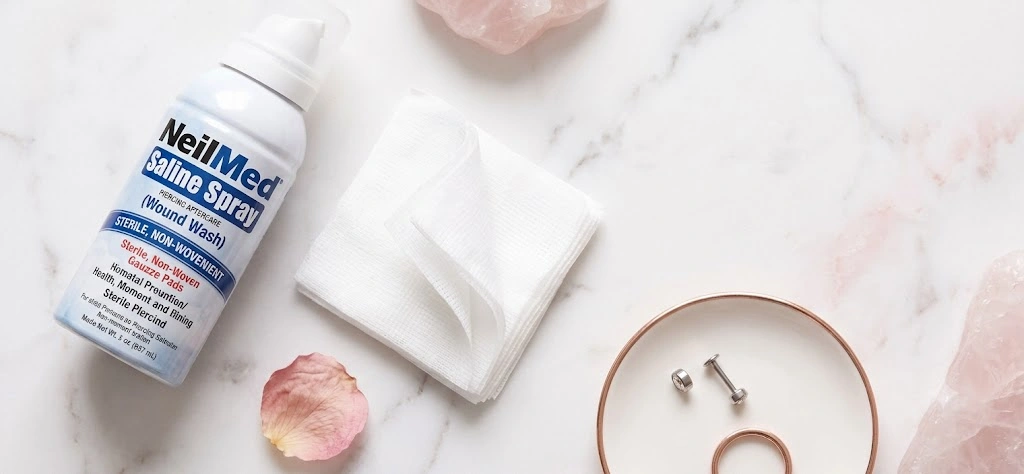
Use 0.9% sodium chloride saline spray (no additives, no essential oils). Spray directly onto both the front and back of the piercing. Allow to soak for 30 seconds.
Allow clean warm water to run over the area. Let crust soften and rinse away naturally — never pick or force dried lymph fluid off dry.
Use a clean paper towel only — never cloth towels, which harbor bacteria. Pat thoroughly dry. Moisture is a friend of bacteria.
Twice daily is the standard — morning and evening. More frequent cleaning is unnecessary and can over-dry the tissue.
What to Avoid
| Avoid | Why |
|---|---|
| Touching with unwashed hands | Primary cause of piercing infections |
| Rotating or twisting jewelry | Tears forming tissue, significantly extends healing |
| Alcohol, peroxide, Bactine | Kills healing cells, causes chemical irritation |
| Sleeping on the piercing side | Hours of sustained pressure causes irritation bumps |
| Knocking with lobe earrings | Specific lower helix hazard — be deliberate with lobe jewelry |
| Over-ear headphones | Pressure on the rim disrupts healing |
| Hair products near the ear | Chemical residue irritates the channel |
| Changing jewelry before 6 months | Channel not stable — high damage and closure risk |
A travel neck pillow with the opening aligned over your pierced ear eliminates direct pressure while sleeping. This single habit makes a measurable, consistent difference to lower helix healing speed and irritation rates.
Common Problems & How to Handle Them
The lower helix is a reliable healer when aftercare is consistent, but a few specific issues arise more commonly here than at other placements — primarily related to its proximity to lobe piercings. Here is what to watch for.
Irritation from Adjacent Lobe Jewelry
The most lower-helix-specific issue. Inserting or removing hoop-style lobe earrings, or knocking the lower helix with the back of a lobe earring, causes repeated micro-traumas that accumulate into irritation bumps and extended healing. The solution: slow down during lobe jewelry changes, switch to stud-style lobe jewelry temporarily, and be deliberate about keeping lobe jewelry backs away from the lower helix site.
Irritation Bumps
Small raised bumps at the piercing site — the most common complaint across all helix placements. Almost always caused by an identifiable trigger: sleeping on the ear, snagging, or a knock. Irritation bumps are not infections. Identify and remove the cause, continue consistent saline aftercare, and most resolve within 2–4 weeks. If a bump persists beyond 4 weeks of corrected aftercare, see your piercer.
Jewelry Embedding
If the initial jewelry post is too short, swelling can cause the disc end or front gem to press into the skin. Signs: the jewelry end looks sunken, or skin appears to be growing over the disc. See your piercer immediately — this is a jewelry length issue easily resolved with a longer post. Do not attempt to address embedding at home.
Infection Signs
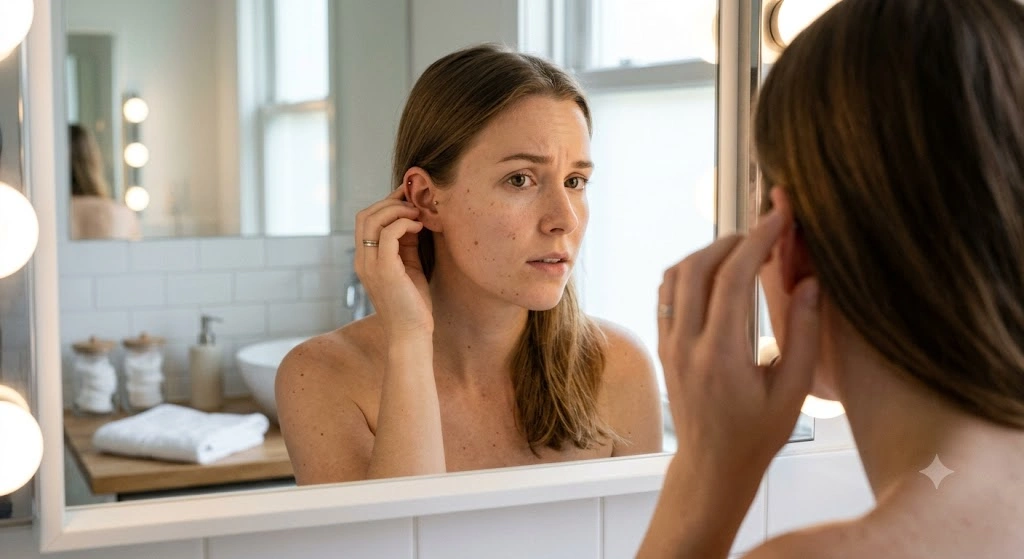
True infection — as opposed to normal healing or irritation — presents as: increasing pain after the first week, hot skin around the site, thick green or yellow discharge with odour, spreading redness, or systemic symptoms like fever. If you suspect infection, see a doctor promptly. Do not remove the jewelry without medical guidance.
Hypertrophic Scars
Raised, reddish scar tissue around the piercing — typically caused by ongoing irritation, poor jewelry material, or jewelry that is too tight. Addressing the root cause usually leads to gradual resolution. True keloids (scar growth beyond the wound boundary) are genetic and rare. Discuss keloid history with your piercer before any cartilage work.
Any sign of true infection, embedding, irritation bumps that do not improve after 3–4 weeks of corrected aftercare, or jewelry that feels like it is moving or migrating. Do not wait and hope — early intervention consistently produces better outcomes.
Lower Helix Piercing Cost in 2026
The lower helix is one of the most affordably priced cartilage placements — it is anatomically straightforward and does not require the specialization of fold or inner-ear piercings. In 2026, expect the following across the United States:
| Component | Typical Cost (US) |
|---|---|
| Piercing fee (studio) | $25–$50 |
| Initial titanium labret jewelry | $15–$35 |
| Total at time of piercing | $40–$85 |
| Downsize appointment (month 6) | $10–$20 |
| Solid gold upgrade jewelry | $40–$150+ |
| Post-healing hoop (titanium/gold) | $20–$80 |
In high-demand urban markets (New York, Los Angeles, Chicago), studio piercing fees commonly reach $50–$75 for cartilage work. In smaller markets, quality studios may charge $30–$45. As with all piercings, price is a poor indicator of quality — prioritize piercer experience, APP membership, and studio hygiene standards over cost savings.
Piercing + initial jewelry ($40–$85) + downsize ($10–$20) + saline spray ($8–$15 for a year’s supply) + optional gold or hoop upgrade ($40–$150) = $98–$270 total for a fully healed, beautifully styled lower helix.
Lower Helix Piercing — FAQ
Ready to Get Your Lower Helix?
Read our complete Aftercare & Cleaning guide — know exactly what to do from day one.
Aftercare Guide →