Triple Helix Piercing: Complete Guide 2026
Three-stud stack: placement & spacing, staging vs all-at-once, honest pain levels, 9–12 month healing, jewelry harmony, aftercare routine, and full 2026 cost breakdown.

Triple Helix Piercing: The Complete 2026 Guide
Jump to a section:
What Is a Triple Helix Piercing?
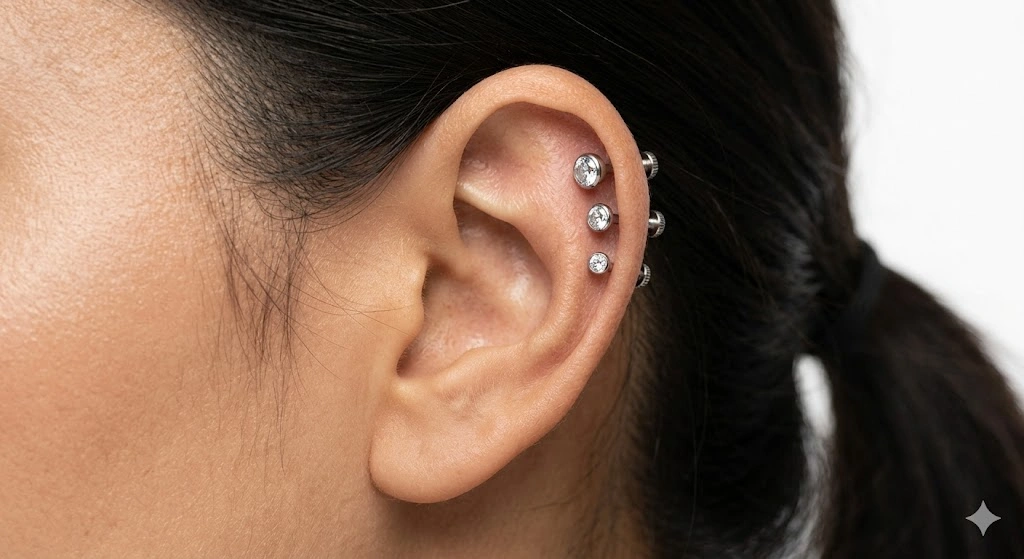
A triple helix piercing consists of three helix piercings placed vertically along the same section of the outer cartilage rim, each spaced 6–9mm apart center-to-center. It is the most ambitious standard helix configuration — bold, unmistakably intentional, and one of the most striking upper-ear arrangements in modern piercing culture.
Where a double helix creates a composed two-piece statement, the triple helix creates an architectural statement. Three coordinated jewelry pieces cascading down the outer rim produce a visual line that is immediately readable as curated and deliberate. The full stack — whether matched solitaires, graduated gems, or a carefully chosen mix of shapes — creates an upper-ear aesthetic that commands attention while remaining elegant when the right jewelry is chosen.
The triple helix is also the gateway into what professional piercers call the “full curated ear” — once all three helix positions are healed and styled, the ear naturally calls for complementary pieces (tragus, conch, lobe additions) to complete the composition. Many of the most beautiful curated ears on social media in 2026 have a triple helix stack at their center.
One important clarification: a triple helix refers specifically to three piercings on the outer curved rim of the helix. It should not be confused with a triple forward helix (three piercings at the crus of helix near the temple), which has a completely different anatomy, pain profile, and jewelry approach. This guide covers the outer rim triple helix configuration specifically.
Piercings: 3 on outer helix rim | Spacing: 6–9mm between each center | Pain: 4/10 each (4.5–5.5/10 for 2nd and 3rd if same session) | Healing: 9–12+ months (same session); 6–9 months each (staged) | Best approach: Staged | Cost US: $120–$250+ | Initial jewelry: Three flat-back labret studs — implant-grade titanium
Why the Triple Helix Is Having a Moment in 2026
The triple helix sits at the intersection of two dominant 2026 piercing trends: the maturation of the curated ear aesthetic and the growing appetite for vertical ear “stacks” that read as intentional wardrobe accessories rather than impulse decisions. As piercing culture has become increasingly integrated with fashion and jewelry culture, the triple helix has emerged as the configuration that signals genuine piercing commitment — it requires planning, patience, and investment, and the result shows it.
APP studio booking data from major US, UK, and Australian cities shows triple helix consultations have increased significantly year-over-year since 2024. It remains a more advanced configuration than the double helix — most people work up to it rather than starting here — but it is no longer the niche choice it was five years ago.
Triple Helix Placement & Spacing: Everything That Matters
Correct placement and spacing in a triple helix is more critical than in any other helix configuration. Three piercings must be evenly distributed, correctly spaced for both biological and aesthetic reasons, and positioned to accommodate your ear’s anatomy over what will be a multi-month healing journey.
The 6–9mm Rule: Why Three Piercings Demand It Even More
The correct spacing between each pair of adjacent piercing centers in a triple helix is 6–9mm. This range exists for the same aesthetic and biological reasons as the double helix — but the stakes are higher with three piercings.
Aesthetically: Less than 5mm between any two centers and the jewelry ends crowd each other — three pieces fighting for the same narrow rim space creates visual clutter rather than a clean cascade. More than 12mm between any pair breaks the visual cohesion of the stack. Uneven spacing — 6mm between the upper pair and 10mm between the lower — looks accidental rather than intentional.
Biologically: Three healing cartilage wounds placed too closely together compete severely for the limited nutrient supply available through diffusion in avascular tissue. Each wound’s inflammatory response affects the others — inflammatory mediators travel through shared cartilage and disturb all adjacent healing sites simultaneously. This produces reliably longer healing times and higher complication rates for all three piercings.
Does Your Ear Have Enough Room?
A triple helix requires a total stack height of approximately 12–18mm of usable helix rim — enough to place three piercing centers with 6–9mm between each. Most ears accommodate this comfortably in the upper rim. However, some ears have:
- A shorter or tighter helix curve that physically cannot hold three well-spaced piercings without pushing the lowest too close to the lobe or the highest off the ear rim entirely
- Existing piercings that constrain available placement positions
- Cartilage topology (ridges, bumps, flat spots) that affects how jewelry sits at certain positions
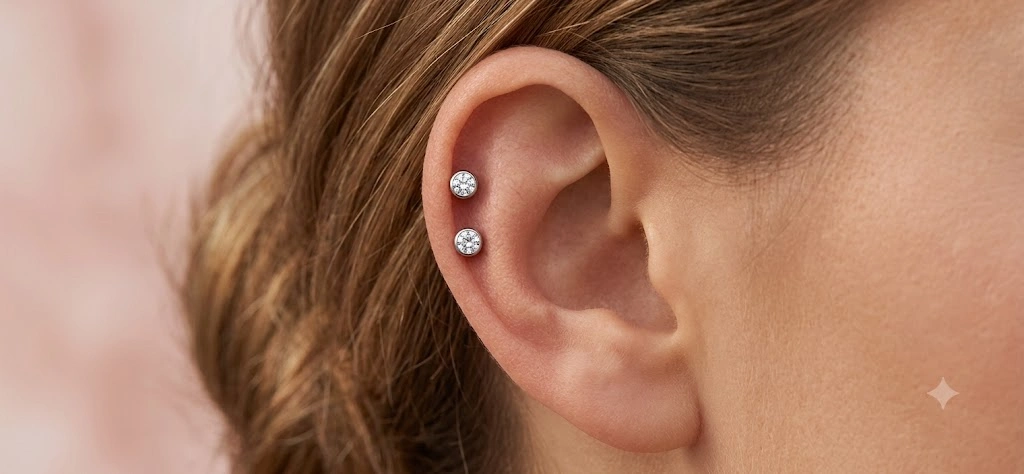
A professional APP-certified piercer assesses all of this before any marking happens. Never assume your ear can accommodate three piercings — confirm it first. A good piercer will tell you honestly if the anatomy isn’t there for a full triple, and may suggest a double plus a mid or forward helix as an alternative that achieves a similar visual effect.
Common Triple Helix Configurations
The Marking Stage: More Critical Than Ever with Three Piercings
With three piercings, the marking stage is even more important than with a double. Your piercer marks all three positions simultaneously and shows you the complete layout in a mirror before any needle is used. What to do:
Profile view (most common daily view), slight front-facing angle, and mirror-behind view if possible. Three marks create a visual line — check that line is straight and evenly distributed from every angle you care about.
The marker dots are smaller than your jewelry ends. Visualize 4–5mm flat-back gem studs at all three positions simultaneously — do they work at this spacing with this size? Do they overlap? Do they have breathing room?
All three gaps should look equal. An uneven triple — where the upper pair is closer than the lower pair — is immediately visible and very difficult to correct after piercing.
If you might want a fourth piercing (converting to a quad or adding a forward helix), does the current placement leave room? Plan for the full project now, even if you’re executing it in stages.
Three marks means three independent adjustment decisions. If any one position doesn’t feel right, ask for it to be adjusted. The marker costs nothing and takes seconds. Never rush this stage for any reason.
Uneven spacing in a triple helix — where one gap is noticeably different from the other — cannot be corrected after the needle goes in. The only remedy is retiring one or more piercings and starting over. The marking stage is the only opportunity to get spacing exactly right. Any piercer who rushes you through the marking stage, or who becomes impatient with adjustment requests, is not the right piercer for a triple helix project.
Triple Helix: Staged vs All-at-Once — The Complete Honest Answer
With three piercings, this question is even more important — and the answer leans even more strongly toward staging than it does for a double. Both approaches are technically possible. But the calculus here is clearer than for a double helix: staged is better for most people in almost every meaningful way.
Getting All Three at Once: What It Really Involves
Three cartilage piercing events in one session. First at 4/10. Second minutes later at 4.5–5/10 as ear sensitization compounds. Third at 5–5.5/10 as the ear is now running three simultaneous early inflammatory responses with adrenaline dynamics significantly shifted. You leave with three simultaneously healing cartilage wounds. Every aftercare failure affects all three simultaneously. Every trauma event ripples through shared cartilage to disturb all three adjacent healing fistulas. Healing time: 9–12+ months for all three. Complication rate: meaningfully higher than staged.
Getting Them Staged: The Professional Recommendation
The most experienced APP piercers recommend a specific staging sequence for the triple helix: start with the middle piercing. Once fully healed (6–9 months, all 5 healing signs consistently met), add either the upper or lower. Once that heals, add the final piece. Why middle first? It establishes the visual and positional anchor for the stack — the two subsequent piercings are marked relative to a fixed, known point rather than trying to predict both outer positions simultaneously.
Total project from first needle to all three fully healed: 18–27 months with this approach. That sounds long. But each individual healing phase is as manageable as a single helix, complications are dramatically reduced, and the final result is a fully healed triple stack achieved without the stress and elevated risk of three simultaneous healing wounds.
Side-by-Side Comparison
| Factor | All at Once | Staged (Recommended) |
|---|---|---|
| Studio visits | One | Three minimum |
| Immediate appearance | All three from day one | One, then two, then three over time |
| Pain in session | 4 / 4.5–5 / 5–5.5/10 | 4/10 each at separate sessions |
| Healing burden | Very high — three simultaneous wounds | Low — one at a time |
| Complication rate | Significantly higher | Lowest possible |
| Total healing time | 9–12+ months for all three | 6–9 months each, sequentially |
| Spacing precision | All three marked together — easiest | Each subsequent marked relative to healed pieces |
| Aftercare complexity | Triple — three sites simultaneously | Single at a time |
| Cost upfront | Higher — possible multi-piercing discount | Spread across multiple visits |
| Best for | Very experienced piercees, proven aftercare compliance | Most people — especially those new to cartilage |
Unlike the double helix (where same-session is a viable option for experienced piercees), the triple helix is one configuration where the vast majority of experienced APP piercers actively recommend against same-session for almost everyone. Three simultaneous cartilage wounds in close proximity creates a healing burden that even experienced aftercare performers find significantly more challenging than they expected. Staging isn’t just easier — it’s the approach most likely to produce a beautiful, complication-free result. The time investment is worth it.
Triple Helix Piercing Pain Level: Complete Breakdown
Each Piercing Individually: 4 out of 10
Each individual helix piercing in a triple helix rates 4/10 when experienced at a separate session — the standard helix baseline. The sensation is the familiar helix experience: sharp brief pinch, distinct cartilage pressure and crunching quality as the needle moves through, under one second for transit. Mild throbbing for 2–6 hours afterward. Manageable and well within most people’s comfort range.
Same-Session Escalation: 4 → 4.5–5 → 5–5.5/10
When all three are done in one session, each subsequent piercing is consistently rated more uncomfortable. Three physiological mechanisms compound with each piercing:
- Progressive tissue sensitization: Each piercing triggers a local inflammatory response that lowers the pain threshold for adjacent tissue. By the third needle, the entire upper ear zone is in early multi-point inflammatory response.
- Adrenaline depletion: The analgesic adrenaline surge from the first piercing has largely subsided by the third. No analgesic buffer remains.
- Cumulative cartilage response: Three wounds in the same cartilage zone share the same limited tissue environment. The third needle goes into cartilage that is already responding to two existing wounds in its immediate proximity.
Most same-session triple helix piercees describe the progression as: “first was fine, second was noticeably more, third was the hardest but still okay.” The third rarely exceeds 6/10 even with significant sensitization — but the compounding is real and consistent.
Pain Comparison Table
| Piercing | Pain | vs Triple Helix (each staged) |
|---|---|---|
| Lobe piercing | 2/10 | Much less painful |
| Single / Double / Triple Helix (each staged) | 4/10 | Same |
| Tragus | 4/10 | Same |
| Flat / Mid helix | 4/10 | Same |
| Hidden helix | 5/10 | Slightly more |
| Forward helix | 6/10 | More painful |
| Conch | 5–6/10 | More painful |
| Rook | 6/10 | More painful |
| Industrial | 6/10 | More painful (denser anatomy) |
Pain Reduction Tips for Triple Helix
- ✅ Eat a full meal 1–2 hours before — low blood sugar is the single biggest pain amplifier. Non-negotiable, especially important for a triple session.
- ✅ Stay well hydrated — dehydration raises body-wide pain sensitivity across all three piercings
- ✅ Avoid caffeine on piercing day — constricts blood vessels, heightens sensory sensitivity
- ✅ Use the exhale technique — breathe in deeply, exhale slowly as each needle goes through. Repeat for each of the three.
- ✅ Take short breaks between piercings — allow 5–10 minutes between each needle if doing same-session, to slightly reduce cumulative sensitization
- ✅ Choose a highly skilled APP-certified piercer — piercer skill and needle sharpness matter more with three piercings in close proximity
- ✅ Strongly consider staging — each at a separate session means all three experienced at their individual 4/10 baseline with zero compounding
- ❌ Avoid aspirin and alcohol for 24 hours before — both thin blood, increase bleeding and bruising at all three sites
Triple Helix Healing Timeline: Phase by Phase
Understanding each healing stage across all three piercings helps you manage the process correctly, identify what’s normal vs concerning at any of the three sites, and avoid the mistakes that cause most triple helix complications.
Same-Session Triple Helix: 9–12+ Month Timeline
Days 1–7: Triple Acute Inflammation
Three simultaneously inflamed cartilage wounds produce the most pronounced initial inflammation of any standard helix configuration. Expect significant swelling across the entire upper ear zone, redness that may visually connect all three sites, and sustained tenderness across the full stack. All three piercings produce clear-to-white lymph discharge from day one. Clean all three twice daily without exception. A travel pillow is not optional — sleeping on three healing piercings is three times the pressure trauma risk concentrated in the same ear.
Weeks 2–6: Initial Settling
Swelling resolves progressively across the stack — typically the lower piercing first, then mid, then upper, as cartilage density can vary slightly along the rim. By week 3, most acute swelling has reduced. Daily crust at all three sites settles into a predictable pattern. Week 6–8 milestone: book a downsize consultation for all three piercings simultaneously. Three over-long healing bars on the same ear create three independent snagging sources — get all three downsized at the same visit.
Months 2–5: The Extended Middle
All three piercings enter the long settling phase. Between months 3–5, all three will enter the false heal phase — each looking and feeling completely healed while internal cartilage fistulas remain immature throughout the stack. This is the most dangerous phase: the temptation to change jewelry at any of the three sites is at its peak exactly when the fistulas are most vulnerable. Never change any of the three pieces during this phase, regardless of how healed any individual site looks or feels.
Months 6–12+: Deep Healing and Full Maturation
By month 6–9 with consistent correct aftercare, professional jewelry changes become appropriate — but each of the three piercings must be assessed independently. It is completely normal for one piercing in a triple stack to be ready at month 6 while another isn’t ready until month 10. Always assess each against the 5 healing signs individually. Never rush the slower-healing piercings because the faster-healing ones are already changed.
Staged Triple Helix: Each Piercing 6–9 Months
When staged correctly (middle first, then lower, then upper — or middle, lower, upper per piercer recommendation based on your anatomy), each piercing heals independently on its own 6–9 month timeline with its own full immune and repair resource allocation. No shared complication risk. No mutual inflammatory interference. Total project from first needle to all three fully healed: 18–27 months — but each individual phase is as manageable as a single helix.
Healing Timeline Comparison
| Milestone | Same Session | Staged |
|---|---|---|
| All three visible | Day 1 | After third session (month 12–18+) |
| False heal phase | Months 3–5 (all three piercings) | Months 2–4 for each individually |
| First safe jewelry changes | Month 6–10 (piercer-confirmed each) | Month 6–9 after each respective piercing |
| All three fully healed | Month 9–12+ | Month 18–27 from first piercing |
| Healing complexity | Very high — three simultaneous wounds | Low — one at a time |
In a same-session triple, it is very common for all three piercings to heal at different rates. The upper piercing may be fully healed at month 8 while the lower isn’t ready until month 11. Different cartilage density at different rim positions, different exposure to snagging based on hair length and sleeping position, and subtle differences in blood diffusion patterns all contribute. Always assess each of the three piercings individually against the 5 healing signs — never treat the triple as a single unit when evaluating healing readiness.
Triple Helix Jewelry: Creating a Cohesive Three-Piece Stack
The triple helix offers the richest jewelry styling potential of any outer-rim helix configuration. Three coordinated positions provide creative opportunities — and challenges — that a single or double helix cannot match. Achieving visual harmony across three adjacent pieces requires more deliberate planning than most piercees initially expect.
Healing Jewelry: The Exact Specification for All Three
All three piercings must wear flat-back labret studs in ASTM F136 implant-grade titanium throughout healing. Exact spec for all three:
- Material: ASTM F136 implant-grade titanium — biocompatible, zero nickel, lightweight, non-reactive
- Style: Flat-back labret stud — threadless push-pin or internally threaded. All three the same style for consistent mechanics.
- Gauge: 16g (1.2mm) standard; 18g (1.0mm) if your piercer uses finer gauge. All three piercings same gauge.
- Initial bar length: 8mm for all three to accommodate swelling. Downsize all three to 6mm at week 6–8 in the same appointment.
- Decorative ends: 3–5mm. Matching ends on all three looks cleanest during healing. Choose something you genuinely love — you’ll wear them for 9–12+ months.
After Healing: 6 Beautiful Styling Approaches
Visual Harmony Principles for Three Pieces
Three pieces in close proximity demand more deliberate coordination than two. Key principles:
- Metal consistency is non-negotiable: All three pieces in the same metal family (all titanium, all yellow gold, all rose gold). Mixing metals across a triple creates visual noise — save any metal mixing for other ear positions.
- The anchor piece principle: Choose one statement piece (usually upper or middle) and let the other two be smaller or simpler. This creates a focal point the eye is naturally drawn to, and prevents three competing statement pieces from overwhelming each other.
- Graduated sizes read better than identical at large sizes: Three 6mm gems in a tight stack crowds the space. Three gems at 6mm / 4mm / 3mm uses the same vertical space far more elegantly.
- Shape mixing works — with rules: A round gem, a flat disc, and a star in the same metal creates interesting variety. Three completely different shapes in three different metals creates chaos.
Materials Ranked
| Material | Healing | Healed | Notes |
|---|---|---|---|
| ASTM F136 Implant Titanium | ✅ Best | ✅ Excellent | Zero nickel, biocompatible, lightweight. First choice for all three healing pieces. |
| Solid 14k/18k Gold | ✅ Excellent | ✅ Premium choice | Beautiful, biocompatible. Avoid gold-plated. Best post-healing upgrade. |
| ASTM F138 Implant Steel | ✅ Good | ✅ Good | Trace nickel — avoid if nickel-sensitive. Heavier than titanium. |
| Niobium | ✅ Good | ✅ Good | Nickel-free, anodizable. Slightly heavier than Ti but excellent biocompatibility. |
| 316L Surgical Steel | ❌ Avoid | ⚠️ Acceptable | 12–14% nickel. Not for healing piercings — ever. |
| Silver / Plated metals | ❌ Never | ⚠️ Caution | Tarnishes, reacts. Never use during healing — at any of the three sites. |
Triple Helix Aftercare: Caring for Three Piercings
The aftercare principle for a triple helix is identical to a single or double helix — sterile saline twice daily, leave it alone otherwise — with the additional complexity of three piercing sites to monitor simultaneously. Three healing wounds on the same ear require the same aftercare, but amplify the consequences of any mistake.
Complete Daily Routine
Before touching anything near any of the three piercings. Non-negotiable, every single time. Three healing wounds means three opportunities for hand-contact contamination.
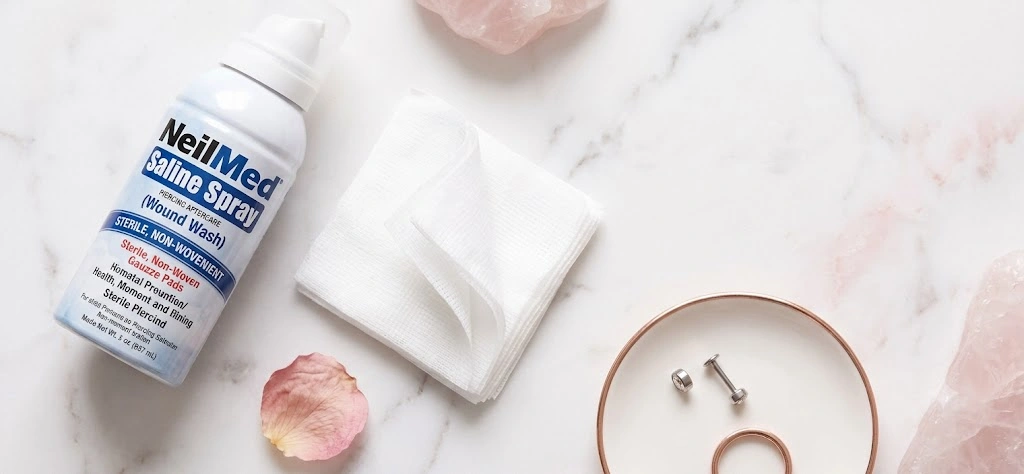
Front and back of all three piercings — six application points total. NeilMed Wound Wash or equivalent 0.9% preservative-free saline. Saturate each generously. Let soak 20–30 seconds for the full stack area.
Use a separate piece of gauze per piercing if any show discharge. This prevents cross-contamination between healing sites. Light pressure only — softened crust releases easily without force.
Moisture trapped between three adjacent healing wounds creates an optimal bacterial environment affecting all three simultaneously. Dry the complete upper ear zone thoroughly after every clean.
No touching, rotating, adjusting, or checking any of the three pieces between cleaning sessions. Three undisturbed healing wounds heal faster and with fewer complications than three frequently disturbed ones.
Triple Helix Specific Aftercare Considerations
| Situation | Triple-Specific Guidance |
|---|---|
| Sleeping | Travel/donut pillow is absolutely essential — not optional. Three bars can catch on pillow in different ways. For side sleepers: opposite-side sleeping only for the entire healing period of all three piercings. |
| Hair management | Three jewelry ends on the upper ear creates triple the snagging opportunities. Tie hair back consistently and secured throughout healing — especially in the first 6–9 months for all three piercings. |
| Headphones | Over-ear headphones pressing on three adjacent healing piercings is one of the most significant complication triggers for triple helix piercees. Switch to in-ear earphones for the full healing period of all three — no exceptions. |
| Monitoring | Assess each of the three piercings independently. One may develop a bump while the other two progress normally — each requires its own diagnosis and response. Don’t treat the stack as one unit when monitoring. |
| Downsize appointments | Get all three bars downsized at the same appointment (week 6–8). Three over-long healing bars are three simultaneous snagging sources — eliminating all at once is more efficient and addresses the full snagging risk in one visit. |
| Swimming | Avoid pools and open water for a minimum of 4–6 months. Three healing cartilage wounds mean triple the bacterial exposure risk from pool water. |
| Hair products / Sprays | Keep all hair products, dry shampoo, hairspray, and styling products away from the entire upper ear zone. With three adjacent healing wounds, product residue buildup is a meaningful irritation risk. |
Triple Helix Problems: What to Watch For Across Three Piercings
The triple helix carries a higher complication rate than the double or single helix — three healing wounds in proximity create more opportunities for the mechanical and aftercare failures that drive most helix complications. Knowing what to watch for at all three sites — and how adjacency affects each healing fistula — enables quick, correct responses.
Irritation Bumps — Three Sites, Three Potential Triggers
Irritation bumps can develop at any one, two, or all three piercings. The most common trigger pattern in triple helix piercees is sleeping on the ear — even a week of sleeping on the wrong side can produce bumps at all three simultaneously, since all experience the same pillow pressure on the same ear. Other common triggers: any of the three bars still too long, hair snagging on any of the three jewelry ends, wrong material in any piece.
If a bump develops at one or two piercings but not all three, the cause is typically specific to those sites — a longer bar in that position, or anatomy that makes that jewelry more susceptible to a particular snagging trigger. Investigate each affected piercing independently.
Treatment: Identify and eliminate the specific cause at the affected site(s). Return to strict twice-daily saline for all three piercings. Downsize assessment for all three bars. Implant-grade titanium check for all three pieces. Allow 4–10 weeks with cause fully eliminated. Bumps at multiple sites simultaneously usually share a common cause — find it.
Shared Inflammation: When One Affects the Others
A significant trauma at one piercing in a triple stack can trigger sympathetic inflammatory responses at the other two — even if they weren’t directly affected. Inflammatory mediators released at the trauma site diffuse through shared cartilage tissue to disturb adjacent healing fistulas. In a triple, this effect is more pronounced than in a double because the three wounds share a larger common cartilage zone. Signs: one or two piercings suddenly become more sore or produce more discharge shortly after the adjacent piercing experiences trauma, with no independent cause at the affected sites. Treat the original trauma’s cause and enhance aftercare for all three.
The “Weak Link” Phenomenon
In almost every same-session triple helix, one piercing heals significantly more slowly or develops more complications than the other two. This “weak link” piercing typically experiences more snagging (due to position on the rim), sits in denser cartilage (upper positions often have denser cartilage), or faces more consistent mechanical pressure from sleeping position. Identify the weak link early — by week 3 or 4, you’ll typically have a sense of which of the three is most troublesome — and give it extra attention and care without neglecting the other two.
Infection Signs — Assess Each Piercing Separately
Infection at one triple helix piercing doesn’t automatically mean the others are infected — but proximity means all three should be monitored closely if signs appear at any. Signs requiring attention: yellow-green thick pus (not white crust), spreading redness beyond the piercing site, increasing swelling, warmth spreading outward beyond the immediate site, or fever. See your piercer first for any developing infection signs. See a doctor if signs are moderate-to-severe. Never remove jewelry during an active infection at any site.
See your piercer: Bumps developing at any of the three sites; one healing faster than the others; soreness after months at any site; any uncertainty about normal healing vs early problem at any of the three piercings. See a doctor: Yellow-green pus with spreading redness at any site; significant swelling; fever; skin hot beyond immediate piercing area; condition worsening despite improved aftercare for 48+ hours at any site.
Triple Helix Piercing Cost 2026: Complete Breakdown
| Region / Studio | Same Session Triple | Per Visit (Staged) |
|---|---|---|
| US — Budget studio | $70–$120 | $25–$45 per visit |
| US — Mid APP studio | $120–$200 | $50–$80 per visit |
| US — High-end / luxury | $200–$350+ | $80–$150+ per visit |
| UK — Mid APP studio | £95–£170 | £40–£70 per visit |
| Australia — Mid APP | AUD $160–$270 | AUD $65–$110 per visit |
Full Project Budget (US, Mid-Range APP Studio)
| Cost Item | Same Session | Staged (Full Project) |
|---|---|---|
| Piercing(s) + initial jewelry | $120–$200 | $150–$240 across three visits |
| Aftercare saline (12–18 months) | $60–$90 | $75–$110 |
| Non-woven gauze | $10–$20 | $15–$25 |
| Travel pillow | $10–$20 | $10–$20 |
| Downsize appointments | $30–$75 (all three) | $15–$30 per piercing |
| First jewelry changes | $30–$75 (all three) | $15–$25 per piercing |
| Post-healing jewelry upgrades | $40–$200+ per piece × 3 | $40–$200+ per piece, phased |
| Total project estimate | $380–$750+ | $340–$700+ phased over time |
Even more so than for a double. The skill required to precisely mark and execute three evenly-spaced piercings on a curved rim, the quality of initial jewelry across all three pieces, and the aftercare guidance have a measurable and compounded impact on healing outcomes for a triple. Complications from a budget studio — bumps at multiple sites, jewelry reactions, spacing errors — create follow-up costs that far exceed the original price difference between budget and quality studios. For a triple helix, the investment in the right studio is the highest-value decision you’ll make in the whole project.
Triple Helix Piercing FAQ

Ready to Build Your Triple Helix?
Read our complete Aftercare & Cleaning guide — know exactly what to do from day one.
Aftercare Guide →