Helix Piercing for Beginners
Everything a first-timer needs to know — is it right for you, how to choose a studio, exactly what happens on piercing day, honest pain levels, healing timeline, starter jewelry, and the mistakes that cause most problems.

Helix Piercing for Beginners: The Complete 2026 Guide
Jump to a section:
Is a Helix Piercing Right for You?
A helix piercing is the most popular cartilage piercing in the world — and for most people who want one, it is absolutely the right choice. It is manageable in terms of pain (4/10), achievable in terms of aftercare demands, and genuinely beautiful when healed and styled well. But it is meaningfully different from a lobe piercing in ways that matter, and understanding those differences before you commit is what separates a smooth experience from a frustrating one.
The helix piercing is placed through cartilage — not soft tissue. Cartilage has no direct blood supply, which means it heals more slowly, is more sensitive to disruption, and less forgiving of aftercare mistakes than a lobe piercing. A lobe can tolerate inconsistent cleaning and still heal fine. A helix cannot. The 6–9 month healing timeline is real, and the daily cleaning routine needs to be maintained throughout. If you’re willing to commit to that — and most people who genuinely want the piercing are — you’ll be absolutely fine.
Pain: 4/10 — manageable | Healing: 6–9 months | Daily aftercare: 5 minutes twice a day | Biggest challenge: Not sleeping on it | Cost US: $50–$100+ | Best starting type: Single helix | Initial jewelry: Flat-back titanium labret stud
Good Signs You’re Ready
Which Helix Type Is Best for Beginners?
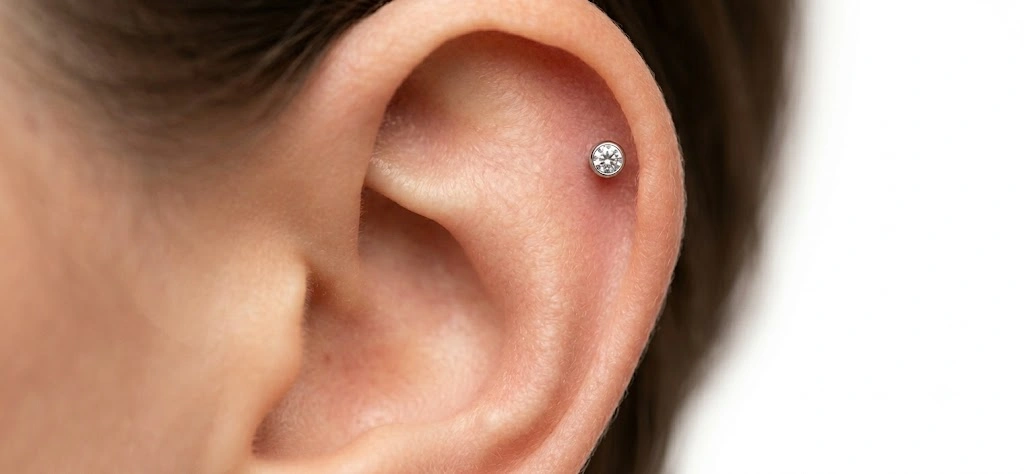
Start with a single helix — one piercing on the outer rim. It has the most manageable pain profile (4/10), the shortest healing timeline (6–9 months), the simplest aftercare demands, and the most room for error. A single helix also teaches you everything you need to know about helix healing and aftercare before you commit to more complex configurations like a double or forward helix.
The forward helix (6/10 pain, 9–12 month healing) is not ideal as a first cartilage piercing — it is more demanding in every way. The double helix (two simultaneous wounds) is achievable for a first-timer but requires excellent aftercare from day one. If you’re new to cartilage piercings, one single helix is the right starting point. You can always build from there once you understand the healing process from experience.
Most professional studios pierce cartilage from age 16 with parental consent, and without consent from age 18. Some studios set their own minimum ages higher. Requirements vary by country and region — check with your chosen studio before booking. Budget studios and mall kiosks often have looser enforcement; APP-certified studios typically follow strict age verification policies.
Choosing the Right Studio: The Most Important Decision You’ll Make
The studio and piercer you choose has more impact on your experience and healing outcome than any other single factor — including your aftercare routine. A skilled piercer with quality jewelry at a clean studio can offset minor aftercare imperfections. A poor piercer with low-grade jewelry at a budget studio will cause problems that even perfect aftercare cannot fully correct.
What to Look For in a Studio
The Association of Professional Piercers (APP) maintains rigorous standards for piercer training, studio hygiene, and jewelry quality. An APP-certified studio is a very strong indicator of professional practice. In countries where APP membership is less common, look for equivalent national professional body membership.
Ask directly before booking: “Do you use a hollow needle for cartilage piercings?” The correct answer is yes. A gun forces blunt jewelry through tissue with blunt-force trauma — it causes significantly more cartilage damage, higher complication rates, and longer healing times. Any studio that uses a gun on cartilage is not following professional standards.
Ask what the initial jewelry is made from. The correct answer is ASTM F136 implant-grade titanium, solid 14k/18k gold, or ASTM F138 implant-grade steel. “Surgical steel,” “hypoallergenic,” or “titanium” without an ASTM specification are not sufficient answers. If the studio can’t tell you the material standard, their jewelry is not verified implant-grade.
The studio should look and smell clean. Needles should be single-use and opened in front of you. An autoclave (sterilization equipment) should be on-site and regularly tested with spore test records available on request. If a studio can’t show you autoclave test records when asked, look elsewhere.
A good piercer welcomes questions from beginners. They explain the procedure, discuss placement options, ask about your lifestyle and future plans, and give you thorough aftercare guidance — ideally written. A piercer who rushes you, dismisses your questions, or makes you feel like you’re being difficult is not the right person for your first cartilage piercing.
Most professional piercers have an Instagram or portfolio of their work. Look at their helix piercings specifically — placement quality, jewelry choices, healing photos. If their helix portfolio looks consistently well-placed and beautifully styled, that’s a good indicator of skill and aesthetic sensibility.
Studio Types: What Each Offers
| Studio Type | What You Get | Risk Level | Best For |
|---|---|---|---|
| APP-Certified Studio | Verified implant-grade jewelry, hollow needle, trained piercer, full aftercare guidance | Lowest | Everyone — especially beginners |
| Independent Professional Studio | Usually excellent — varies by piercer. Research individual piercer’s training and portfolio. | Low–Medium | Good if piercer is well-reviewed and trained |
| Budget / Mall Chain | Often gun piercing on cartilage, unverified jewelry material, minimal aftercare guidance | High | Not recommended for cartilage |
| Tattoo Shop Piercing | Highly variable — some are excellent, some are not. Ask the same questions as any studio. | Variable | Research thoroughly before booking |
The APP maintains a searchable member directory at safepiercing.org. Entering your city or postcode returns a list of current APP members in your area. This is the most reliable way to find a qualified studio for a first cartilage piercing in any location.
Piercing Day: What to Expect From Start to Finish
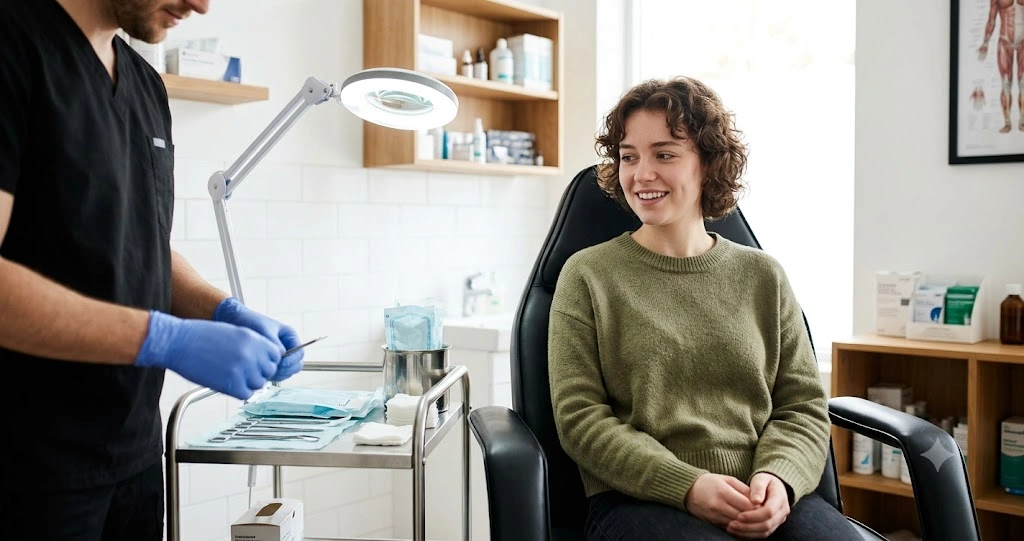
Knowing exactly what will happen removes most of the anxiety from your first helix piercing. The entire appointment from arrival to leaving is typically 20–40 minutes. The actual piercing takes under one minute. Here is the complete walkthrough.
Before You Go: Preparation Checklist
Step-by-Step: What Happens at the Studio
Your piercer discusses placement options, asks about your lifestyle, any metal sensitivities, and whether you’re planning future additions. They examine your ear anatomy. This is your opportunity to ask every question you have — no question is too basic for a good piercer.
You choose your initial decorative end from the studio’s implant-grade titanium range. The post gauge, bar length, and back disc are standard for healing. You’re choosing the decorative front piece — a gem, flat disc, opal, or similar. Pick something you’ll genuinely enjoy wearing for 6–9 months.
Your piercer cleans the area and places a small surgical marker dot at the proposed position. You check it in a mirror — from the side, slightly front-facing, and any angle you care about. Request adjustments freely. This moment determines where your piercing lives permanently. Never feel rushed through it.
You’re seated comfortably. Your piercer positions your ear and stabilizes it — usually placing a small receiving tube or clamp behind the rim at the mark. Takes a few seconds. You may feel gentle pressure on the ear from the stabilization tool.
Your piercer tells you to take a breath in. On your exhale, the needle passes through. You feel: a sharp, brief pinch, then a distinct pressure and cartilage-crunching quality as the needle moves through. It is over in under one second. Mild throbbing begins immediately — this is completely normal.
The flat-back labret stud threads through as the needle withdraws. The flat disc back is positioned against the inside of the rim. The decorative end is secured at the front. Your piercer cleans the area and confirms the jewelry is correctly seated.
Your piercer gives you aftercare instructions — ideally written. They confirm what product to use, how often, and what to avoid. This is the second most important part of the appointment after the marking stage. Pay attention and ask for clarification on anything unclear.
Immediately After: What to Expect the First 24 Hours
Mild throbbing at the piercing site is normal for 2–6 hours. Ibuprofen (not aspirin) is appropriate for managing post-piercing soreness. A small amount of clear fluid or very slight redness at the site is normal — your body has started its inflammatory healing response. Clean the piercing for the first time before bed tonight. Use a travel pillow from the very first night — this is not optional.
Helix Piercing Pain: The Honest Answer for Beginners
4 out of 10 — Less Than Most People Expect
The single helix consistently and reliably rates 4/10 — and “less painful than I expected” is the most common reported experience across first-time helix piercees worldwide. The internet tends to amplify worst-case accounts; the realistic experience for most people is far more manageable than the research rabbit hole suggests.
The sensation has two components that happen simultaneously in under one second: a sharp brief pinch as the needle enters, followed by a distinct pressure and a crunching quality as the needle moves through cartilage. The crunch isn’t painful — it’s simply the sensory experience of dense tissue being displaced. It’s over before the brain fully processes it. Mild throbbing follows for a few hours. Most beginners report feeling mild soreness at the site for 24–48 hours, manageable with ibuprofen.
Why Beginners Are Often Pleasantly Surprised
Several factors consistently make the helix piercing less painful than first-timers expect:
- It’s over in under a second. The brief duration keeps the total pain experience far lower than slower procedures.
- Cartilage has fewer pain receptors than soft tissue. The outer helix rim is not especially dense in nerve endings compared to, say, a septum or rook.
- Adrenaline provides natural pain buffering. The body’s own nervous system response to anticipated pain helps reduce the immediate sensation.
- A skilled piercer with a sharp needle makes a genuine difference. Needle quality and piercer technique can reduce the experienced pain by 1–2 points compared to a less skilled operator.
Pain Comparison for Beginners
| Piercing | Pain Rating | For Beginners |
|---|---|---|
| Lobe (standard) | 2/10 | Most beginners’ reference point |
| Single Helix ← Start Here | 4/10 | Best beginner cartilage option |
| Tragus | 4/10 | Same as helix — comparable entry point |
| Mid / Flat Helix | 4/10 | Same pain as standard helix |
| Hidden Helix | 5/10 | Slightly more — not ideal as first cartilage |
| Forward Helix | 6/10 | More painful — better after experience with helix |
| Conch | 5–6/10 | More painful — not ideal as first |
| Rook / Daith | 6/10 | Significantly more — for experienced piercees |
For first-time cartilage piercees, the anticipatory anxiety in the days and moments before the needle is typically more intense than the actual piercing experience. This is consistent across virtually all first-timer accounts. The best preparation is knowing exactly what to expect (this guide), eating well before you go, and choosing a skilled piercer who will guide you through the moment calmly.
Helix Healing for Beginners: What’s Normal, What’s Not
The healing timeline is the most important thing beginners consistently underestimate. Most helix complications don’t happen because of bad luck — they happen because of the false heal trap, premature jewelry changes, and underestimating how long consistent aftercare is actually needed. Understanding every phase in advance prevents this.
Complete Healing Phases for Beginners
Days 1–7: Acute Inflammation — Everything Looks Angry
Your ear will be red, slightly swollen around the piercing, tender when touched, and producing clear-to-white fluid (lymph) from both the entry and exit points of the jewelry. This is all completely normal — this is the body’s inflammatory response doing exactly what it’s supposed to do. The lymph fluid dries to white or off-white crust, especially overnight. This crust is normal. Begin cleaning twice daily immediately. Travel pillow from night one — no exceptions.
Weeks 2–6: Settling — Things Calm Down
Swelling reduces. Crust production settles into a predictable daily rhythm. Tenderness decreases but remains present when touched or when the jewelry is moved. The piercing starts feeling less “angry.” Week 6 milestone: book a downsize appointment with your piercer. Your initial jewelry bar is intentionally long to accommodate first-week swelling. Once swelling resolves, the excess bar length catches on hair and pillow constantly — this is one of the most preventable causes of helix complications. Get it downsized to a correctly fitting shorter bar.
Months 2–4: The False Heal — The Trap That Catches Most Beginners
Between months 2 and 4, the surface of the piercing heals over. Crust stops. Tenderness fades. It feels and looks completely healed. It is not. This is the false heal — the single most dangerous phase of helix healing for beginners, because it creates a very convincing illusion of readiness.
The external skin fistula (surface) has closed, but the internal cartilage fistula (the healed channel through the cartilage) is still fragile, immature tissue. A jewelry change at this stage tears that internal tissue. The result: sudden return of discharge, pain, and bumps in a piercing that seemed completely healed. This is the most common beginner mistake — and it’s entirely preventable by knowing it exists and waiting past it.
Months 5–9: True Healing — Finish the Job
The internal fistula continues maturing. By month 6, most single helix piercings are ready for a first professional jewelry change — but confirm with your piercer against the 5 healing signs below. Full internal healing — where the fistula is mature, stable, and can tolerate changes — is typically achieved between months 6 and 9 with consistent correct aftercare.
5 Signs Your Helix Is Fully Healed
| Sign | What It Means |
|---|---|
| Zero tenderness when gently pressed | Internal tissue fully formed — no longer reactive to pressure |
| No crust or discharge for 4–6 consecutive weeks | Lymph production has fully stopped — wound closed internally |
| Jewelry moves completely freely with zero drag | Fistula channel fully matured and smooth throughout |
| Skin around holes looks completely normal | No residual redness, raised tissue, or discoloration |
| All of the above stable for 4+ weeks | Sustained healing — not a temporary quiet phase |
Premature jewelry changes are responsible for the majority of helix complications that appear in beginners. The false heal makes the piercing look ready. It isn’t. Wait for all 5 healing signs to be consistently present, wait for the 6-month minimum, and have your first change done by your piercer — not yourself. This single rule prevents the most common category of helix problems entirely.
Starter Jewelry for Beginners: What to Get and Why
Jewelry choice for a healing helix isn’t about aesthetics — it’s about biology. The right starting jewelry creates the conditions for healthy healing. The wrong jewelry actively prevents it, regardless of how good your aftercare is. Here is exactly what you need and why.
The Only Correct Healing Jewelry: Flat-Back Labret Stud in Implant-Grade Titanium
This is not a preference or a recommendation — it is the specification that produces the best healing outcomes for helix cartilage piercings. Every component matters:
Why Not a Hoop — Even If You Want One
This is the most common question from beginners: “Can I start with a hoop?” The answer is no — and understanding why removes the frustration of not getting the answer you hoped for.
A hoop rotates with every head movement, hair touch, or change in sleeping position. Each rotation drags the ring through the forming fistula tissue, causing micro-tears. The curved shape creates angular pressure at the points where the ring enters the tissue, rather than the straight-axis stability of a labret post. The snag risk from a hoop’s circular shape is dramatically higher than a flat-back stud. All of this accumulates into delayed healing, increased complication rates, and significantly higher rates of irritation bumps.
After your helix is fully healed at 6–9 months, you can absolutely wear a hoop. Seamless hoops, clicker rings, and segment rings are all beautiful healed options. During healing — stud only.
What to Choose for Your Decorative End
You’ll wear your initial decorative end for 6–9 months during healing. Choose something you genuinely like looking at. Good beginner choices:
- Bezel-set CZ (cubic zirconia): Clean, sparkly, professional. The most timeless helix look. Smooth bezel setting has no prongs to snag. Available in every metal tone.
- Flat titanium disc: Minimalist, clean, architectural. The most professional-setting-appropriate choice. Zero fuss during healing.
- Lab opal: Distinctive color-play that shifts with the light. The most eye-catching beginner choice — visible and beautiful from the start. Completely safe in titanium settings.
- Prong-set solitaire: Maximum sparkle. Slightly higher snag risk than a bezel (prongs can catch) — manageable with careful hair management.
What NOT to Use — Avoid These
| Jewelry to Avoid | Why |
|---|---|
| Hoops or rings of any kind | Constant rotation through healing fistula — delays healing, causes bumps |
| “Surgical steel” without ASTM F138 certification | Contains 12–14% nickel — chronic irritant for healing cartilage |
| Gold-plated jewelry | Plating wears off, exposes reactive base metal — often brass or nickel alloy |
| Silver jewelry | Tarnishes in moisture, releases reactive compounds, discolors fistula |
| Acrylic / plastic / BioFlex | Porous — traps bacteria, cannot be sterilized, leaches chemical irritants |
| Unverified “titanium” under $8 | Extremely unlikely to be genuine ASTM F136 — may be titanium-coated steel |
Beginner Aftercare Routine: Simple, Consistent, Effective
Helix aftercare is not complicated — but it requires consistency for 6–9 months. The principle is simple: keep the wound clean, keep it undisturbed, and remove every source of mechanical trauma. That’s it. The failures that cause most helix complications are not complicated errors — they’re simple routines that slip for a week, or single bad decisions at the wrong moment.
The Complete Daily Routine (5 Minutes, Twice Daily)
20 seconds with soap and water before touching anything near the piercing. Always. Without exception. Every single time. Your hands are the primary source of bacteria for healing piercings.
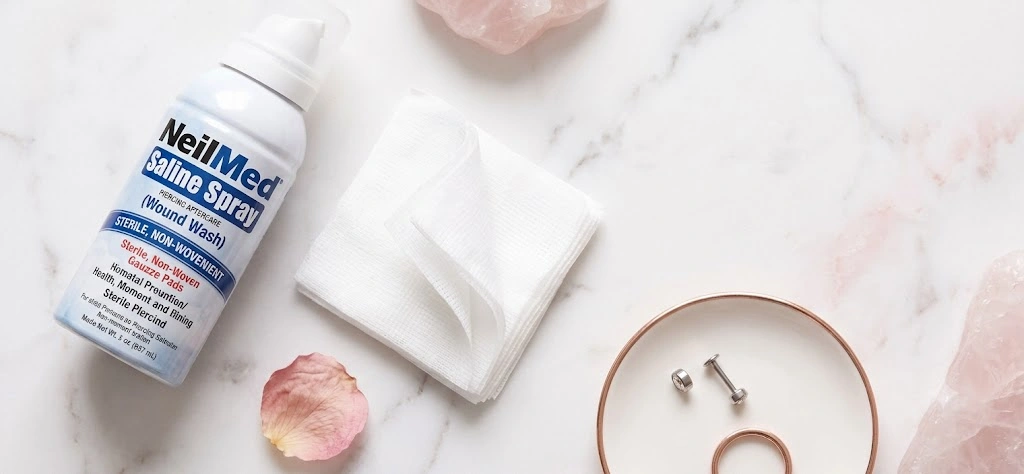
NeilMed Wound Wash (or equivalent 0.9% preservative-free sterile saline). Spray generously on both the front decorative end and back flat disc. Let it soak for 20–30 seconds. This softens any crust, kills surface bacteria, and reaches the wound channel.
Use clean non-woven gauze or folded kitchen paper — never cotton wool or cotton buds (fibres catch on jewelry ends). Light pressure only. Softened crust releases easily without force. Never rub or scrub.
No touching, checking, rotating, or adjusting between cleans. The fistula heals by building undisturbed tissue. Every unnecessary touch disrupts that process. The best aftercare is maximum benign neglect between twice-daily cleans.
When: Morning and evening — twice per day, every day, for the full healing period. Not three times (over-cleaning damages healing tissue), not once (under-cleaning allows bacteria to accumulate).
The Beginner’s Golden Rules
| ✅ Always DO This | ❌ Never Do This |
|---|---|
| Use a travel/donut pillow every night from day one | Sleep on the pierced ear — one bad night causes bumps |
| Use only sterile saline (NeilMed Wound Wash) | Use hydrogen peroxide, alcohol, Dettol, or tea tree oil — these destroy healing cells |
| Tie hair back, especially long hair | Let hair repeatedly snag on the jewelry throughout the day |
| Switch to in-ear earphones during healing | Use over-ear headphones — they press directly on the healing cartilage daily |
| Change pillowcase 2–3 times per week | Leave a pillowcase unchanged for a week — it becomes a bacteria reservoir |
| Get a professional downsize at week 6–8 | Skip the downsize — the long initial bar snags constantly |
| Have your first jewelry change done by your piercer | Change jewelry yourself before the 6-month minimum |
| Keep all hair products and sprays away from the ear | Let hairspray, dry shampoo, or styling products build up near the piercing |
Sterile 0.9% saline wound wash is the only cleaning product appropriate for a healing helix piercing. NeilMed Wound Wash is the gold standard recommendation of the APP and professional piercers globally. It’s available in most pharmacies and online for $8–$12 per can. One can typically lasts 4–6 weeks. Nothing else is needed or appropriate — not antiseptics, not soap, not any other product. Just saline.
The 8 Most Common Beginner Mistakes — And How to Avoid Them
The vast majority of helix complications that beginners experience come from a small set of specific, predictable, entirely preventable mistakes. Understanding these in advance is the single best thing you can do to guarantee a smooth healing experience.
The most impactful mistake, made before the needle even goes in. A gun on cartilage causes tissue damage that correct aftercare cannot fully repair. Unverified jewelry material creates chronic irritation throughout the entire healing period. Spend the extra $30–$50 on an APP studio with verified implant-grade jewelry. It is almost always cheaper in total than the complications it prevents.
The single most common cause of irritation bumps and extended healing timelines. Even a few nights of sleeping on the wrong side creates sustained pressure trauma on the forming fistula. The fix is free: a travel neck pillow with a hole for the ear. Use it from night one, every night, until fully healed.
The initial healing bar is long to accommodate swelling. Once swelling resolves, that extra length catches on hair, pillowcases, and clothing constantly — each snag is a micro-trauma event. Hundreds of micro-traumas per week accumulate into bumps and extended healing. Book the downsize appointment at week 6. It’s typically $15–$30 and eliminates one of the most consistent ongoing trauma sources.
The false heal at months 2–4 creates a convincing illusion of readiness. The piercing looks healed. It isn’t. Changing jewelry at this stage tears the immature internal fistula tissue and causes a dramatic regression that can take months to recover from. Wait for all 5 healing signs consistently, wait for the 6-month minimum, and have the first change done by your piercer.
Hydrogen peroxide, alcohol, Dettol, antiseptic creams, and tea tree oil are all actively harmful to healing piercings. They kill bacteria but also destroy the healing cells your body is using to build the fistula. Many beginners reach for these products when they see any discharge, making the situation worse. Only sterile saline. Always.
An old, outdated myth says you should rotate healing piercing jewelry to “prevent it sticking.” This is completely wrong — rotating jewelry causes direct micro-tears in the forming fistula tissue every single time. Don’t touch the jewelry except during cleaning. Don’t rotate it. Ever. During healing.
Many beginners don’t think of this until complications appear. Over-ear headphones press directly on the helix area for hours daily — 4–8 hours for many people at work, commuting, or gaming. That sustained daily pressure is one of the most consistent sources of helix complications in working-age piercees. Switch to in-ear earphones for the full healing period. This alone prevents a very common category of problems.
When something looks wrong — a bump, unusual discharge, persistent soreness — the right first step is always visiting your piercer, not self-diagnosing from online forums. A professional piercer can identify the issue in minutes, assess your jewelry, and recommend specific corrective action. Most helix problems that are caught early and addressed correctly resolve completely. Problems that are self-treated incorrectly for weeks often don’t.
Helix Piercing Cost for Beginners: Full 2026 Breakdown
| Region / Studio Type | Cost (Piercing + Initial Jewelry) |
|---|---|
| US — Budget / chain studio | $25–$45 |
| US — Mid-range APP studio | $50–$80 |
| US — High-end / luxury APP studio | $80–$150+ |
| UK — Mid-range APP studio | £40–£70 |
| UK — High-end studio | £70–£120+ |
| Australia — Mid-range APP studio | AUD $65–$110 |
| Canada — Mid-range APP studio | CAD $55–$90 |
| Europe (major cities) — Mid-range | €50–€80 |
Complete Year-One Budget for a Beginner (US, Mid-Range Studio)
| Item | Cost | Notes |
|---|---|---|
| Piercing + initial implant-grade titanium jewelry | $50–$80 | The most important spend — don’t cut corners here |
| NeilMed Wound Wash (3–4 cans over healing) | $30–$50 | $8–$12 per can, one can = 4–6 weeks |
| Non-woven gauze pack | $8–$12 | One pack lasts the full healing period |
| Travel/donut pillow | $10–$20 | One-time purchase — use every night |
| Downsize appointment (week 6–8) | $15–$30 | Often included at mid-range studios |
| First jewelry change (by piercer) | $10–$25 | Worth every cent for your first change |
| Post-healing jewelry upgrade (optional) | $20–$200+ | First “real” piece — budget what suits you |
| Total year-one estimate | $143–$417+ | Mid-range studio, correct aftercare supplies |
The $25–$30 difference between a budget studio and a quality APP studio is the single most common place beginners try to save money — and the one that most often costs more in the end. A single complication requiring multiple piercer visits, an infection requiring a GP visit and antibiotics, or jewelry that causes reactions and needs emergency replacement typically costs more in total than the original price difference. Spend the money on the right studio once.
Helix Piercing for Beginners — FAQ
Ready for Your First Helix Piercing?
Read our complete Aftercare & Cleaning guide — know exactly what to do from day one.
Aftercare Guide →