Hidden Helix Piercing: Complete Guide 2026
The subtle, tucked-away piercing that only reveals itself up close — placement, honest 5/10 pain, 6–9 month healing, jewelry options, aftercare routine, and full 2026 cost breakdown.

Hidden Helix Piercing: The Complete 2026 Guide
Jump to a section:
What Is a Hidden Helix Piercing?
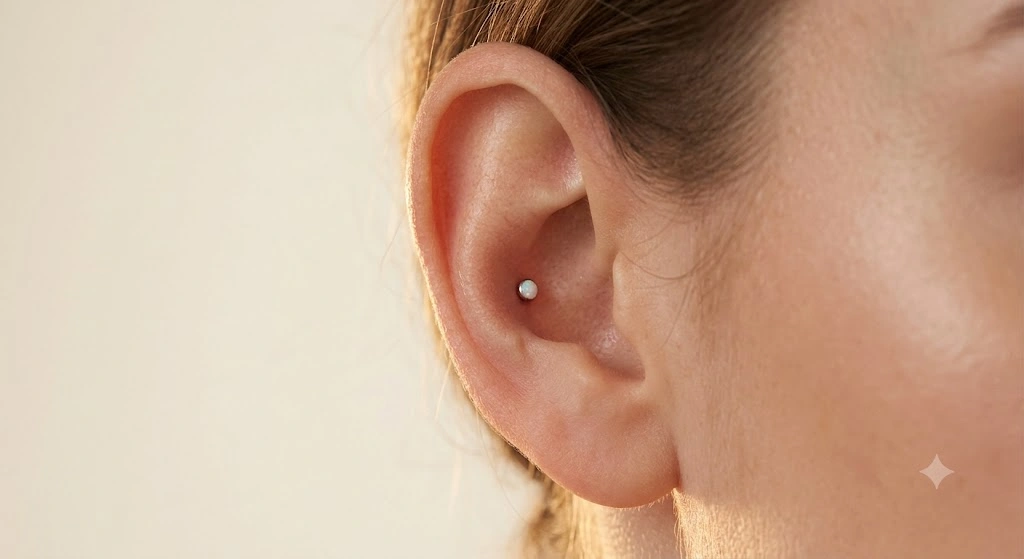
A hidden helix piercing is placed in the innermost fold of the helix cartilage — the tucked, curved groove where the helix rim meets the inner ear structure. Unlike a standard helix piercing that sits prominently on the outer rim, the hidden helix is positioned in a concave crease that naturally conceals the jewelry from straight-on view, revealing itself only from certain angles or when hair is pulled back.
The appeal is unmistakably modern: a piercing that whispers rather than shouts. In an era where curated ear styling has moved toward intentional negative space and editorial restraint, the hidden helix delivers a secret element — a flash of gold or gem that catches light unexpectedly. From the front, the ear appears unpierced or minimally adorned. Tilt the head, pull back the hair, or lean in close, and the hidden helix reveals itself like a small, private discovery.
This quality makes the hidden helix uniquely appealing for people who work in professional environments with conservative piercing policies, or who simply prefer a style that rewards intimacy and attention. It is also an exceptional addition to a curated ear project — tucked behind or below a standard helix stack, it adds depth and dimension without visual clutter.
One important clarification before we proceed: the hidden helix is sometimes confused with the inner conch or the rook. The rook pierces the anti-helix fold higher up, while the inner conch sits in the bowl of the ear. The hidden helix specifically sits in the natural groove of the helix fold itself, lower and more tucked than a standard helix but using the same cartilage structure. Your piercer’s anatomical assessment matters significantly here — not every ear has the fold depth to accommodate a hidden helix comfortably.
- Location: Inner fold/groove of the helix cartilage
- Visibility: Concealed from front — visible at angles
- Pain: 5 / 10
- Healing: 6–9 months
- Initial Jewelry: Flat-back labret (titanium), small curved barbell
- Cost (US): $50–$100+
- Anatomy dependent: Yes — not all ears qualify
Placement — Where Exactly Does It Go?
The hidden helix sits in the concave inner groove of the helix rim — the small curved crease that forms where the helix cartilage folds inward toward the ear canal. On most ears, this groove is most pronounced in the middle-to-lower section of the helix, making this the most common placement zone.
Because the piercing sits in a fold rather than on a flat surface, placement requires precise anatomical assessment. Your piercer will examine the depth and width of your helix groove, the thickness of the cartilage in that area, and how the fold naturally sits at rest. An experienced APP-member piercer will mark the placement and have you check it in the mirror from multiple angles before proceeding.
What Makes a Good Candidate
Not every ear has a helix fold deep enough to support a hidden helix comfortably. Ideal candidates have:
- A clearly defined, reasonably deep helix groove
- Sufficient cartilage thickness in the fold area
- Enough space for jewelry to sit without pressing against adjacent cartilage
- No prior damage or scarring in that zone
If your helix fold is very shallow or flat, a piercer may redirect you toward a standard helix or a low helix placement instead. This is not a failure — it is responsible piercing practice, and a good piercer will always prioritize placement that heals well over placement that simply looks interesting on a moodboard.
Placement Relative to Other Piercings
If you are building a curated ear, the hidden helix pairs beautifully with:
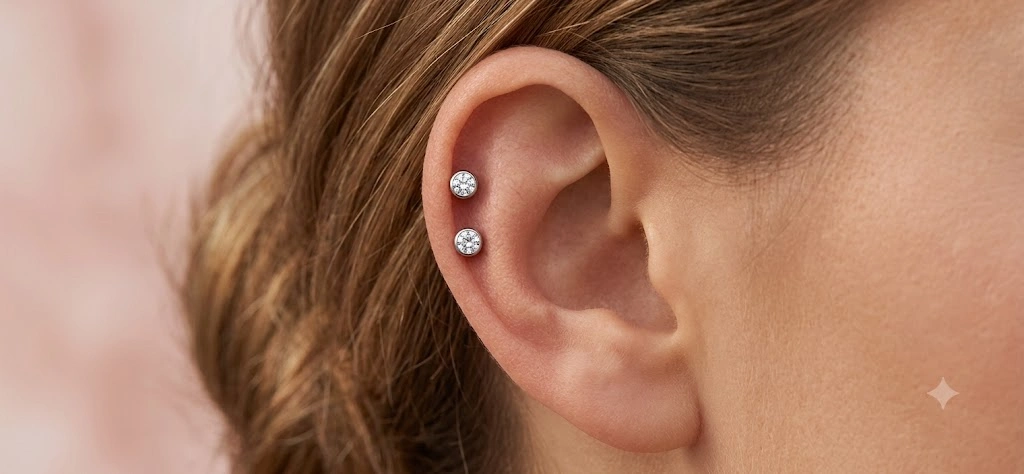
- A standard helix stud above or below it on the outer rim
- A lobe stack at the bottom of the ear
- A forward helix near the temple
Standard spacing guidance applies here too: keep at least 6–8mm between piercing centers when planning adjacent placements. Because the hidden helix sits in the fold rather than on the rim, it typically does not compete visually with rim-based helix piercings — they occupy different planes, which is part of what makes the combination so effective.
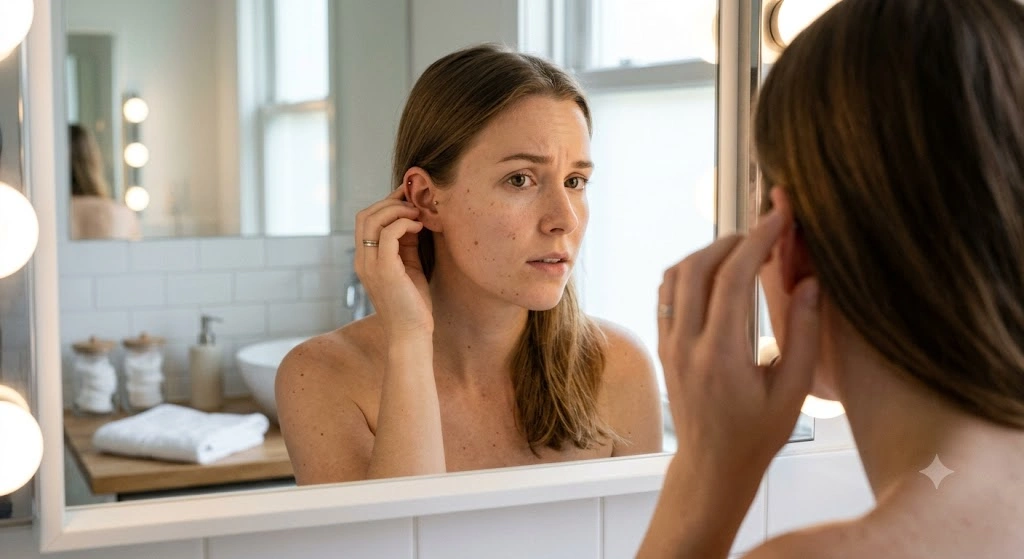
Always have your ear assessed in person before committing to a hidden helix. Photos from social media often show ears with unusually pronounced helix folds. Your ear is unique — work with what you have, not what you saw on Instagram.
Pain Level — What Does It Actually Feel Like?
The hidden helix rates a 5 out of 10 on a realistic pain scale — slightly higher than a standard outer helix (4/10) for two reasons: the fold location means the piercing needle passes through cartilage at a slightly more complex angle, and the confined groove makes it harder to find a truly comfortable resting position for the initial jewelry during healing.
The Piercing Moment
Most people describe the actual needle pass as a sharp, focused pressure — more intense than a lobe but shorter in duration than a rook or daith. The sensation typically peaks for 1–2 seconds and then fades quickly. Because the hidden helix sits in a fold, the initial pressure of the needle finding the correct angle may feel slightly more pronounced than a standard helix.
After the Piercing
Expect a dull ache and tenderness for the first 3–5 days. The fold location means that normal ear movements — sleeping on that side, wearing over-ear headphones, or pressing the ear against a phone — are more likely to aggravate the piercing than with a rim-based placement. Swelling is common in the first 72 hours and usually subsides within a week.
Honest Pain Comparison
| Piercing Type | Pain (1–10) | Notes |
|---|---|---|
| Lobe | 2 | Soft tissue, quick |
| Standard Helix | 4 | Outer cartilage rim |
| Hidden Helix | 5 | Fold angle adds complexity |
| Forward Helix | 5–6 | Thick cartilage near temple |
| Rook | 7 | Deep anti-helix fold |
| Daith | 7–8 | Thick inner fold cartilage |
- Eat a full meal 1–2 hours before your appointment
- Stay hydrated — dehydration increases pain sensitivity
- Avoid alcohol and caffeine 24 hours before
- Breathe steadily — do not hold your breath
- Choose an experienced piercer who works in fold placements regularly
Healing Timeline — What to Expect Month by Month
The hidden helix takes 6–9 months to reach initial healing, with full maturation taking up to 12 months. Because it sits in a fold, it is more prone to irritation from pressure and movement than a standard outer helix — which means healing requires consistent, attentive aftercare throughout.
Month-by-Month Breakdown
Week 1–2 — Acute Phase
Redness, swelling, tenderness. Some lymph fluid (clear/white crust) around the jewelry is normal. Do not touch, twist, or rotate. Keep hair and product away from the area.
Month 1–2 — Early Healing
Swelling reduces. The channel is forming but remains fragile. Avoid sleeping on that side. Saline spray twice daily. Irritation bumps may appear — usually caused by pressure or snagging.
Month 3–5 — Active Healing
Most discomfort resolves. The fold location may still be tender with direct pressure. Do not change jewelry yet regardless of how healed it feels. Continue saline routine.
Month 6–9 — Initial Healing Complete
Most people reach comfortable initial healing in this window. Have your piercer assess readiness before any jewelry change. The fold may still be slightly sensitive to sustained pressure.
Month 9–12 — Full Maturation
The fistula (skin channel) is fully formed and stable. Jewelry changes are comfortable. The hidden helix is now a permanent, reliable part of your ear project.
- Sleeping on the piercing side without a travel pillow
- Over-ear headphones or earbuds pressing the fold
- Hair products (dry shampoo, hairspray) drifting into the fold
- Touching or rotating jewelry
- Changing jewelry too early
- Swimming in pools or open water before initial healing
Jewelry Options for Hidden Helix Piercings
Because the hidden helix sits in a fold, jewelry selection is more constrained than for a standard helix. Pieces need to fit the concave geometry of the groove, lie flush enough not to snag, and be small enough not to visually overwhelm the concealed placement. This is a piercing where less is genuinely more.
Initial Jewelry — Healing Phase
Your piercer will almost always start you with a flat-back titanium labret stud. This is the gold standard for fold placements because:
- The flat disc back sits flush against the inner fold without digging in
- Implant-grade titanium (ASTM F136) is hypoallergenic and lightweight
- The post length can be sized precisely for your fold depth
- No ring backs means no snagging in hair during healing
Typical initial post length: 6–8mm to accommodate healing swelling, downsized to 4–5mm around month 6 when swelling has fully resolved.
Post-Healing Jewelry Options
| Style | Best For | Notes |
|---|---|---|
| Flat-back labret stud | All stages | Most versatile, most comfortable |
| Small curved barbell | Post-healing | Follows fold curvature naturally |
| Tiny seamless ring | Fully healed only | Can snag in fold — choose carefully |
| Gemstone end stud | Post-healing | CZ or opal for subtle sparkle |
| Solid gold flat disc | Post-healing | 14k/18k yellow gold — elevated look |
Recommended Materials
- Implant-grade titanium (ASTM F136) — best for healing and sensitive ears
- 14k or 18k solid gold — ideal for post-healing upgrades
- Implant-grade steel (ASTM F138) — acceptable alternative
- Avoid: Sterling silver, plated metals, acrylic, mystery alloys
The hidden helix fold often accommodates smaller jewelry end sizes than a standard helix — 2mm to 3mm gem ends typically look most proportional. Large decorative ends may protrude awkwardly from the fold or defeat the “hidden” effect entirely.
Aftercare Routine — Daily Care Guide
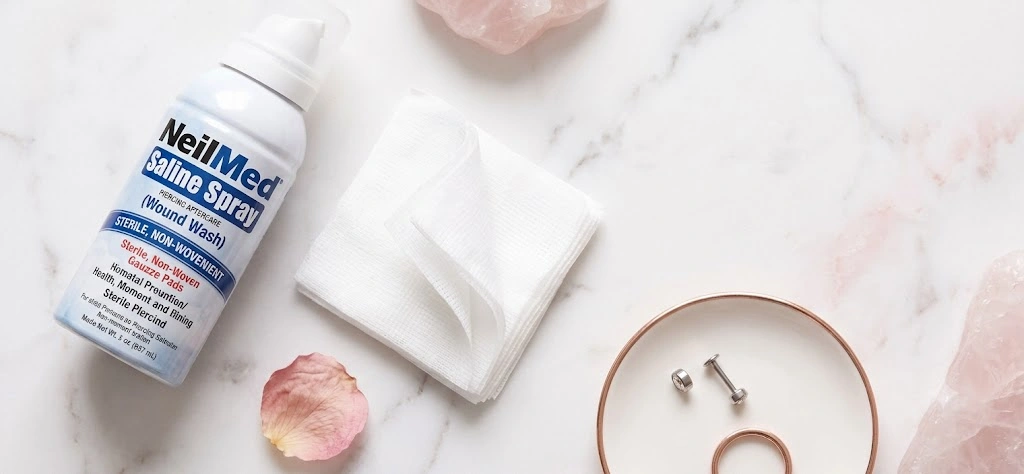
The hidden helix demands particularly consistent aftercare because the fold location creates a microenvironment where moisture, product residue, and debris can accumulate more easily than on an exposed outer rim placement. A simple, twice-daily saline routine is your best tool.
Daily Routine (Months 1–6)
✅ Morning
- Spray sterile saline solution (0.9% NaCl) directly onto the piercing
- Let it soak for 30 seconds
- Gently rinse with clean water
- Pat dry with a clean paper towel — do not use cloth towels (bacteria)
✅ Evening (repeat)
- Spray saline — use extra care to flush the fold groove
- Check for any crust buildup in the fold and gently rinse away
- Pat completely dry — moisture trapped in the fold causes irritation
What to Avoid
| Avoid | Why |
|---|---|
| Touching with unwashed hands | Introduces bacteria into the fold |
| Rotating or moving jewelry | Disrupts healing tissue, causes trauma |
| Hydrogen peroxide / alcohol | Kills healing cells, dries out tissue |
| Over-ear headphones | Direct pressure on fold causes irritation |
| Hairspray / dry shampoo near ear | Chemical residue accumulates in fold |
| Sleeping on that side | Sustained pressure extends healing significantly |
| Swimming (pools/sea) before 3 months | Bacteria and chemicals enter the channel |
Use a travel neck pillow with the hole positioned over your pierced ear. This keeps direct pressure completely off the fold while you sleep — one of the most effective things you can do to accelerate hidden helix healing.
Common Problems & How to Handle Them
The fold placement makes the hidden helix slightly more prone to certain issues than a standard outer helix. Knowing what to watch for — and what to do — keeps small problems from becoming serious ones.
Irritation Bumps
The most common issue. A small raised bump appears at the piercing site, usually caused by pressure on the fold, snagging, or sleeping on it. Not an infection. Treatment: remove the pressure source, continue saline routine, be patient. Most irritation bumps resolve in 2–4 weeks once the cause is eliminated.
Moisture Buildup in the Fold
Unique to fold placements — the groove can trap moisture from showering, sweating, or cleaning. This creates a warm, damp environment that can slow healing or promote bacterial growth. Always dry thoroughly after cleaning. On hot days or after exercise, a single extra saline-and-dry session helps.
Hypergranulation
A raised, reddish growth of excess tissue around the piercing — sometimes confused with infection. Usually caused by too-tight jewelry (not enough room for swelling) or chronic pressure. See your piercer — a jewelry length adjustment often resolves it quickly.
Infection Signs
True infection (versus normal healing) includes: hot to the touch, increasing pain after the first week, thick green or yellow discharge, significant spreading redness, or fever. If you see these signs, see a doctor — do not remove the jewelry, as this can trap infection inside the channel.
Rejection
Less common in cartilage than in surface piercings, but possible in very shallow fold placements. Signs: the jewelry visibly migrating toward the skin surface, the skin over the piercing thinning. If you suspect rejection, see your piercer immediately — earlier intervention gives better outcomes.
Any sign of true infection, significant or worsening irritation bumps after 3 weeks, jewelry feeling embedded, or visible rejection signs. Do not attempt to diagnose or treat serious issues at home.
Cost of a Hidden Helix Piercing in 2026
The hidden helix typically costs slightly more than a standard helix because of the anatomical complexity of the placement and the skill required to pierce accurately within a fold. In 2026, expect the following in the United States:
| Component | Typical Cost (US) |
|---|---|
| Piercing fee (studio) | $30–$60 |
| Initial titanium labret jewelry | $20–$40 |
| Total at time of piercing | $50–$100 |
| Downsize appointment (month 6) | $10–$20 |
| Solid gold upgrade jewelry | $50–$150+ |
High-end studios in major cities (NYC, LA, Chicago) may charge $80–$120 for the piercing fee alone, especially for specialist fold placements. Budget studios may offer lower prices — but for a placement this anatomy-dependent, experience genuinely matters. Do not choose your hidden helix piercer on price alone.
Piercing + initial jewelry ($50–$100) + downsize ($10–$20) + saline spray ($8–$15 for a year’s supply) + optional gold upgrade ($50–$150) = $118–$285 total for a fully healed, beautifully jeweled hidden helix.
Hidden Helix Piercing — FAQ
Ready to Get Your Hidden Helix?
Read our complete Aftercare & Cleaning guide — know exactly what to do from day one.
Aftercare Guide →