Flat Helix Piercing: Complete Guide 2026
The wide, smooth canvas of the upper ear — precise flat cartilage placement, honest 4/10 pain, 6–9 month healing, jewelry styling, aftercare routine, and full 2026 cost breakdown.

Flat Helix Piercing: The Complete 2026 Guide
Jump to a section:
What Is a Flat Helix Piercing?
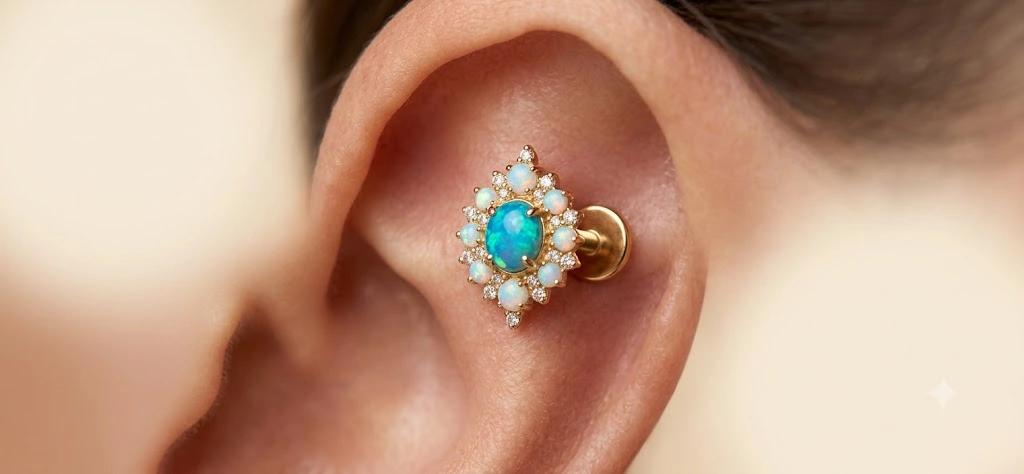
A flat helix piercing — also called a flat piercing or scapha piercing — is placed in the flat, wide expanse of cartilage that sits between the outer helix rim and the inner ridge of the antihelix. This zone, anatomically called the scapha, is the broad, relatively smooth shelf of upper ear cartilage that gives this piercing its defining characteristic: an unusually large, flat surface area on which jewelry can sit flush, visible, and beautifully displayed.
Unlike a standard helix piercing that sits on the narrow curved rim at the edge of the ear, the flat helix occupies the wider inner cartilage shelf. This positional difference has significant aesthetic implications — jewelry on a flat surface lies completely flat against the skin rather than curving around a rim, which makes the flat helix uniquely suited to larger decorative pieces: multi-gem clusters, constellation arrangements, ornate floral ends, and bespoke statement pieces that would look oversized or awkward on the narrow outer rim.
In curated ear culture, the flat helix has become an increasingly sought-after placement precisely because of this display potential. It functions as a natural stage for jewelry that deserves to be seen. A single large opal cluster, a multi-stone geometric piece, or a hand-pressed gold floral end all find their ideal home on the flat helix’s generous, level surface — catching light in a way that no rim-based placement can replicate.
One terminology note worth clarifying: some piercers and online communities use “flat helix” and “helix” interchangeably, or use “flat” to describe any helix piercing done with a flat-back stud rather than a ring. In this guide, we use “flat helix” specifically to mean a piercing placed in the scapha region — the inner cartilage shelf between the outer rim and the antihelix ridge — rather than on the rim itself.
- Location: Scapha — flat inner cartilage shelf of upper ear
- Also called: Flat piercing, scapha piercing
- Visibility: Fully visible, flush display surface
- Pain: 4 / 10
- Healing: 6–9 months
- Initial Jewelry: Flat-back labret stud (titanium)
- Cost (US): $45–$95
- Anatomy dependent: Low — most ears have sufficient scapha area
Placement — The Scapha Zone Explained
The flat helix sits in the scapha — the concave, relatively flat shelf of cartilage that runs between the outer helix rim and the raised inner antihelix ridge. On most ears, the scapha is widest in the upper-to-middle section of the ear, narrowing toward the bottom as the helix and antihelix converge. This upper-to-mid scapha zone is where the vast majority of flat helix piercings are placed.
Choosing the Right Spot Within the Scapha
Because the scapha offers more spatial freedom than a narrow rim, your piercer will assess several factors when marking your flat helix placement:
- Width of the scapha — wider scaphas offer more placement flexibility and accommodate larger jewelry ends
- Cartilage thickness — varies across the scapha zone; your piercer will find the optimal thickness for comfortable healing
- Distance from the rim — typically 3–6mm inward from the outer rim edge
- Existing piercings — spacing from any outer helix or other nearby piercings
- Jewelry end size — if you plan to wear a large decorative end, placement needs to account for its diameter so it does not overlap the rim or antihelix
Single vs. Multiple Flat Helix Piercings
The scapha’s generous surface area makes it one of the few ear zones where multiple piercings genuinely work in close proximity. Constellation piercings — two or three flat helix studs arranged in a small cluster or pattern — are a popular and visually stunning option. For multiple placements, maintain at least 6–8mm between piercing centres and stage new piercings at least 3 months apart for the cleanest healing outcomes.
Flat Helix vs. Outer Helix — Key Differences
| Feature | Flat Helix (Scapha) | Outer Helix (Rim) |
|---|---|---|
| Surface | Wide, flat shelf | Narrow curved rim |
| Jewelry display | Flush, horizontal | Angled, rim-following |
| Best jewelry | Flat-back studs, clusters | Studs and hoops |
| Hoops | Not recommended | Common and popular |
| Statement pieces | Ideal — large ends work well | Limited by rim width |
If you have a statement jewelry piece in mind — a large opal cluster, multi-gem end, or custom gold piece — bring a photo or the actual jewelry to your consultation. Placement should be designed around your intended jewelry, not the other way around.
Pain Level — What Does It Actually Feel Like?
The flat helix rates a 4 out of 10 on a realistic pain scale — comparable to a standard outer helix. The scapha cartilage is relatively thin and accessible, making the needle pass clean and quick. Most people find it a straightforward, manageable experience even as their first cartilage piercing.
The Piercing Moment
Expect a sharp, focused pressure as the needle passes through the cartilage — peaking for 1–2 seconds and fading quickly. Because the scapha is a relatively flat, thin section of cartilage, the needle path is typically shorter and more direct than in thicker cartilage zones like the forward helix or conch. Most people describe it as a more intense version of a lobe piercing — sharper but equally brief.
After the Piercing
A mild throbbing ache for the first few hours is normal and expected. Tenderness when the area is touched or pressed continues for the first week. Because the flat helix is on the upper inner ear rather than the rim, accidental knocks and snags are slightly less common in daily life — which many people find makes the healing period more comfortable than an outer helix.
Pain Comparison Chart
| Piercing Type | Pain (1–10) | Notes |
|---|---|---|
| Lobe | 2 | Soft tissue, very quick |
| Flat Helix | 4 | Thin scapha cartilage, clean pass |
| Mid Helix | 4 | Outer rim cartilage, comparable |
| Hidden Helix | 5 | Fold angle adds complexity |
| Forward Helix | 5–6 | Thicker cartilage near temple |
| Rook | 7 | Deep anti-helix fold |
| Daith | 7–8 | Thick inner fold cartilage |
- Eat a full meal 1–2 hours before your appointment
- Drink plenty of water on the day
- No alcohol or caffeine for 24 hours prior
- Exhale slowly and steadily as the needle passes
- Use a studio that pierces with single-use hollow needles, never guns
- Talk to your piercer — an experienced professional will keep you calm and informed throughout
Healing Timeline — What to Expect Month by Month
The flat helix heals over 6–9 months for initial healing, with full cartilage maturation at 9–12 months. The scapha’s position — somewhat sheltered from the outer rim knocks but still exposed to hair, products, and pillowcase pressure — makes consistent aftercare the single most important factor in your healing timeline.
Week 1–2 — Acute Phase
Redness, localized swelling, and tenderness are all normal. Clear or white lymph fluid crusting around the jewelry is healthy healing activity — not infection. Do not touch, twist, or rotate the jewelry under any circumstances. Keep hair, hair products, and hands away.
Month 1–2 — Early Healing
Swelling resolves. The skin channel (fistula) begins forming but is fragile. Hair is a particular hazard for flat helix piercings during this phase — long hair can wrap around or snag the jewelry repeatedly. Twice-daily saline is essential. Do not change jewelry.
Month 3–5 — Active Healing
Day-to-day discomfort largely resolves. The channel continues forming internally even when the surface looks healed. Resist the temptation to change jewelry — the most common mistake at this stage. Continue saline routine. Some flare-ups during illness or high-stress periods are normal.
Month 6–9 — Initial Healing Complete
Most flat helix piercings reach initial healing comfort in this window. Book a downsize appointment with your piercer — replacing the longer healing post with a shorter, snugger fit dramatically reduces snagging and improves jewelry appearance. Always have your piercer perform the downsize.
Month 9–12 — Full Maturation
Cartilage fully stable. Jewelry changes are smooth and comfortable. Now is the ideal time to upgrade to the statement piece you have been planning — the large opal cluster, the solid gold floral end, the constellation arrangement. Your flat helix is fully ready to showcase it.
- Long hair tangling around or snagging the jewelry
- Sleeping directly on the piercing without ear protection
- Over-ear headphones pressing on the scapha zone
- Hair products (dry shampoo, hairspray) settling onto the jewelry
- Changing jewelry before professional assessment at 6 months
- Touching or adjusting the jewelry — even when it feels fine
Jewelry Options for Flat Helix Piercings
The flat helix is the premier ear placement for decorative flat-back jewelry. Its wide, smooth surface is purpose-built for studs with statement ends — and almost uniquely unsuitable for hoops, which require a rim to hang from. If you want to wear a striking, ornate jewelry piece on your ear, the flat helix is where it belongs.
Initial Jewelry — Healing Phase
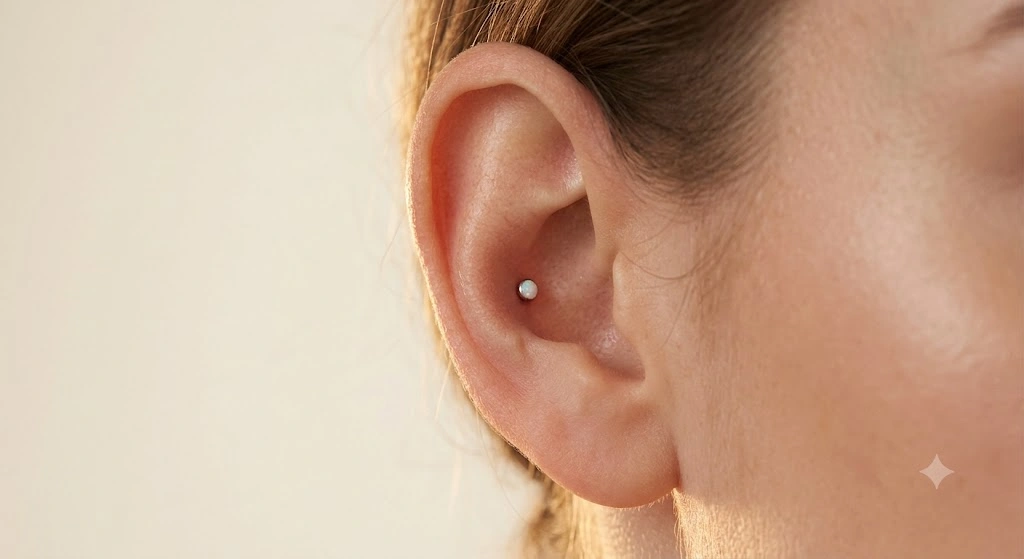
Your piercer will start you with a flat-back titanium labret stud with a longer post (typically 8–10mm) to accommodate initial swelling. The flat back disc sits flush against the back of the ear, while a simple titanium ball or small gem end sits on the front. At the downsize appointment (month 6), the post is shortened to 5–6mm for a cleaner, more secure fit.
Post-Healing Jewelry Guide
| Style | Best For | Notes |
|---|---|---|
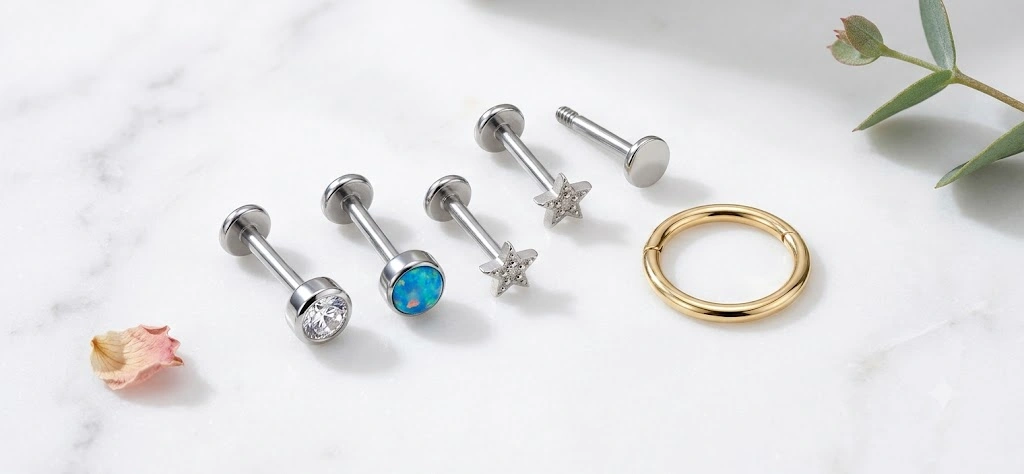
| Flat-back labret stud | All stages | The definitive flat helix jewelry style |
| Multi-gem cluster end | Post-healing | Flat surface shows clusters perfectly |
| Large opal or gemstone end | Post-healing | 5–8mm ends look proportional on scapha |
| Floral / botanical end | Post-healing | Ornate ends shine on flat surface |
| Solid gold disc or flat end | Post-healing | 14k/18k — sits flush, catches light |
| Constellation arrangement | Post-healing (multiple) | 2–3 flat helix studs in a pattern |
| Hoops | Not recommended | No rim to hang from — poor fit on scapha |
Jewelry End Size Guide
The flat helix’s wide surface accommodates larger jewelry ends than most other ear placements. General guidelines:
- 2–3mm ends: Minimalist look — subtle sparkle, easy daily wear
- 4–5mm ends: The sweet spot for most ears — present but not overpowering
- 6–8mm ends: Statement pieces — best for wide scaphas and intentional bold looks
- 8mm+: High-impact jewelry — ensure your scapha width can accommodate without overlapping the rim or antihelix
Recommended Materials
- Implant-grade titanium (ASTM F136) — best for healing and sensitive ears, available in anodized colors
- 14k or 18k solid gold — ideal for post-healing statement pieces
- Implant-grade steel (ASTM F138) — acceptable alternative for healing
- Avoid: Sterling silver (tarnishes, reactive), gold-plated metals (plating wears off), acrylic, mystery alloys
A hoop needs a rim or edge to curve around and hang from naturally. The flat scapha surface has no such rim — a hoop placed here would protrude at an awkward angle, sit uncomfortably, and be prone to snagging. Embrace what the flat helix does best: flat-back studs with beautiful decorative ends.
Aftercare Routine — Complete Daily Guide
Flat helix aftercare follows the same core principles as all cartilage piercing care — sterile saline twice daily, hands off, protect from pressure and snagging. One additional consideration unique to flat helix placements: because it sits on the inner cartilage shelf, hair is a more significant hazard than for rim-based piercings, and hair management during healing deserves specific attention.
Daily Cleaning Routine (Months 1–6)
✅ Morning
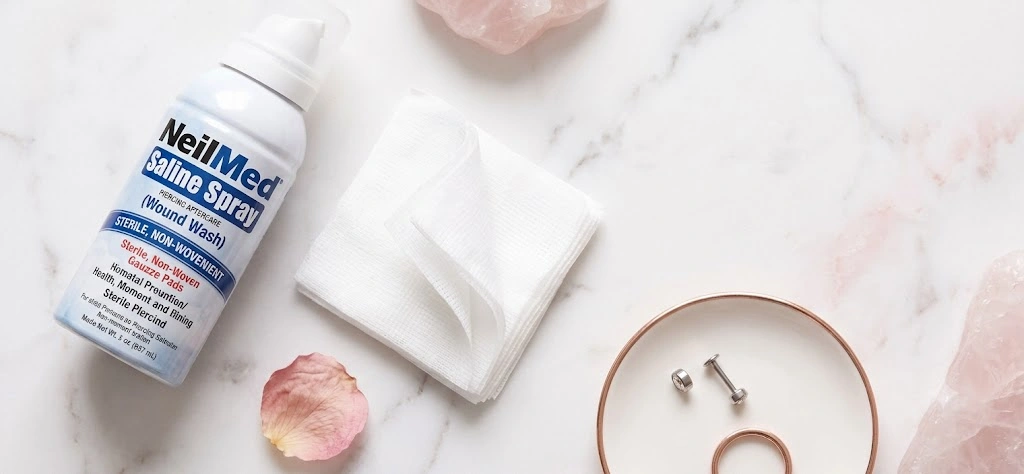
- Spray sterile saline solution (0.9% NaCl — no additives) directly onto both sides of the piercing
- Allow to soak for 30 seconds
- Rinse gently with clean warm water
- Pat completely dry with a clean paper towel
✅ Evening (repeat)
- Spray saline — allow any crust to soften naturally before gentle rinsing
- Never pick crust off dry — always soften first
- Pat thoroughly dry — moisture encourages bacteria
Hair Management During Healing
Hair is the flat helix’s primary healing hazard. Long or medium-length hair can continuously wrap around and snag on the jewelry as you move throughout the day — each snag being a small trauma that accumulates and extends healing. Practical steps:
- Pull hair into a bun, braid, or ponytail during the first 3 months
- Use a silk or satin pillowcase — hair slides more freely and is less likely to tangle around jewelry
- Be conscious when brushing or styling hair — slow movements near the pierced ear
- Avoid hair masks, conditioners, and oils that drip down toward the ear
What to Avoid
| Avoid | Why |
|---|---|
| Hair tangling in jewelry | Primary flat helix healing disruptor |
| Touching with unwashed hands | Introduces bacteria directly to the channel |
| Rotating or twisting jewelry | Tears forming tissue, resets healing |
| Alcohol, peroxide, ointments | Kills healing cells or clogs pores |
| Sleeping on the piercing side | Hours of sustained pressure = irritation bumps |
| Over-ear headphones | Pressure on scapha zone disrupts healing |
| Swimming before 3 months | Pools (chlorine) and open water (bacteria) both harmful |
| Changing jewelry before 6 months | Channel not stable — high damage and closure risk |
A travel neck pillow with the opening aligned over your pierced ear eliminates pressure while sleeping. Combined with a silk pillowcase to reduce hair tangling, this setup makes a significant, measurable difference to flat helix healing speed.
Common Problems & How to Handle Them
The flat helix is a reliable healer when aftercare is consistent, but certain issues arise more commonly here than at rim-based placements — primarily related to hair and pressure. Knowing what to watch for keeps small problems from becoming serious complications.
Hair-Related Trauma
The most unique flat helix challenge. Repeated hair snagging accumulates micro-traumas that the body responds to with irritation, redness, and bump formation. The fix is straightforward: manage your hair more carefully around the piercing. Pulling hair back consistently during the first 3 months eliminates the majority of flat helix hair-related issues.
Irritation Bumps
Small raised bumps at the piercing site — the most common flat helix complaint. Almost always caused by an identifiable trigger: sleeping on the ear, hair snagging, a knock or snag, or chemical irritation from a hair product. Irritation bumps are not infections. Identify and remove the cause, continue consistent saline aftercare, and most resolve within 2–4 weeks. If a bump persists beyond 4 weeks of corrected aftercare, see your piercer.
Embedding
If the initial jewelry post is too short — or if significant swelling occurs — the flat disc back or the front end can begin to press into the skin. Signs: the jewelry end looks sunken, or you can see the skin beginning to grow over the disc. See your piercer immediately if you notice this. It is a jewelry length issue, not a permanent problem, and is easily resolved with a longer post.
Hypertrophic Scars
Raised, reddish scar tissue forming around the piercing — distinct from a true keloid, which grows beyond the wound boundary. Hypertrophic scars are most often caused by ongoing irritation (pressure, snagging), poor jewelry material, or jewelry that is too tight or too heavy. Addressing the cause usually leads to gradual resolution. If you have a keloid history, discuss this with your piercer before any cartilage work.
Infection
True infection is uncommon but serious. Signs that distinguish infection from normal healing: increasing pain after the first week, hot skin, thick green or yellow discharge with an odour, spreading redness beyond the piercing site, or feeling unwell systemically. If you suspect infection, see a doctor — do not remove the jewelry without medical guidance, as closure can trap infection inside the channel.
Any sign of true infection, embedding, irritation bumps that do not improve after 3–4 weeks of corrected aftercare, jewelry that feels like it is shifting or migrating, or any concern you cannot confidently explain. Do not wait — early assessment prevents small problems from becoming major ones.
Flat Helix Piercing Cost in 2026
The flat helix is priced similarly to other standard cartilage placements — the scapha is anatomically accessible and the technique is well within the skillset of any experienced piercer. However, because the flat helix is often chosen specifically for statement jewelry, the overall investment tends to be higher when you factor in the decorative pieces that make this placement truly shine.
| Component | Typical Cost (US) |
|---|---|
| Piercing fee (studio) | $25–$55 |
| Initial titanium labret jewelry | $20–$40 |
| Total at time of piercing | $45–$95 |
| Downsize appointment (month 6) | $10–$20 |
| Statement jewelry upgrade (opal cluster, floral) | $50–$200+ |
| Solid 14k gold end | $60–$180+ |
In major urban markets (New York, Los Angeles, Chicago, Miami), studio piercing fees for cartilage work commonly reach $50–$80. In smaller markets, quality studios may charge $30–$50. Statement jewelry from independent makers or high-end piercing studios can range from $80 to $400+ for bespoke pieces — the flat helix’s display potential makes this investment worthwhile for many.
Piercing + initial jewelry ($45–$95) + downsize ($10–$20) + saline spray ($8–$15 for a year’s supply) + statement jewelry upgrade ($50–$200) = $113–$330 total for a fully healed, beautifully showcased flat helix. The jewelry is often the largest investment — and the most rewarding one.
Flat Helix Piercing — FAQ
Ready to Get Your Flat Helix?
Read our complete Aftercare & Cleaning guide — know exactly what to do from day one.
Aftercare Guide →