Forward Helix Piercing Complete Guide 2026
Exact placement, honest pain level (6/10), full 9–12 month healing timeline, double and triple forward helix, best jewelry, cost breakdown, and step-by-step aftercare.

Forward Helix Piercing: The Complete 2026 Guide
Jump to a section:
What Is a Forward Helix Piercing?
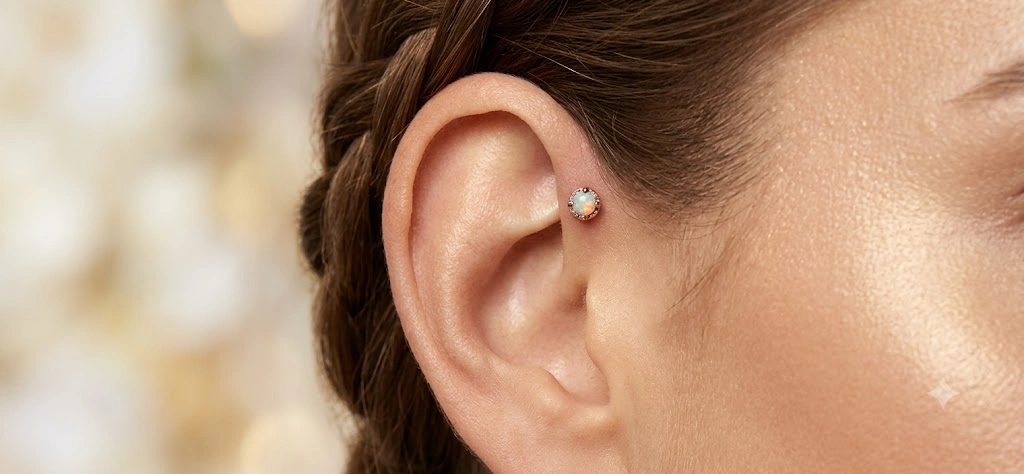
A forward helix piercing — also called a front helix piercing — is a cartilage piercing placed at the very front of the helix rim, specifically at the anatomical point where the outer ear cartilage ridge begins its curve forward toward the face. This specific location is called the crus of helix — the root or starting point of the helix where it emerges from the head near the temple region.
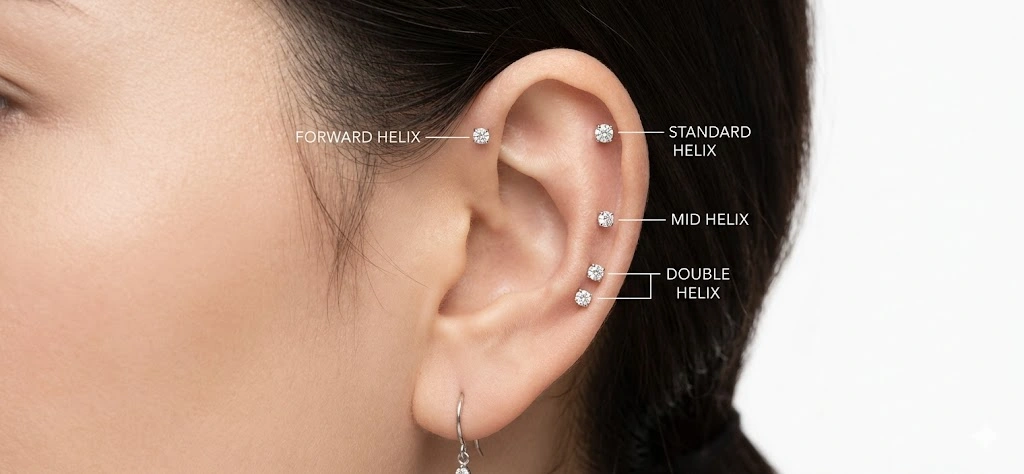
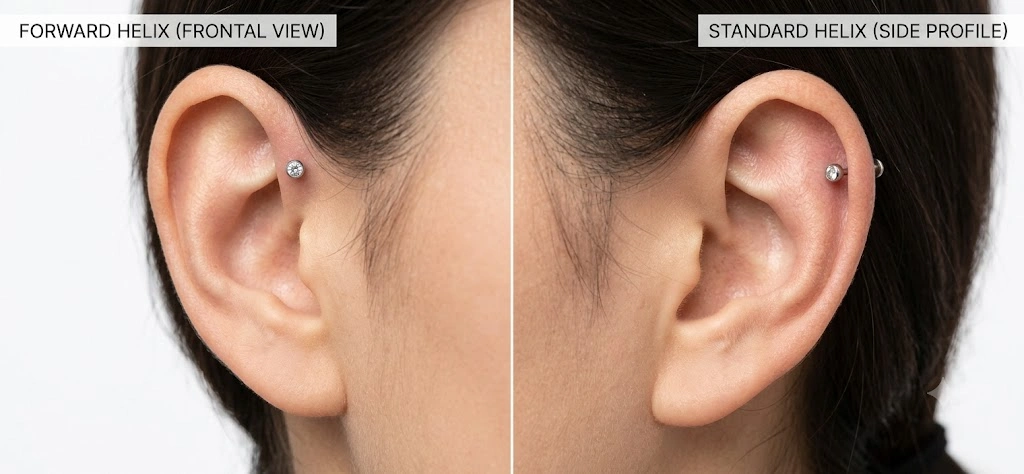
Unlike a standard helix piercing (which sits on the outer curved rim and faces sideways), the forward helix faces directly forward — toward your face. This makes it one of the most visible piercings in face-to-face interactions and one of the most impactful choices for front-facing photography, video calls, and everyday social visibility. When someone looks directly at you, your forward helix is one of the first ear piercings they’ll notice.
The forward helix has become one of the most requested cartilage piercings of the 2020s decade — partly because of its distinctive front-facing visibility and partly because it serves as a natural complement to tragus piercings in the growing curated ear movement. In 2026, forward helix piercings — particularly double and triple configurations — rank among the top five most requested cartilage piercings globally.
Location: Crus of helix — front cartilage ridge near temple | Faces: Forward (toward face) | Pain: 6/10 | Healing: 9–12 months | Cost: $50–$120 (studio + jewelry) | Jewelry: Flat-back labret stud (healing); small hoops (healed) | Gauge: 16g most common | Best metal: Implant-grade titanium (ASTM F136)
Why Is It Called “Forward” Helix?
The name directly describes the anatomy. The helix rim runs from the crus (at the very front of the ear, near the face) around the top and down the back. A “forward” helix piercing sits at the forward-most point of this rim — literally the front of the helix. In contrast, a standard helix piercing sits on the outer portion of the rim, which curves away from the face and faces sideways rather than forward.
Some piercers and clients use the term “front helix” interchangeably with forward helix — both terms describe the same placement. The crus of helix position is consistent regardless of what you call it.
Forward Helix vs Standard Helix: The Key Difference in One Sentence
A standard helix piercing is best seen from the side; a forward helix piercing is best seen from the front. Every other difference flows from this fundamental distinction in direction.
Who Gets Forward Helix Piercings?
The forward helix appeals to a wide range of people, but it’s particularly popular with:
- People who spend time on video calls or in face-to-face professional settings — the forward-facing position makes the piercing highly visible in exactly these contexts.
- Curated ear enthusiasts — the forward helix is almost always included in planned ear stacks because it provides front-facing presence that no other single piercing delivers from the upper ear.
- People who wear their hair down — when hair falls around the face, a forward helix peeks through in a way that a standard helix (largely hidden by the hair touching the outer ear) cannot match.
- Those who already have a standard helix and want to add depth and front-facing dimension to their ear jewelry collection.
Forward Helix Anatomy & Placement: Where Exactly Does It Go?
Understanding the anatomy of the forward helix position is essential — both for knowing what to expect from the procedure and for communicating clearly with your piercer about what you want. The forward helix sits in a specific and relatively small anatomical zone.
The Crus of Helix: Exact Anatomy
The crus of helix is the anterior (forward-facing) root of the helix — the point where the cartilage rim begins as it emerges from the head. In a typical ear, it sits roughly level with or just above the opening of the ear canal, at the very front of the upper ear where the ear meets the side of the head near the temple.
The cartilage at the crus of helix has distinct characteristics compared to the rest of the helix rim:
- Thicker and denser: The crus cartilage is generally thicker than the outer rim — creating more resistance to the needle during piercing and a different healing environment.
- More nerve-dense: The front of the ear near the temple has higher sensory nerve density due to proximity to the auriculotemporal nerve — one of the reasons forward helix piercings rate more painful than standard helix piercings.
- Limited space: The crus is a relatively narrow ridge compared to the broad outer rim. This limits how many piercings can be safely and aesthetically placed — most ears accommodate 1–3 forward helix piercings in this zone.
- Anatomy-dependent: The crus varies significantly between individuals. Some people have a prominent, well-defined crus ideal for forward helix piercings; others have a flatter, less distinct crus that limits options. A professional piercer assesses this in the consultation.
Single Forward Helix: Standard Placement
For a single forward helix, the piercing passes through the crus from front to back — entering on the forward-facing surface (what the world sees) and exiting on the back (facing your head). The jewelry sits horizontally or at a slight angle depending on the specific anatomy of the crus at that point.
The exact position of the single forward helix can vary slightly — some people prefer it positioned higher on the crus (closer to where the crus meets the main helix rim), others lower (closer to the ear canal). Your piercer will mark the exact spot with a surgical marker and show you in a mirror before any needle is used — this is the moment to confirm the position is where you want it.
What Makes Good Forward Helix Anatomy?
Not every ear has ideal anatomy for forward helix piercings. Characteristics that favor good outcomes:
Never decide on a forward helix piercing based purely on photos of someone else’s ear. Your crus anatomy is unique. An APP-certified piercer can assess your specific anatomy in under two minutes and tell you exactly which forward helix configurations are viable for your ear — and which aren’t. This assessment is why the consultation exists.
Forward Helix Piercing Pain Level: Honest 1–10 Rating
The forward helix consistently rates more painful than a standard helix — 6 out of 10 on average versus the standard helix’s 4/10. This is not an arbitrary difference; it has clear anatomical explanations. Understanding why it hurts more helps you prepare accurately and approach the piercing with realistic expectations rather than unpleasant surprises.
Forward Helix Pain Scale: 6 out of 10
A 6 out of 10 sits firmly in “clearly painful but absolutely manageable” territory. It is the kind of pain that makes you inhale sharply, that requires a moment to collect yourself immediately after, and that produces a more noticeable throbbing ache for 24–72 hours rather than the few hours typical of a standard helix. It is not the kind of pain that makes people regret their decision or feel they cannot handle it — the needle moment itself lasts under two seconds.
Why the Forward Helix Hurts More: Two Anatomical Reasons
The Two Phases of Forward Helix Pain
| Phase | What You Feel | Rating | Duration |
|---|---|---|---|
| Needle transit | Sharp, intense pinch with pronounced crunching pressure — greater resistance than standard helix | 6/10 | Under 2 seconds |
| Jewelry insertion | Sustained lower-level pressure as jewelry is threaded through the dense cartilage channel | 4/10 | 15–45 seconds |
| Immediate aftermath | Warm, pulsing heat in ear — noticeably more intense than standard helix | 3/10 | Minutes |
| Post-piercing ache | Noticeable throbbing — more pronounced and longer-lasting than standard helix | 2–3/10 | 24–72 hours |
Pain Comparison: Forward Helix vs Other Piercings
| Piercing | Pain vs Forward Helix | Rating |
|---|---|---|
| Lobe | Much less | 2/10 |
| Standard helix | Less | 4/10 |
| Tragus | Less | 4/10 |
| Forward helix | — Reference — | 6/10 |
| Rook | Similar | 6/10 |
| Conch | Similar | 5–6/10 |
| Industrial | Similar (two piercings) | 6/10 |
| Double forward helix (2nd in session) | More than single | 6.5–7/10 |
Tips to Reduce Forward Helix Pain
- ✅ Eat a full meal 1–2 hours before — low blood sugar is the single biggest pain amplifier. Never get pierced on an empty stomach.
- ✅ Stay hydrated throughout the day — dehydration creates body-wide stress that elevates pain sensitivity.
- ✅ Avoid caffeine on piercing day — caffeine constricts blood vessels and heightens sensory sensitivity.
- ✅ Use the exhale technique — breathe in deeply, exhale slowly as the needle goes through. This activates the parasympathetic nervous system and measurably reduces perceived pain.
- ✅ Choose a highly experienced APP piercer — piercer skill and needle sharpness make a significant difference. An expert piercer with a fresh needle can reduce the pain experience by 1–2 points on a 10-point scale.
- ✅ Tell your piercer you’re nervous — good piercers adjust their technique and give you a clear countdown, removing the anxiety of the unknown.
- ✅ Get good sleep the night before — sleep deprivation measurably increases pain sensitivity.
- ❌ Avoid alcohol for 24 hours before — thins blood, increases bruising and bleeding.
- ❌ Avoid aspirin before — blood thinner. Ibuprofen is fine to take after.
Forward Helix Piercing Healing Time: Full 9–12 Month Timeline
A forward helix piercing takes 9 to 12 months to fully heal internally — consistently at the longer end of the helix healing range. This is due to the thicker cartilage at the crus of helix (which builds the fistula channel more slowly), the higher inflammation response at the position, and the greater snagging risk from the forward-facing location (proximity to hair, glasses, and temple area). Understanding the full healing timeline — including what’s normal at each stage — prevents the most common mistakes.
Forward Helix Healing Week by Week
Days 1–5: Acute Inflammation
Expect more pronounced initial inflammation than a standard helix — swelling, redness, and warmth that are noticeably more intense due to the thicker cartilage’s response to piercing. The ear may feel warm and tender for 3–5 days rather than the 1–3 days typical of a standard helix. Clear or pale-yellow lymph fluid begins weeping immediately — drying to white crust. This is completely normal. Use a travel pillow from the very first night.
Week 1–3: Initial Settling
Initial swelling begins resolving — usually slower than a standard helix. By the end of week 2 most acute tenderness has reduced to background soreness only when disturbed. Daily crust formation settles into a predictable pattern. The position near the temple means you may notice the piercing more when chewing, talking, or moving your jaw — this is normal as the surrounding muscle movements transmit subtle vibrations to the piercing site.
Weeks 4–8: Early Stabilization + Downsize Appointment
The piercing enters a more comfortable, stable phase. Crust production continues but decreases. At week 6–8, book a downsize appointment with your piercer — this is even more critical for forward helix piercings than for standard helix, because the crus position is particularly susceptible to snagging on hair growing near the temple. A correctly sized, shorter bar eliminates a significant amount of the daily mechanical irritation that extends forward helix healing.
Month 2–5: Active Internal Building
The surface continues to look progressively more normal while internal fistula tissue builds through the dense crus cartilage. Crust production gradually reduces. The piercing is becoming more comfortable but is absolutely not healed internally. Many forward helix piercings enter their false heal phase during months 3–5 — appearing and feeling completely healed while the internal cartilage channel is still fragile. Do not change jewelry during this phase.
Month 5–9: Deep Cartilage Healing
The fistula channel through the dense crus cartilage continues maturing. By month 6, a forward helix with excellent aftercare and implant-grade jewelry may be ready for a professional jewelry change — but many piercers recommend waiting until 9 months for forward helix specifically, due to the thicker cartilage taking longer to build a fully robust channel. No tenderness, no discharge, jewelry moves freely — look for all of these for at least 4 weeks before considering any change.
Month 9–12: Full Internal Healing
A well-cared-for forward helix piercing with correct jewelry reaches full internal healing at 9–12 months. The fistula is mature and stable. All five healing signs (zero tenderness when pressed, no crust, jewelry moves freely, normal skin appearance, all signs consistent for 4–6 weeks) should now be met. Jewelry can be changed safely — first change by a professional piercer.
Healing Timeline Table
| Timeline | What’s Normal | Action |
|---|---|---|
| Days 1–5 | Pronounced swelling, redness, warmth, lymph discharge | Saline 2x daily. Travel pillow every night. No touching. |
| Week 1–3 | Swelling slowly reducing, daily crust, background ache | Continue routine. Awareness of jaw movement sensitivity. |
| Week 4–8 | Stable, crust reducing, comfortable except when disturbed | Book downsize appointment at week 6–8. |
| Month 2–5 | False heal likely — looks healed, isn’t internally | DO NOT change jewelry. Maintain aftercare. |
| Month 5–9 | Deep healing — fistula maturing through dense crus | Possible professional jewelry change at 6+ months if all signs met. |
| Month 9–12 | Full internal healing — all healing signs met consistently | Safe for jewelry changes. First change by piercer. |
The forward helix position creates specific healing challenges beyond a standard helix: (1) Hair snagging: Hair growing near the temple frequently catches on the jewelry end — tie hair back consistently. (2) Glasses/sunglasses: The temple arm of glasses can press on or brush the forward helix — switch to contact lenses where possible during healing, or adjust your glasses to minimize contact. (3) Phone holding: Holding a phone against the ear presses directly on the forward helix position — use speakerphone or earphones during healing. (4) Hats and headbands: Anything that presses around the temple area compresses the healing crus.
Double & Triple Forward Helix: The Complete Guide
The double and triple forward helix are among the most dramatically beautiful cartilage piercing configurations available — a vertical row of piercings along the crus creating an architectural column of jewelry on the front of the ear. They require specific anatomy, careful planning, and more demanding aftercare than a single forward helix.
Double Forward Helix
Two forward helix piercings placed vertically along the crus of helix, typically spaced 5–7mm between centers. The spacing is tighter than a standard double helix because the crus is narrower than the outer rim — this is why precise piercer skill and anatomy assessment matter even more for double forward helix configurations.
Anatomy requirement: The crus must be long enough to accommodate two piercings with safe spacing. Some ears simply don’t have enough crus length for two piercings — your piercer will tell you immediately if this applies to your ear.
Pain level (same session): The first forward helix piercing rates 6/10. The second in the same session typically rates 6.5–7/10 as the ear becomes sensitized and the crus area is already responding to the first wound. This makes the double forward helix one of the most demanding same-session pain experiences in standard ear piercing.
Should you get both at once? Most experienced APP piercers recommend staging — getting the first forward helix, healing it fully (9–12 months), then adding the second. Staged piercings heal dramatically better and the reduced pain burden of doing them separately is significant. If you want both immediately and have good cartilage healing history: it’s possible, but budget for up to 12 months of healing and prepare for a more demanding aftercare period.
Triple Forward Helix
Three forward helix piercings in a vertical line — the boldest configuration of this type. The triple forward helix requires substantial crus anatomy and should only be attempted by very experienced APP piercers who have assessed that your specific ear has adequate length and definition. The healing burden is significant: three simultaneous wounds in a small, dense cartilage zone with high nerve density.
The almost universal recommendation for triple forward helix is staged over 2–3 years — one piercing per healing cycle. The visual result when complete is extraordinary, but patience in achieving it produces dramatically better healing outcomes for all three piercings.
Jewelry for Double and Triple Forward Helix
With multiple piercings in close proximity on the narrow crus, jewelry sizing is critical. Key principles:
- Small decorative ends only: 3mm–4mm maximum for double/triple configurations. Larger ends overlap at this spacing and create pressure on each other and surrounding tissue.
- Matching metals: Keep all pieces in the same metal family. Mixed metals on double/triple forward helix configurations look accidental rather than curated.
- Consistent or graduated sizing: Either identical pieces for a clean stacked look, or very subtly graduated (4mm top, 3mm bottom) for natural visual flow.
- Same jewelry brand if possible: Pieces from the same collection ensure consistent proportions, finishes, and stone quality across the stack.
Forward Helix vs Tragus: Which Should You Get?
The forward helix and tragus are the two dominant front-facing ear piercings — both visible face-on, both in the anterior ear zone, and both commonly paired in curated ears. Many people agonize over which to choose first. Here is the complete comparison.
| Feature | Forward Helix | Tragus |
|---|---|---|
| Exact position | Crus of helix — top front ear, near temple | Small cartilage flap directly over ear canal |
| Visibility from front | High — sits in prominent upper-front position | High — very visible at ear canal level |
| Visibility from side | Less visible — faces forward not outward | Less visible — faces forward |
| Pain | 6/10 | 4/10 |
| Healing | 9–12 months | 6–12 months |
| Multiple placements? | Yes — double, triple forward helix possible | No — single only |
| In-ear earphone impact? | Minimal during healing | In-ear earphones incompatible during healing period |
| Hair snagging risk | Higher — near hairline and temple hair | Lower — sits in ear, more protected |
| Jaw movement sensitivity | Mild — especially during first weeks | Sometimes more noticeable — very near jaw hinge |
| Curated ear visual role | Upper front accent — high and forward | Lower front accent — at ear canal level |
| Best for? | Front visibility at upper ear; stacking options | Front visibility at mid-ear; single statement piece |
⚖️ Which First?
If choosing just one to start: the tragus is less painful (4/10 vs 6/10), heals slightly faster on average, and has a lower snagging risk. For the forward helix first: choose this if multiple placements (double/triple) are your goal, or if upper-ear front visibility is your priority aesthetic. In 2026, the most popular front-ear combination is forward helix + tragus together in a curated stack — they frame the front of the ear at two distinct heights beautifully. If planning both, stage them appropriately — get one fully healed before adding the other.
Forward Helix vs Standard Helix: The Full Comparison
The most common comparison question for anyone considering a forward helix is how it differs from the standard helix they may already have or are considering. The two share a name and the same cartilage rim — but they are genuinely different piercings in almost every practical dimension.
| Feature | Forward Helix | Standard Helix |
|---|---|---|
| Location on ear | Crus — front of helix near temple | Outer curved rim — upper/mid ear |
| Faces | Forward — toward face | Sideways and outward |
| Best seen from | Front / face-on view | Side / profile view |
| Pain | 6/10 | 4/10 |
| Why the pain difference | Thicker crus cartilage + more nerve endings | Outer rim — standard cartilage density |
| Healing time | 9–12 months | 6–9 months |
| Post-piercing ache | 24–72 hours | 2–6 hours |
| Snagging risk | Higher — near hairline, glasses temple | Moderate — outer rim |
| Jaw movement sensitivity | Mild — especially early healing | None |
| Hoop options (healed) | Small diameter hoops only — sizing critical | Wide range of hoop diameters |
| Curated ear role | Front accent — horizontal visual frame | Upper anchor — vertical visual height |
| Good for beginners? | Better after standard helix experience | Ideal first cartilage piercing |
Forward Helix Piercing Jewelry: Types, Materials & Sizing
Jewelry choice for a forward helix piercing requires more specific consideration than for a standard helix because the forward-facing position creates unique geometry requirements and the narrow crus limits your options more than the broader outer rim.
Healing Jewelry: Flat-Back Labret Stud (Only Option)
During the 9–12 month healing period, a flat-back labret stud in implant-grade titanium is the only appropriate jewelry for a forward helix. Here’s why no other style works during healing:
- Flat back: The flat disc back sits flush against the inside of the crus — no protrusion, no snagging from behind, no pressure on the head side. Essential for comfort in this position.
- Rigid straight post: A straight post creates a stable, non-moving wound channel. Hoops, curved barbells, or any jewelry that moves with head motion is completely inappropriate during healing.
- Implant-grade titanium: ASTM F136 titanium is the safest healing material — biocompatible, nickel-free, lightweight, and available in anodized colors. The forward helix crus is an even more demanding healing environment than the outer rim, making material quality especially important.
Healing Bar Length & Gauge
Gauge: Most forward helix piercings are done at 16 gauge (1.2mm) — the same as standard helix. Some piercers use 18g (1.0mm) for the narrow crus where a finer gauge suits the anatomy better. Ask your piercer what gauge they’re using at the consultation so you can match it when buying replacement jewelry.
Healing bar length: Initial healing bars are typically 8mm to accommodate first-week swelling. The downsize (at 6–8 weeks, once swelling resolves) typically reduces to 5mm–6mm. The correct-length bar is critical for the forward helix — the crus position means an over-long bar protrudes toward the hairline and catches on everything. Get the downsize done — do not skip it.
Decorative End Options During Healing
Because you’ll be wearing your healing jewelry for 9–12 months, the decorative end you choose matters aesthetically. Forward helix jewelry ends that work well:
Healed Forward Helix Jewelry Options
After full healing (9–12 months), your jewelry options expand significantly:
- Small seamless hoops: 6mm–8mm diameter is the correct range for most forward helix piercings. The hoop must be sized so it sits close to the ear without pressing into the back of the crus. A piercer can help with correct diameter measurement.
- Clicker rings: Hinged segment rings that click open and closed — easier to insert than seamless hoops and can feature decorative elements on the visible forward-facing segment.
- Continued labret studs: Many forward helix piercees stick with flat-back labret studs permanently — the stud look suits the forward-facing position well and is far easier to manage day-to-day than hoops.
- Solid gold pieces: Once healed, upgrading to a solid 14k or 18k gold labret stud or small hoop is a popular choice — particularly for the forward helix, where the front-facing position makes the jewelry highly visible and worth investing in a quality piece.
Forward Helix Piercing Aftercare: Complete Routine
The aftercare routine for a forward helix is the same as for any helix piercing — sterile saline twice daily, leave it alone the rest of the time — but several specific adjustments are important because of the forward-facing crus position.
Daily Aftercare Routine
Non-negotiable before every contact with the piercing.
NeilMed Wound Wash or equivalent 0.9% preservative-free saline. Hold 2–3cm from the piercing. Spray a generous burst on the front entry point (the visible face of the forward helix) then reach behind the ear and spray the exit point. Both sides need direct saline contact.
Allow the saline to soften any overnight crust. Don’t rush this step.
Light pressure. Softened crust releases easily. Never pick dry crust — always soften first.
Fresh gauze or paper towel. The crus area has slightly less natural air circulation than the outer rim — thorough drying is important.
Do not touch, rotate, or adjust the jewelry. Your job is to clean it and then forget it exists.
Forward Helix Specific Aftercare Considerations
| Situation | Forward Helix Specific Advice |
|---|---|
| Sleeping | Travel/donut pillow every night — the crus position can contact the pillow more than a standard helix when side-sleeping. Stricter discipline required. |
| Glasses/sunglasses | The temple arm of glasses passes very close to the forward helix. Adjust fit to minimize contact. Consider contact lenses during the most active healing phase (first 3 months). |
| Phone use | Do not hold phone against the ear during healing — use speakerphone, earphones, or handsfree. Direct phone pressure compresses the healing crus. |
| Hair management | Tie hair back away from the ear consistently during healing. Temple-area hair is the most likely to snag forward helix jewelry. |
| Hats / headbands | Avoid anything that presses around the temple area. Wide-brimmed hats are fine; close-fitting beanies or headbands that contact the forward ear area can cause pressure irritation. |
| Swimming | Avoid pools and open water for 4–6 months (longer than standard helix recommendation) due to the higher healing burden of the forward helix position. |
Forward Helix Piercing Cost 2026
Forward helix piercings typically cost slightly more than standard helix piercings at the same studio — reflecting the additional skill required to pierce the crus anatomy precisely and the typically higher-grade jewelry used at quality studios for this visible, front-facing position.
| Location / Studio Type | Single Forward Helix | Double Forward Helix |
|---|---|---|
| US — Mid-range APP studio | $55–$90 | $90–$160 (some discount for multiple) |
| US — High-end / luxury studio | $90–$150+ | $150–$280+ |
| UK — Mid-range APP studio | £45–£75 | £75–£130 |
| Australia — Mid-range APP studio | AUD $70–$120 | AUD $120–$200 |
Full Year-One Cost Breakdown (Forward Helix, US)
| Cost Item | Typical Range |
|---|---|
| Piercing + initial jewelry (quality studio) | $55–$150 |
| Aftercare saline (NeilMed, ~6 bottles for 12 months) | $48–$60 |
| Non-woven gauze pads (year supply) | $10–$15 |
| Travel/donut pillow | $10–$20 |
| Downsize appointment (if not included) | $15–$30 |
| First professional jewelry change | $15–$30 |
| Replacement/upgrade jewelry (once healed) | $20–$150+ |
| Total Year-One Estimate | $173–$455+ |
Forward Helix Piercing Problems: What to Watch For
The forward helix is more complication-prone than a standard helix — a combination of thicker cartilage, higher baseline inflammation, more snagging exposure, and the longer healing timeline. Here are the specific problems to watch for and how to respond.
Irritation Bumps (Most Common)
Irritation bumps are even more common at forward helix piercings than standard helix piercings, primarily because of the higher snagging risk from hair, glasses, and phone use at the crus position. A bump appearing at the front entry point of the forward helix is almost always caused by one of these mechanical traumas rather than infection or keloid formation.
Treatment: Identify and eliminate the cause (hair, glasses, phone, sleep pressure), switch to implant-grade titanium if not already using it, get a downsize if needed, return to strict twice-daily saline aftercare. Give it 4–8 weeks to resolve after the cause is eliminated.
Prolonged Soreness
Due to the longer healing timeline (9–12 months), forward helix piercings routinely feel sore for longer periods than piercees expect. Background soreness up to month 6 with occasional flare-ups is within the normal range for this specific position. Soreness that increases, spreads, or is accompanied by discharge warrants assessment.
Glasses-Related Irritation
A specific forward helix complication not common in other piercings: the temple arm of glasses or sunglasses pressing against the crus during healing. This creates a sustained pressure irritation pattern — similar to sleeping on the piercing but occurring during waking hours. Signs: soreness worse on days when glasses are worn; mild indentation or redness where the glasses arm contacts the ear. Fix: adjust glasses fit, use a foam or silicone pad on the temple arm, or wear contact lenses during the most sensitive healing phase.
Infection Warning Signs
Forward helix infections progress similarly to other cartilage infections but with slightly higher risk due to the longer healing period and greater exposure to hair bacteria. Watch for: yellow-green pus (not white crust), spreading redness beyond the immediate piercing site, increasing swelling, fever, or the ear feeling hot to the touch. Any of these signs warrant professional assessment — see your piercer first and a doctor if it’s clearly infected.
Forward Helix Piercing FAQ

Ready to Get Your Forward Helix?
Read our complete Aftercare & Cleaning guide before your appointment — know exactly what to do from day one for the fastest possible healing.
Aftercare Guide →