Does a Helix Piercing Hurt?
Honest 1–10 pain ratings, Helix vs lobe comparison, needle vs gun, 10 proven tips to reduce pain, and exactly what to expect at every step of the procedure.

Does a Helix Piercing Hurt? Complete Pain Guide 2026
Jump to a section:
Does a Helix Piercing Hurt?
Yes — a helix piercing hurts, but far less than most people expect. The most common reaction from first-timers stepping out of the studio is: “That was way less than I built it up to be.” Across thousands of first-person accounts from piercing communities, forums, and studio surveys, helix piercing pain consistently rates between 3 and 5 out of 10 — firmly in the manageable, brief discomfort range rather than the intense pain range.
The sensation is characteristically described as a sharp pinch followed by brief pressure. The sharp pinch is the needle passing through the cartilage — it’s intense but instantaneous, over in under a second. The pressure sensation comes immediately after as the tissue adjusts and the jewelry is inserted. The whole procedure — needle through, jewelry in, bar secured — takes roughly 20–45 seconds from start to finish. The worst of it is genuinely over in less than a second.
What sets helix pain apart from a lobe piercing isn’t intensity — it’s character. Cartilage offers more resistance than soft tissue, so you feel a different quality of sensation: more of a crunching pressure alongside the sharp pinch, compared to the clean snap of a lobe piercing. This distinct sensation surprises some people even though it’s no more painful — just unfamiliar if you’ve only had lobe piercings before.
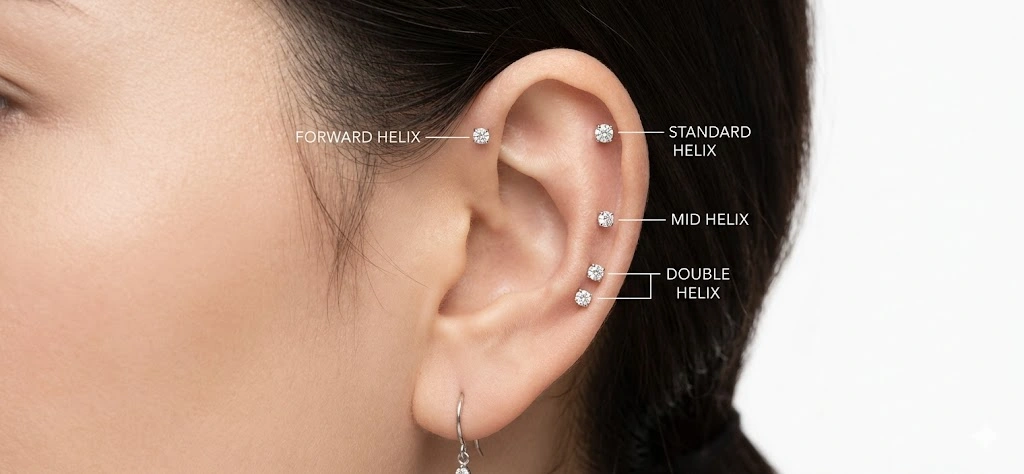
Standard helix: 4/10 | Forward helix: 6/10 | Double helix (same session): 4/10 each, but second feels slightly more | Triple helix: 4/10 with fatigue by the third | For comparison — lobe: 2/10 | These are averages across large sample sizes. Individual experience varies based on anatomy, anxiety level, piercer skill, and preparation.
Why Helix Piercing Pain is Often Overstated
The gap between expected pain and actual pain is wider for helix piercings than almost any other common piercing. There are several reasons for this:
- The “cartilage = extreme pain” myth: Many people assume cartilage piercings must be intensely painful because cartilage is hard and structural. In reality, cartilage has fewer nerve endings per unit volume than soft vascularized tissue like the earlobe. The density of cartilage does create a distinct pressure sensation, but it doesn’t translate to greater pain intensity.
- Anticipatory anxiety amplifies perception: Pain research consistently shows that anxious anticipation measurably increases perceived pain intensity. People who dread a piercing tend to rate it more painful than people who are relaxed — even when the objective stimulus is identical. Managing anxiety before your appointment genuinely reduces how much the piercing hurts.
- Social storytelling exaggerates: People who had painful experiences (often due to poor technique, gun use, or wrong placement) share their stories more loudly than people who sailed through. This creates a biased sample in the stories you hear.
- Professional skill makes an enormous difference: A skilled, experienced APP-certified piercer working with a sharp, correctly sized needle creates a cleaner, faster wound than an inexperienced piercer. The difference in pain experience between an expert piercer and a poor one can be a full 2–3 points on a 10-point scale.
Helix Piercing Pain Level: Honest 1 to 10 Scale
Pain scales in piercing are inherently subjective — no two people experience pain identically, and the same person can have different experiences on different days depending on stress, sleep, hydration, and anxiety. That said, large-scale surveys from piercing communities and professional studios produce consistently convergent data. Here is the most honest, data-informed pain scale for helix piercings available.
Standard Helix: 4 out of 10
A 4 out of 10 means: noticeable, unmistakably present pain that grabs your attention for under a second, followed by a dull ache or throbbing that fades within hours. You would not describe it as “terrible” or “unbearable.” You would describe it as “sharp for a moment, then fine.” Most people at a 4/10 don’t need any pain management beyond ibuprofen if the post-piercing ache bothers them.
What Each Pain Level Actually Feels Like
| Pain Level | What It Feels Like | Helix Context |
|---|---|---|
| 1–2/10 | Barely noticeable; like a light tap | Lobe piercing with a skilled piercer |
| 3/10 | Clear sensation but easy to tolerate; brief | Best-case helix with expert piercer + good prep |
| 4/10 | Sharp, distinct pinch; grabs attention; fades fast | Average standard helix experience |
| 5/10 | Moderate pain; makes you flinch; manageable | Anxious first-timer or slightly thicker cartilage |
| 6/10 | Clearly painful; deep breath needed; lingers briefly | Forward helix average; or gun-pierced helix |
| 7–8/10 | Significant pain; difficult to stay still; noticeable throbbing | Gun on cartilage; or botched placement |
| 9–10/10 | Extreme; hard to endure | Not characteristic of any standard helix technique |
The Two Distinct Moments of Pain
Understanding that helix piercing pain has two distinct phases helps you prepare more accurately:
Helix Piercing Pain Compared to Lobe: How Much More Does It Hurt?
The most common comparison people make when evaluating helix piercing pain is against the lobe piercing — almost everyone has had a lobe piercing, so it serves as a familiar pain reference point. The honest answer: a helix piercing hurts more than a lobe piercing, but the difference is smaller than most people expect.
The Lobe vs Helix Pain Comparison
| Feature | Lobe Piercing | Standard Helix |
|---|---|---|
| Pain rating | 2/10 | 4/10 |
| Tissue type | Soft fatty tissue (richly vascularized) | Elastic cartilage (avascular) |
| Nerve density | Moderate — lobe has good nerve supply | Lower nerve density than lobe per unit area |
| Resistance felt | Minimal — needle passes through easily | Noticeable — cartilage offers firm resistance |
| Sensation quality | Clean, sharp snap | Sharper pinch with distinct pressure/crunch |
| Duration of acute pain | Under 0.5 seconds | Under 1 second |
| Post-piercing ache | Minimal, often absent | Mild, fades within hours |
| Healing pain | Days to weeks | Months (but low-level) |
| Gun safe? | Generally (though needle better) | Never — guns damage cartilage |
Why Lobe Hurts Less — The Biology
The earlobe is made of soft, fatty connective tissue with a dense network of blood vessels. This rich vascularity means the needle moves through with minimal resistance — there’s no firm structure to push through, so the needle completes its path very quickly. The brevity of the needle’s transit time directly correlates with how brief the pain stimulus is.
Cartilage, by contrast, is a dense, semi-rigid structure. The needle must push through this resistance over a slightly longer path, creating a distinctive pressing sensation alongside the sharp pinch. Interestingly, cartilage actually has lower nerve density than the well-vascularized lobe — but the mechanical resistance of the tissue creates a pain quality that feels more intense even if the neural signal isn’t actually stronger.
Helix vs Other Common Piercings — Full Pain Comparison
| Piercing | Pain Level | Tissue Type | Healing |
|---|---|---|---|
| Lobe | 2/10 | Soft tissue | 4–6 weeks |
| Standard Helix | 4/10 | Cartilage | 6–9 months |
| Tragus | 4/10 | Cartilage | 6–12 months |
| Mid / Flat Helix | 4/10 | Cartilage | 6–12 months |
| Nostril (nose) | 4/10 | Soft + cartilage | 4–6 months |
| Forward Helix | 6/10 | Dense cartilage | 9–12 months |
| Conch | 5/10 | Inner cartilage | 9–12 months |
| Rook | 6/10 | Thick inner cartilage fold | 12–18 months |
| Daith | 5/10 | Innermost cartilage fold | 9–12 months |
| Industrial | 6/10 | Two cartilage piercings | 9–12 months |
| Septum | 5/10 | Septum tissue / columella | 6–8 months |
| Nipple | 6/10 | Sensitive soft tissue | 9–12 months |
The standard helix sits comfortably in the middle of the piercing pain spectrum — more than a lobe, less than a rook, industrial, or nipple piercing. For anyone who has had a tragus or nose piercing before, the helix will feel very familiar. For someone whose only reference point is a lobe piercing, the helix will feel noticeably different in character but not dramatically worse in intensity.
Forward Helix Piercing Pain Level: What to Really Expect
The forward helix piercing is consistently the most painful of the standard helix types, averaging 5.5–6.5 out of 10 on pain scales. If you’re comparing it to a standard helix (4/10), the forward helix is a meaningful step up — not unbearable by any measure, but noticeably more intense and longer-lasting in its immediate aftermath. Understanding why it hurts more helps you prepare mentally and physically.
Why the Forward Helix Hurts More Than a Standard Helix
The forward helix sits at the crus of helix — the ridge where the helix cartilage begins at the very front of the ear, close to the temple and side of the head. This specific anatomical location has two characteristics that make it more painful to pierce:
Forward Helix Pain Scale: 6 out of 10
A 6 out of 10 sits in “clearly painful but completely manageable” territory. It’s the kind of pain that makes you inhale sharply, that requires a moment to collect yourself afterward, and that produces a noticeable throbbing ache for a day or two. It is not the kind of pain that makes people regret their decision or feel they can’t handle it. Most people who get forward helix piercings describe it as intense but brief — “worse than I expected but still okay.”
Double Forward Helix: Pain Doubles in a Single Session
Getting two forward helix piercings in the same session is one of the most demanding in-studio pain experiences in standard ear piercing. The first piercing rates at 6/10. By the time the second needle goes through, the ear is already sensitized — nerves are fired up, adrenaline from the first piercing is partly spent, and the tissue around the crus is already inflamed. Most people report the second forward helix in the same session as 6.5–7/10.
This is a strong argument for staging forward helix piercings rather than getting both at once — not just for healing quality (staged piercings heal better) but for the pain experience itself. Getting the second forward helix at a separate appointment, after the first has healed, means experiencing both at their individual 6/10 level rather than the compounded experience of a same-session double.
Overwhelmingly, yes — if you want that front-facing, face-framing aesthetic. The extra pain lasts under 2 seconds in the needle phase and a day or two in the post-ache phase. The piercing itself lasts for life. When you frame it as “2 seconds of 6/10 pain for a permanent aesthetic upgrade,” the calculation becomes easy. Thousands of people get forward helix piercings every week knowing exactly what the pain experience is.
Forward Helix vs Other High-Pain Piercings
| Piercing | Pain vs Forward Helix | Notes |
|---|---|---|
| Lobe | Less painful (2/10) | 4 points lower |
| Standard helix | Less painful (4/10) | 2 points lower |
| Forward helix | — (6/10) | Reference point |
| Rook | Similar (6/10) | Thickest inner cartilage fold |
| Industrial | Similar (6/10) | Two cartilage piercings connected |
| Nipple | Similar to slightly more (6–7/10) | Highly sensitive soft tissue |
| Snug | More painful (7/10) | Anti-helix — very thick cartilage |
How Painful Is a Helix Piercing? All Types Compared
Every helix type has a slightly different pain profile based on where it sits anatomically. Here is a complete, honest pain breakdown for every helix variant — with the reasons behind each rating.
| Helix Type | Pain Score | Key Reason | Post-Ache Duration |
|---|---|---|---|
| Single (standard) helix | 4/10 | Outer rim cartilage — standard density, moderate nerve supply | 2–6 hours |
| Mid helix | 4/10 | Similar anatomy to standard helix — no meaningful difference | 2–6 hours |
| Double helix (same session — 1st) | 4/10 | Same as single | 2–6 hours |
| Double helix (same session — 2nd) | 4.5–5/10 | Ear sensitized by first piercing; adrenaline partly spent | Up to 24 hours |
| Triple helix (3rd in same session) | 5/10 | Compounded sensitization; fatigue from first two piercings | Up to 24 hours |
| Flat helix (scapha) | 4/10 | Similar cartilage density to outer rim | 2–8 hours |
| Hidden helix | 5/10 | Angled needle path through rim fold — slightly more tissue contact | 4–12 hours |
| Forward helix | 6/10 | Thicker crus cartilage + higher nerve density near temple | 24–72 hours |
| Double forward helix (2nd in session) | 6.5–7/10 | Maximum sensitization + densest cartilage pierced twice | 24–72 hours |
These are statistical averages across large populations. Your individual experience can be meaningfully higher or lower based on: your personal pain tolerance, anxiety level on the day, how well-rested and nourished you are, your piercer’s skill level and needle sharpness, and the specific anatomy of your ear. A well-prepared person with an expert piercer can experience a standard helix as low as 2/10. A poorly-prepared first-timer with an inexperienced piercer may rate the same piercing at 6/10. Preparation and piercer quality are within your control — use them.
Helix Piercing: Needle vs Gun — Which Hurts Less?
This comparison has a clear, unambiguous answer: a hollow needle causes significantly less pain than a piercing gun for helix piercings. And beyond just pain, the needle is the only safe option for cartilage — the gun causes physical damage to cartilage tissue that creates serious long-term complications regardless of pain level.
How Each Method Works
Pain Comparison: Needle vs Gun on Helix
| Factor | Hollow Needle | Piercing Gun |
|---|---|---|
| Initial pain (piercing moment) | 4/10 — sharp, brief | 6–7/10 — blunt impact, more intense |
| Sensation quality | Clean pinch + pressure | Dull thud + intense pressure + possible crunch |
| Post-piercing ache | Mild, 2–6 hours | Significant, days to weeks |
| Tissue trauma | Minimal — clean cut | High — blunt displacement, possible cartilage fracture |
| Healing outcome | Clean fistula, predictable healing | Irregular wound, significantly higher complication rate |
| Infection risk | Low with proper aftercare | Significantly higher — guns can’t be fully sterilized |
| Keloid/bump risk | Moderate (normal for cartilage) | High — blunt trauma increases keloid formation risk |
| Safe for cartilage? | ✅ Yes — the only appropriate method | ❌ No — condemned by all professional piercing bodies |
Why Guns Can’t Be Sterilized (And Why This Matters)
Beyond the mechanical damage argument, there is a fundamental sterilization problem with piercing guns. An autoclave — the medical-grade pressurized steam sterilizer that professional piercers use for their equipment — cannot be used on most piercing guns because the plastic components melt at autoclave temperatures. This means guns are cleaned with surface disinfectants at best — which reduces surface bacteria but cannot sterilize the device to the standard required for a tool that penetrates living tissue.
A hollow needle used by a professional piercer is single-use — it comes in a sterile sealed package, is opened in front of you, used once, and immediately disposed of. There is zero cross-contamination risk. Guns, even when cleaned, carry residual biological material from previous clients. For a piercing that passes through body tissue, this is a serious hygiene concern.
No legitimate professional piercing studio will use a gun on cartilage. The Association of Professional Piercers Association of Professional Piercers (APP) , the Piercing Industry (UK equivalent), and every major professional piercing body globally prohibit guns on cartilage. If any studio — including well-known chain stores — offers to use a gun on your helix, politely decline and find an APP-certified professional studio. This is non-negotiable for your safety.
Helix Piercing Steps: What to Expect at Every Stage
One of the most effective ways to reduce piercing pain is to remove the unknown. Anxiety about “what’s about to happen” is a major amplifier of perceived pain — your brain fills uncertainty with worst-case scenarios. Here is a precise, step-by-step account of exactly what happens during a helix piercing at a professional studio, so you know what to expect at every moment.
You’ll complete a consent form and health questionnaire. The piercer will ask about allergies (particularly metal allergies), any medication that affects bleeding or healing, and whether you’ve had complications with piercings or surgeries before. Answer honestly — this information directly affects the recommendations they make. You’ll be asked for ID if you’re near the studio’s age threshold.
Your piercer examines your ear anatomy under good lighting. They assess the helix rim shape, cartilage thickness, and the space available for placement. They’ll discuss your aesthetic goals — single helix, forward helix, planned stack — and make recommendations based on what your specific anatomy can support. This is when you discuss jewelry options. A good piercer will guide you toward appropriate choices for initial healing; you’ll have many more options once healed.
The piercer cleans the area with an antiseptic solution — usually a pre-packaged medical wipe or spray. This removes surface bacteria and skin oils from the area. You’ll feel a slightly cold, wet sensation. The antiseptic may have a mild smell. This is entirely normal and takes just a minute.
Using a skin-safe surgical marker, the piercer marks the exact entry point on the front of the helix. They’ll hold a mirror for you to see the mark and confirm you’re happy with the position. Take your time here — once the needle goes through, placement is fixed. Ask for adjustments if anything doesn’t feel right. Experienced piercers expect this and will not be bothered by minor changes.
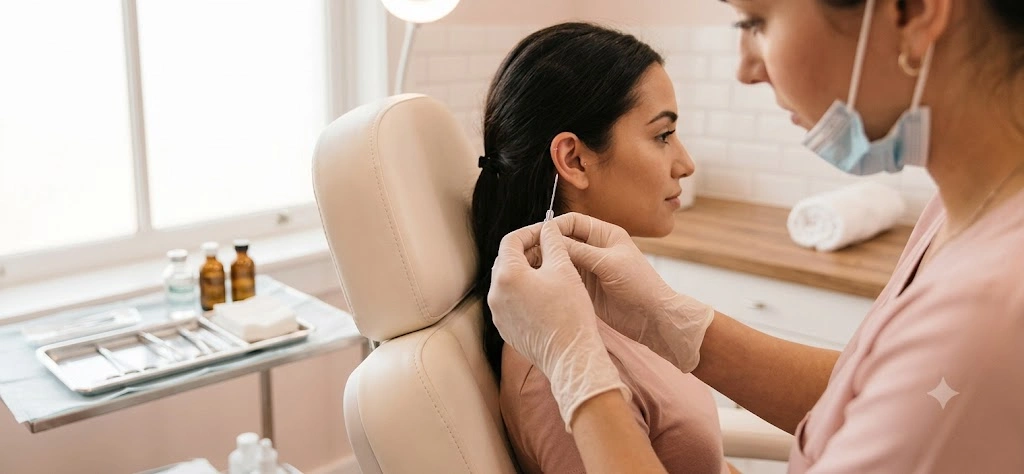
The piercer positions you comfortably — usually seated, sometimes reclined depending on the studio setup. They’ll place a receiving tube, cork, or similar backing behind the helix to protect your ear canal and give the needle something to pass into cleanly. They unwrap the sterile single-use needle from its packaging in front of you.
The piercer will give you a clear cue — usually “take a deep breath in… and exhale slowly.” As you exhale, the needle passes through the cartilage. The entire needle transit takes under one second. What you feel: a sharp, intense pinch with a distinct pressure sensation as the needle moves through the cartilage resistance. Then it’s done. Many people say something to the effect of “is that it?” immediately afterward.
With the needle still in place (it keeps the channel open), the piercer threads the initial jewelry through the same path. This takes longer than the needle and produces a lower but more sustained sensation — a gentle pressure and possibly a feeling of movement through the ear. The jewelry end is then secured (threaded, clicked, or pressed into place depending on the style).
The piercer removes any remaining setup materials, checks that the jewelry is correctly positioned and secure, and wipes the area. You’re shown the result in a mirror. This is when most people break into a grin — the combination of adrenaline, relief, and the sight of the finished piercing produces a genuine rush of satisfaction for most first-timers.
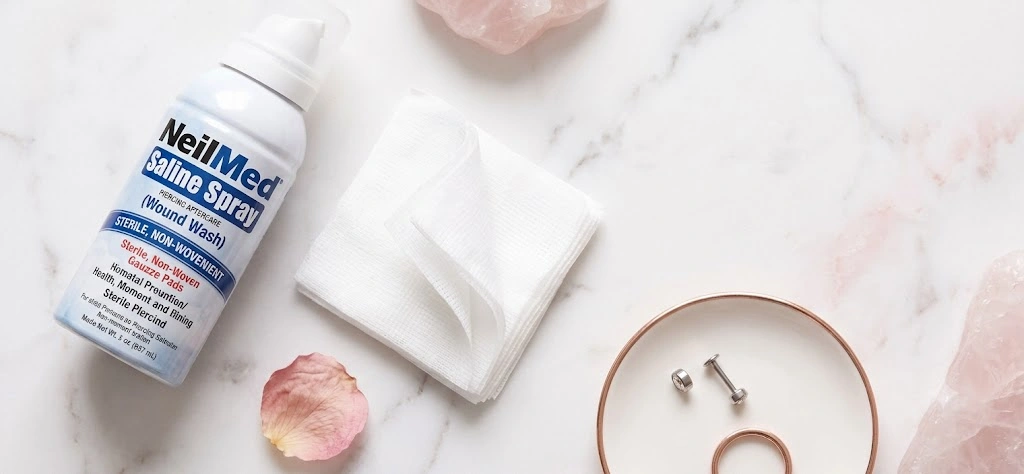
Your piercer goes through the aftercare protocol in detail — what to use, how often, what to avoid, warning signs to watch for. You may receive a written aftercare card. This is arguably the most important part of the entire visit — the quality of your healing is mostly determined by what you do at home over the next 6–12 months. Pay attention, ask questions, and follow the instructions precisely.
A helix piercing appointment at a professional studio typically takes 20–40 minutes total, including consultation, marking, the actual piercing, and aftercare briefing. The needle itself is through in under a second. The rest of the time is preparation, communication, and setup. Block out 45–60 minutes on your calendar to avoid feeling rushed.
How to Reduce Helix Piercing Pain: 10 Proven Tips
While you can’t eliminate the pain of a helix piercing entirely — it’s a needle through cartilage — you have far more control over your pain experience than most people realize. These 10 evidence-based tips can meaningfully reduce how much a helix piercing hurts, both in the moment and in the days that follow.
This is the single most impactful preparation step. Low blood sugar increases pain sensitivity, heightens anxiety, and dramatically raises the risk of feeling faint or dizzy during the procedure. Eat a complete meal — protein, carbohydrates, and fats — 1–2 hours before your appointment. Not a snack. A proper meal.
Dehydration creates body-wide physiological stress — elevated heart rate, reduced blood pressure, heightened cortisol. All of these increase pain sensitivity. Drink adequate water from the morning of your appointment onward.
Caffeine is a vasoconstrictor and a stimulant that raises baseline anxiety and heightens sensory sensitivity. Studies on pain perception consistently find that caffeine-loaded individuals rate pain stimuli higher than matched controls. Skip your morning coffee on piercing day.
A skilled, experienced piercer with a sharp, correctly-sized needle creates a clean, fast wound that minimizes pain. The difference can be 2 full points on a 10-point scale. Choose APP-certified piercers with years of documented cartilage experience.
Controlled breathing is one of the most clinically validated non-pharmacological pain management techniques available. Taking a slow breath in through the nose and exhaling slowly through the mouth as the needle pierces triggers the parasympathetic nervous system — reducing heart rate, muscle tension, and pain sensitivity.
Good piercers have helped hundreds of anxious clients. If you tell them you’re nervous, they’ll give you a clearer explanation of each step, provide a strong countdown so the needle moment isn’t a surprise, and check in with you throughout.
Alcohol thins the blood (anticoagulant effect), which increases bruising and bleeding during and after the procedure — both of which increase pain and extend healing. Many studios will refuse to pierce someone who has been drinking.
Aspirin has a blood-thinning effect that lasts several days — avoid it in the week before piercing. Standard ibuprofen is safe to take after piercing for pain and swelling management. Paracetamol/acetaminophen is safe before and after if you want pre-emptive pain management.
Sleep deprivation measurably reduces pain tolerance — there is significant peer-reviewed research confirming this relationship. A well-rested person experiences the same stimulus as less painful than a sleep-deprived person. Aim for 7–9 hours the night before your appointment.
Distraction is one of the most effective non-pharmacological pain management strategies in clinical settings. Bring a trusted friend to chat with, put your earphones in for the waiting and marking stages, or focus intensely on a specific object in the room. Even minor distraction measurably reduces pain ratings in controlled studies.
Pain After a Helix Piercing: What’s Normal and How Long It Lasts
The pain of the piercing moment is brief — under a second for the needle. But the healing period involves its own pain and discomfort profile that plays out over days, weeks, and months. Here’s exactly what to expect after you leave the studio.
The First 24–48 Hours
Immediately after the piercing, most people experience a warm, pulsing sensation in the ear as blood flows to the area. This is the inflammatory response beginning — entirely normal and expected. For the first few hours, the ear will be noticeably tender and warm. The intensity of post-piercing discomfort varies considerably by person. Ibuprofen (not aspirin — aspirin thins blood) taken as directed is appropriate if the ache is bothering you.
Days 3–14: Settling Soreness
After the first 48 hours, most of the acute post-piercing pain resolves. What remains is a more background tenderness — the piercing is aware of itself rather than actively hurting. You’ll notice it when you accidentally touch it, when pressure is applied (sleeping on it, bumping it), or when cleaning. This is normal and gradually reduces over the first 2–4 weeks.
Ongoing Healing Soreness (Months 1–6)
Throughout the healing period, intermittent mild soreness is completely normal. This typically follows a pattern — quiet periods of comfortable healing followed by brief episodes of renewed tenderness, often triggered by snagging, sleeping on the ear, or accidental trauma.
When Ongoing Pain is a Warning Sign
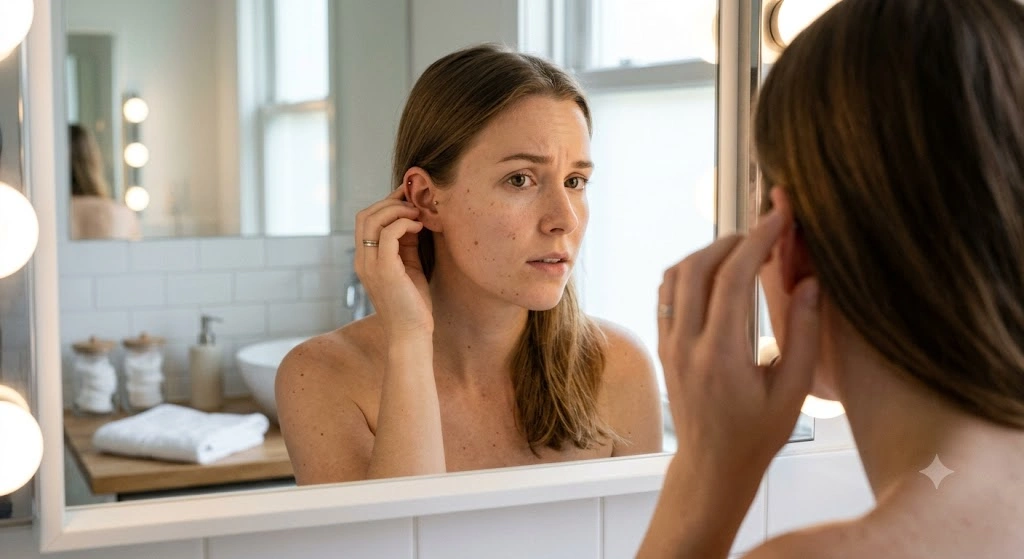
Seek advice from your piercer or a doctor if you experience: Spreading redness — redness expanding beyond the immediate piercing site; Increasing pain — getting worse rather than gradually better; Significant swelling — beyond normal first-week swelling; Hot to touch — warmth spreading beyond the piercing; Yellow-green discharge — thick, colored pus rather than clear/white crust; Fever — systemic infection sign.
Long-Term Soreness: Most Common Causes
If your helix is still notably sore beyond 3–4 months of healing, identify and address the cause rather than simply waiting it out:
- Sleeping on it repeatedly: The #1 cause of prolonged healing soreness. Use a travel pillow.
- Wrong jewelry material: Non-implant-grade metals cause chronic low-level irritation. Switch to ASTM F136 titanium.
- Bar too long: Excess bar length snags on hair and clothing. Get a downsize from your piercer.
- Over-ear headphones: Daily pressure on a healing piercing. Switch to in-ear earphones.
- Hair catching on jewelry: Repeated micro-snagging during the day. Tie hair back.
- Over-cleaning: More than twice daily disrupts healing. Reduce to exactly two daily cleans.
Helix Piercing Pain — Frequently Asked Questions
Ready to Get Pierced?
Read our full piercing guide before booking — make sure your piercer meets every safety standard.
Read the Guide →