FAQ — All TopicsUpdated May 202630 min read · 60 questions
Helix Piercing FAQ — 60 Most Asked Questions
We’ve collected the 60 most searched helix piercing questions and answered every one in detail. Each answer links to the full dedicated guide on that topic. Jump to the section you need:
Basics & Overview
Full guide: What Is a Helix Piercing? →
What exactly is a helix piercing? +
A helix piercing passes through the outer curved cartilage rim at the top of the ear — the structure anatomically called the helix. It is one of the most popular ear piercings globally because it sits in a highly visible, stylish position while remaining professional-environment-friendly. Unlike lobe piercings, helix piercings go through firm cartilage, which means they take 6–12 months to fully heal and require consistent aftercare throughout. The helix rim is long enough to accommodate multiple placements, making it the foundation of most curated ear projects.
Is a helix piercing a cartilage piercing? +
Yes — definitively. The helix is made of elastic cartilage, a firm, flexible connective tissue with almost no direct blood supply. This is the fundamental reason helix piercings take so much longer to heal than lobe piercings (months vs weeks) and why aftercare is more demanding. It also means piercing guns are categorically unsafe on helix piercings — cartilage can fracture under the blunt force of a gun, something soft lobe tissue does not. Always use a hollow needle from a professional APP-certified piercer.
Is a helix piercing good for beginners? +
Yes — the standard helix is one of the most beginner-friendly cartilage piercings available. Pain is manageable (4/10 average), it works on most ear anatomies, and the outer rim position is accessible and well-tolerated. It’s a much better starting cartilage piercing than the rook, daith, or snug — all of which involve thicker, harder-to-access cartilage. For a first cartilage piercing, a standard single helix at the top or mid rim is the ideal entry point.
What is the meaning of a helix ear piercing? +
The word helix comes from ancient Greek meaning a spiral or coil — accurately describing the outer curved rim of the ear. In modern culture, a helix piercing represents personal expression and aesthetic intentionality. It carries no single fixed cultural meaning, though upper ear cartilage piercings have significant ceremonial importance in many South Asian traditions (the Karnavedha rite of passage). Today, most people get a helix piercing purely because it looks beautiful, suits professional environments, and serves as the versatile foundation for a curated ear stack.
Where exactly does a helix piercing go on the ear? +
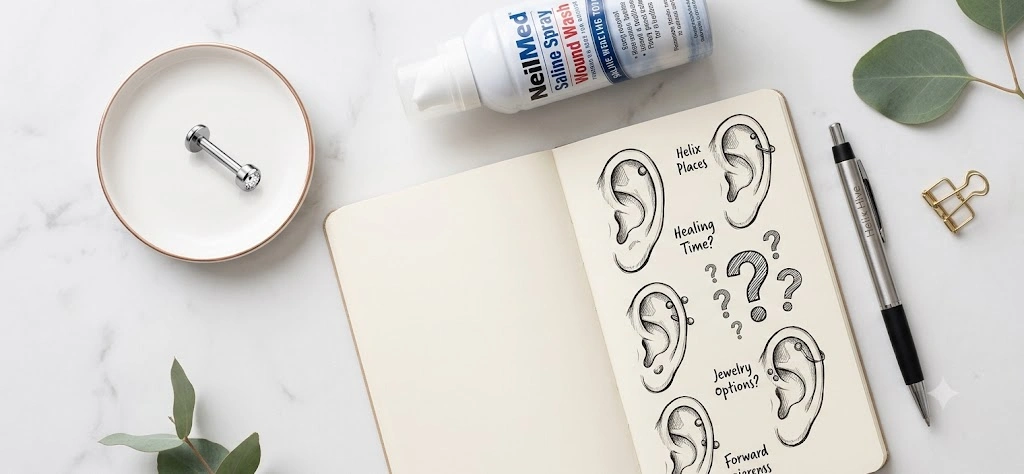
The helix piercing goes through the outer curved rim that runs along the top and back of the upper ear. This rim starts at the crus of helix (where it meets the head near the temple) and curves around the top and down the back. A standard helix typically sits in the upper third of this rim, near the top curve of the ear. The exact position varies based on individual anatomy and aesthetic preference — your piercer will assess your specific ear and mark the placement for your approval before any needle goes through.
How is a helix piercing done? +
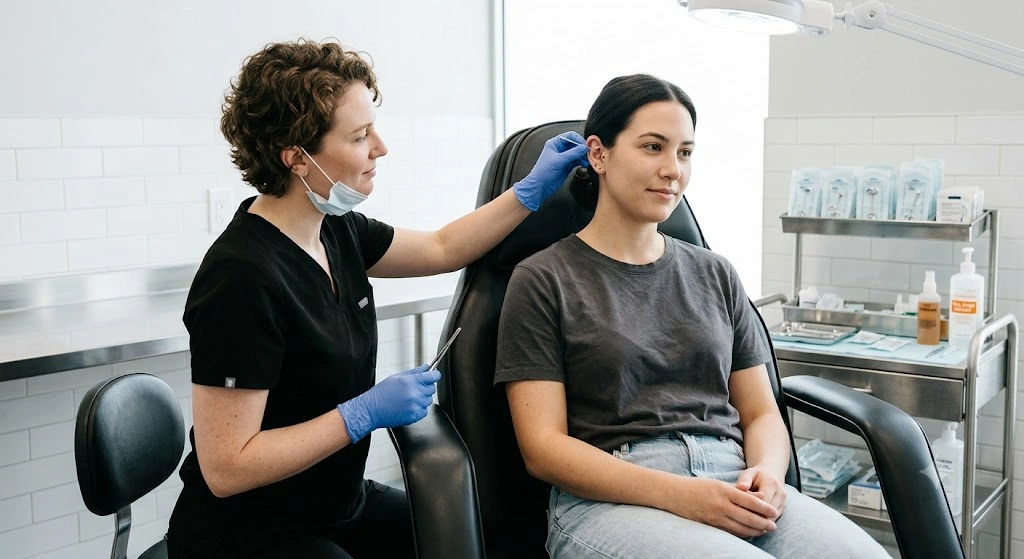
At a professional studio: (1) Consultation — piercer assesses your ear anatomy. (2) Jewelry selection — implant-grade titanium flat-back labret stud chosen. (3) Area cleaned with antiseptic. (4) Placement marked with skin-safe marker — you approve in a mirror. (5) A single-use hollow needle passes through the cartilage in under one second. (6) Jewelry threaded through the channel and secured. (7) Aftercare instructions provided. Total appointment time: 20–40 minutes. The needle transit itself: under one second.
How old do you have to be to get a helix piercing? +
Age requirements vary by country and studio. In the US and UK, most reputable studios require: 18+ for no parental involvement, or 16+ with a parent or legal guardian present and signing consent. Some studios require 18+ regardless. In some countries (e.g., Australia), age laws vary by state. Always bring valid photo ID. If you’re under 16, many studios will decline regardless of parental consent due to concern about cartilage healing compliance in younger children.
Types of Helix Piercings
Full guide: All Helix Piercing Types →
What is the difference between a helix and a forward helix? +
A standard helix sits on the outer curved rim of the upper ear and is most visible from the side. A forward helix sits at the very front of the helix (the crus of helix, near the temple) and faces forward — most visible when someone looks at you face-on. The forward helix is more painful (6/10 vs 4/10) because the cartilage at the crus is thicker and has more nearby nerve endings. It also takes longer to heal (9–12 months vs 6–9 months). Aesthetically, a forward helix is ideal for front-facing visibility; a standard helix is better for side-profile looks.
What is a double helix piercing? +
Two helix piercings stacked vertically on the same section of the outer cartilage rim, typically spaced 7–10mm apart. One of the most popular curated ear configurations. Can be done at once (one session) or staged (each piercing added after the previous has fully healed — recommended for easier healing). After full healing, the double helix can be styled with matching studs, graduated sizes, or a stud-and-hoop combination for variety.
Should I get all three helix piercings at once? +
For a triple helix, most experienced APP piercers strongly recommend staging rather than getting all three simultaneously. Three simultaneous cartilage wounds create a high healing burden — more inflammation, higher complication risk, and a longer overall healing period. The recommended approach: get the middle piercing first, heal it fully (6–9 months), then add the lower, then the upper. Yes, it takes 18–24 months total. The healing outcomes are dramatically better and the finished result is worth the patience.
What is a flat helix piercing? +
A flat helix (also called a scapha piercing) passes through the flat area of cartilage just inside the helix rim, rather than through the rim itself. This broader surface area accommodates larger, more elaborate decorative jewelry ends — gem clusters, large opals, ornate flat-top designs — that would look oversized on the narrow rim. It requires specific ear anatomy (a broad enough scapha) and heals in 9–12 months. Hoops don’t work geometrically for flat helix piercings — flat-back studs are always the jewelry of choice.
What is the hidden helix piercing trend 2026? +
The hidden helix is placed in the folded crease of the helix rim so that the jewelry tucks partially underneath, creating a subtle sparkle visible only from certain angles. It’s one of the top rising piercing trends of 2025–2026 — appealing to people who want a discreet, intimate aesthetic rather than an obvious statement piece. It requires a pronounced rim fold (specific anatomy), rates 5/10 in pain, heals in 9–12 months, and needs extra care cleaning the fold area. Not all ears have suitable anatomy — a piercer can assess this in under a minute.
What is a curated ear and how does the helix fit in? +
A curated ear is a planned, intentional arrangement of multiple piercings across the entire ear that work together as a unified aesthetic composition. The helix almost always features prominently — it provides height at the top of the ear, and the variety of helix types (forward, mid, upper, double, hidden) means multiple distinct helix placements can form the visual backbone of the whole composition. A professional APP piercer can help you map the entire curated ear project before the first needle, accounting for anatomy, spacing, healing order, and jewelry coordination.
Pain & Procedure
Full guide: Helix Piercing Pain Guide →
Does a helix piercing hurt? +
Yes, but significantly less than most people expect. The needle moment — which is the worst part — lasts under one second and rates 4/10 on average. It’s a sharp pinch with a distinct pressure sensation as the needle passes through cartilage resistance. The area then throbs mildly for a few hours. The overwhelming majority of first-timers say it was “way less than I built it up to be.” The most effective pain reduction preparation: eat a full meal 1–2 hours before, stay hydrated, avoid caffeine, and choose a skilled APP-certified piercer.
How painful is a helix piercing on a scale of 1 to 10? +
Standard helix: 4/10. Forward helix: 6/10. Double helix (same session, second piercing): 4.5–5/10. These are consistent averages across large community samples. Individual experience varies based on anxiety level, preparation, piercer skill, and personal pain tolerance. A well-prepared person with an expert piercer may experience a standard helix as 2–3/10. An anxious, underprepared first-timer with an inexperienced piercer may rate it 5–6/10.
Does a helix piercing hurt more than a lobe piercing? +
Yes — a helix rates about 4/10 vs a lobe’s 2/10. Numerically that’s double, but in practice the experience is more about the character of the sensation than the intensity. A lobe piercing is a clean, fast snap through soft tissue. A helix has a distinct crunching pressure alongside the pinch because the needle moves through dense cartilage. Most people who’ve had both describe the helix as noticeably different in quality rather than dramatically worse in intensity.
How painful is a forward helix? +
The forward helix averages 6/10 — about 2 full points higher than a standard helix. The crus of helix has thicker cartilage and higher nerve density than the outer rim, producing a more pronounced and longer-lasting pain response. Post-piercing throbbing can last 24–72 hours rather than the few hours typical of a standard helix. Still completely manageable for most people — but go in with accurate expectations rather than the standard helix benchmark.
Should I take painkillers before a helix piercing? +
Avoid aspirin (blood thinner — affects clotting for days). Ibuprofen is safe to take after for pain and swelling management. Paracetamol/acetaminophen is safe before and after. However, the most effective “pain reduction preparation” doesn’t involve any medication — it involves eating a full meal 1–2 hours before, staying hydrated, sleeping well the night before, avoiding caffeine, and managing anxiety by knowing exactly what to expect.
Does a helix hurt more with a needle or gun? +
A needle causes significantly less pain than a gun — and a gun should never be used on cartilage at all. A hollow needle creates a clean, precise cut in under a second (4/10). A piercing gun uses blunt force that crushes and displaces cartilage tissue, producing a duller, more traumatic impact (6–7/10) that also causes far more damage to the cartilage structure. Beyond the pain difference, gun-pierced helixes have dramatically higher infection rates, higher bump formation rates, and significantly worse healing outcomes.
What does a helix piercing feel like step by step? +
Step by step: (1) Antiseptic wipe — cold, slightly clinical sensation. (2) Marker placement — light pressure as the spot is marked. (3) Receiving tube positioned behind ear. (4) Deep breath in… exhale. Needle through — sharp intense pinch with pressing/crunching feel. Under 1 second. (5) Jewelry insertion — 10–30 seconds of lower-level pressure and movement sensation. (6) Securing the end — click or thread tightening. (7) Immediate aftermath — warm pulsing heat spreading through the ear. Throbbing for a few hours. Most common reaction: “Oh, is that it?”
Healing Timeline
Full guide: Helix Healing & Aftercare Guide →
How long does a helix piercing take to heal? +
A helix piercing takes 6 to 12 months to fully heal internally. The surface skin heals earlier (2–4 months) in what piercers call the “false heal” phase — where the piercing looks and feels healed but the internal cartilage fistula is still fragile. Changing jewelry during the false heal phase is the most common cause of late-stage complications. Forward helix, flat helix, and hidden helix piercings tend toward the longer end (9–12 months). Factors that speed healing: implant-grade titanium jewelry, consistent twice-daily saline aftercare, no sleeping on the piercing, and no snagging.
What are the helix piercing healing stages week by week? +
Days 1–3: Swelling, redness, warmth, tenderness, clear/white lymph discharge — all normal inflammatory response. Weeks 1–2: Swelling reducing, crust forming daily, occasional throbbing. Months 1–3: Crust settles into predictable pattern, tenderness only when disturbed, background healing. Months 3–6: False heal — looks healed, feels fine — but DO NOT change jewelry. Months 6–9: Deep fistula strengthening, most people genuinely symptom-free. Months 9–12: Full internal healing — jewelry change now safe with piercer confirmation.
What does a fully healed helix piercing look like? +
Five signs of full healing — all must be consistently present for 4–6 consecutive weeks: (1) Zero tenderness even when the jewelry is gently pressed; (2) No crust or discharge whatsoever; (3) Jewelry glides completely freely with zero resistance; (4) Skin around the holes looks completely normal — no redness, no raised tissue; (5) All of the above stable for at least a month with no fluctuations.
My helix won’t heal after a year — what’s wrong? +
Prolonged healing always has a cause. The most common culprits: (1) Wrong jewelry material — switch to ASTM F136 implant-grade titanium; (2) Bar too long — get a downsize from your piercer; (3) Chronic sleeping on the piercing — strict travel pillow use; (4) Jewelry was changed too early — treat as if it’s a new piercing; (5) Over-ear headphones daily — switch to in-ear; (6) Hair snagging on jewelry; (7) Nickel allergy — allergy testing and switch to nickel-free titanium. See an APP-certified piercer for an in-person assessment — they can identify the specific cause in one appointment.
What is the false heal in helix piercing healing? +
The false heal occurs around months 2–4 when the surface skin closes and the piercing looks and feels completely healed — but the internal cartilage fistula is still fragile and immature. Many people change their jewelry during this phase thinking they’re healed, causing internal micro-tears, bacterial introduction, and healing setbacks that appear as a sudden “reactivation” of symptoms months after the piercing. Prevention: never change jewelry before 6 months minimum, regardless of how healed it looks or feels at the surface.
Aftercare & Daily Care
Full guide: Complete Aftercare Routine →
What is the best aftercare routine for a helix piercing? +
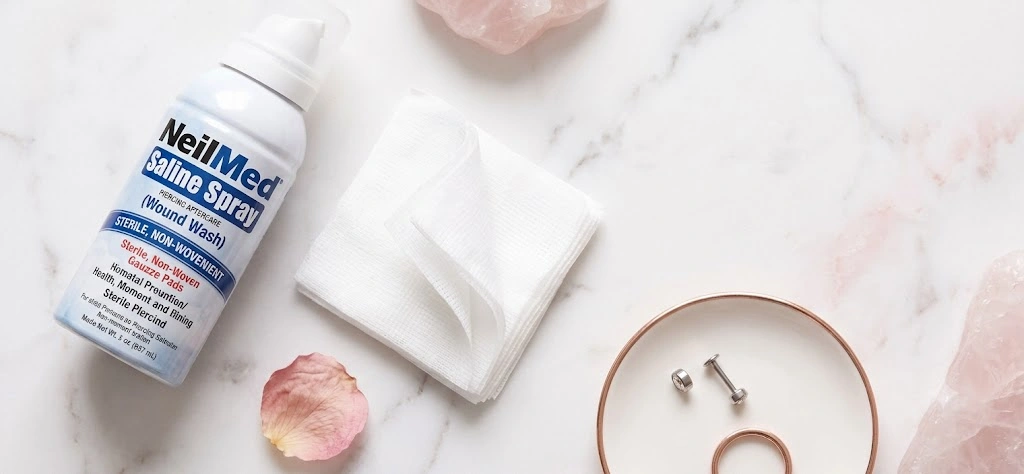
The APP-recommended routine: (1) Wash hands thoroughly before any contact. (2) Spray sterile 0.9% saline (NeilMed Wound Wash) on both front and back of the piercing. (3) Let soak 20–30 seconds to soften any crust. (4) Gently pat dry with non-woven gauze or paper towel — never cloth. (5) Repeat exactly twice daily — morning and evening. That’s it. No antiseptics, no twisting, no over-cleaning. The most common aftercare mistake is doing too much — using extra products, cleaning more than twice daily, or rotating the jewelry. Less is more.
How do I clean a helix piercing with saline? +
Use sterile 0.9% saline wound wash — NeilMed Wound Wash is the most recommended brand. Hold the nozzle 2–3cm from the piercing and spray a burst onto the front and back. Let it sit for 20–30 seconds. Gently dab with non-woven gauze (never cotton wool — it leaves fibres). Pat completely dry. Do not rub, do not pick crust off dry, and do not use cotton buds. Never use contact lens saline (contains preservatives), hydrogen peroxide, alcohol, tea tree oil, Dettol, or any antiseptic product.
Is white crust on my helix normal? +
Yes — completely normal. White or off-white crust is dried lymph fluid — your body’s natural wound-response fluid that weeps from the piercing during healing and oxidizes into a chalky crust when it dries. It is not pus, not infection, and not a sign of bad aftercare. Infection discharge is thick, yellow-green, opaque, often smells unpleasant, and comes in increasing amounts — clearly different from the small amount of white crust you see with normal healing. Soften crust with saline before removing. Never pick it off dry.
Can I sleep on my helix piercing? +
Not during active healing. Sleeping on the piercing causes pressure trauma to the jewelry, movement within the forming fistula, and bacterial transfer from the pillowcase — all of which delay healing and cause irritation bumps. Solutions: use a travel/donut neck pillow (creates a gap for your ear), sleep on the opposite side, or train yourself to sleep on your back. Critical period: first 3–6 months.
Can I swim with a new helix piercing? +
Pools: wait 3–4 months minimum (chlorine irritates healing tissue). Sea/ocean: wait 3–6 months (bacteria, wave trauma). Fresh water (lakes, rivers): wait 6 months (high bacterial load). Hot tubs: wait until fully healed — 9–12 months (warm standing water = highest infection risk). Showers: safe immediately. If you must swim before the recommended wait time: cover with Tegaderm waterproof film dressing, keep exposure brief, rinse immediately with clean water and saline afterward, and dry thoroughly.
What should I absolutely NOT do during helix healing? +
The definitive don’t list: ❌ Rotate or twist the jewelry — ever. ❌ Touch with unwashed hands. ❌ Use hydrogen peroxide, alcohol, Dettol, tea tree oil, Neosporin, or any antiseptic. ❌ Use cotton wool or cotton buds. ❌ Change jewelry before 6 months minimum. ❌ Wear over-ear headphones. ❌ Sleep on the piercing side. ❌ Let hairspray, dry shampoo, or makeup near the piercing. ❌ Swim in pools, sea, or hot tubs too early. ❌ Over-clean (more than twice daily). ❌ Pick crust off dry.
Jewelry Questions
Full guide: Helix Jewelry & Cost Guide →
Should I get a hoop or stud for my helix? +
During healing: stud, always — specifically a flat-back labret stud in implant-grade titanium. Hoops rotate and swing with every head movement during healing, dragging through the forming fistula and causing micro-tears, irritation bumps, and delayed healing. After full healing (9–12 months): both are equally valid — the choice becomes purely aesthetic. Many people wear a stud daily and switch to a hoop for special occasions.
What gauge is a helix piercing — 16g or 18g? +
Most professional helix piercings are done at 16 gauge (1.2mm) — the APP standard for cartilage piercings. Some studios pierce at 18g (1.0mm), particularly in Asian markets and some European studios. If you don’t know your gauge, ask your original piercer or have it measured at an APP studio. Never buy replacement jewelry without confirming your gauge — forcing a larger gauge jewelry through a smaller gauge fistula causes tissue damage.
What is implant-grade titanium and why use it? +
ASTM F136 implant-grade titanium is the medical standard for body jewelry — the same titanium used in orthopedic and dental implants. It is completely biocompatible (doesn’t react with tissue), contains zero nickel, is very lightweight (minimizing jewelry movement during healing), doesn’t corrode or leach compounds, and can be anodized to various colors without any compromise to safety. It’s the safest healing jewelry material for most piercees and the first choice of virtually every APP-certified professional piercer for initial helix jewelry.
When can I change my helix jewelry? +
Minimum 6 months — and only when all five healing signs are consistently present for 4–6 weeks: zero tenderness when pressed, no discharge/crust, jewelry moves completely freely, skin looks completely normal, all signs stable for over a month. Have your first change done by your piercer — not at home. They confirm healing visually and change the jewelry without unnecessary trauma.
Is surgical steel safe for a helix piercing? +
316L surgical steel — the most commonly used “surgical steel” in fashion jewelry — contains 12–14% nickel and does not meet any implant-grade body jewelry standard. It is not recommended for healing piercings. For guaranteed safety, particularly if nickel sensitivity is possible, implant-grade titanium (ASTM F136) with zero nickel is always the superior choice.
Can I wear a ring in my helix while healing? +
No — not during the healing period. Hoops, rings, seamless rings, and clicker rings are all inappropriate for healing helix piercings. They all share the same problem: constant rotation through the fistula channel with every head movement, hair touch, or positional change. This continuous micro-movement prevents the fistula from forming stable tissue and dramatically increases healing complications. Start with a flat-back labret stud, heal fully (9–12 months), then switch to a ring with your piercer’s confirmation.
Cost Questions
Full guide: Helix Piercing Cost 2026 →
How much does a helix piercing cost in 2026? +
US prices in 2026: budget studios $25–$40; mid-range studios $50–$80; high-end APP studios $80–$150+. UK: £20–£130+ depending on level. Australia: AUD $35–$200+. These prices typically include both the procedure and initial jewelry. The quality difference between price points is significant — budget studios often use low-grade jewelry and less thorough technique, while premium studios use verified implant-grade pieces from trusted brands.
Does the helix piercing cost include jewelry? +
Yes, at most studios the quoted price includes both the procedure fee and initial jewelry. However, the jewelry quality varies enormously — budget studios include unknown-grade jewelry while premium studios include verified implant-grade titanium or solid gold from brands like Anatometal or NeoMetal. A studio that charges $80 but includes $30 implant-grade titanium jewelry is often better value than a studio charging $40 with $5 mystery-metal jewelry that causes complications requiring extra treatment.
Is it worth paying more for a professional studio? +
Almost universally yes. The financial logic: the cost difference between a budget studio and a quality APP studio is typically $30–$50. A single complication — a keloid requiring dermatology treatment, an infection requiring antibiotics, or a botched placement requiring retirement and re-piercing — costs more than that difference in money plus months of additional healing time. The best value in helix piercing is the studio most likely to produce a complication-free result the first time.
What extra costs should I budget for beyond the initial piercing? +
Full year-one budget: Initial piercing ($50–$150 at quality studio) + Aftercare saline ($50–$100 for the year) + Downsize appointment at 6–8 weeks ($15–$30 if not included) + First jewelry change by piercer ($10–$25) + Replacement/upgrade jewelry once healed ($20–$200+ depending on style/metal). Total realistic year-one cost at a quality studio: $145–$505 in the US.
Bumps, Keloids & Problems
Full guide: Helix Problems & Infections Guide →
Why do I have a bump on my helix piercing? +
Almost certainly an irritation bump — the most common helix complication, affecting a significant proportion of piercees at some point during healing. It forms when repeated mechanical stress (sleeping on the piercing, snagging, wrong jewelry material, bar too long) disrupts the forming fistula faster than it repairs. It is not a keloid (which grows beyond the wound site and is hard/rubbery) and not an infection (which produces yellow-green pus with spreading redness). Treatment: identify and eliminate the cause, return to strict saline aftercare, switch to implant-grade titanium if not already, get a downsize from your piercer. Resolves in 4–10 weeks with correct care.
Is my helix bump a keloid? +
Almost certainly not — 90–95% of helix bumps are irritation bumps, not keloids. A true keloid: grows beyond the wound boundaries into surrounding healthy skin; is very firm or rubbery; is often darker than surrounding skin; develops over months or years (not days or weeks); and requires medical treatment (steroid injections, laser, surgery). An irritation bump: stays within the piercing site; is soft; is skin-toned or pink-red; appears within days to weeks of a trigger; and resolves fully with correct aftercare in 4–10 weeks.
Why is my helix still sore after months? +
Persistent soreness months into healing has a specific, fixable cause in almost every case. The six most common: (1) Sleeping on the piercing. Fix: travel pillow. (2) Bar too long. Fix: downsize from piercer. (3) Wrong jewelry material. Fix: switch to ASTM F136 titanium. (4) Over-ear headphones. Fix: switch to in-ear earphones. (5) Hair snagging. (6) Low-grade ongoing infection. Identify your cause from the pattern of soreness.
My helix is bleeding — is that serious? +
A small amount of bleeding immediately after piercing is normal. Minor bleeding after an accidental snag or trauma during healing is also normal — apply clean gauze pressure for 5–10 minutes until it stops, rinse with saline, and treat as a healing setback with enhanced aftercare for 2 weeks. If bleeding won’t stop after 15–20 minutes of sustained pressure, or is recurring without clear cause, see a piercer or doctor.
Infections & Warning Signs
Full guide: Infection Signs & Treatment →
Is my helix infected or still healing? +
The key differentiator is the direction of change. Normal healing improves gradually over time with consistent aftercare. Infection worsens over time even with aftercare. Normal healing signs: white/clear crust (dried lymph fluid), mild localized pink, occasional tenderness when touched — all gradually improving. Infection signs: yellow-green thick pus, spreading redness beyond the piercing site, increasing tenderness and swelling, warmth extending outward, possible fever — worsening or staying the same despite aftercare.
How do I treat a mildly infected helix at home? +
Home treatment is appropriate only for mild localized infections — slight redness confined to the piercing, small amount of yellowish discharge, mild tenderness, no fever, no spreading. Steps: (1) Wash hands thoroughly. (2) Strict twice-daily sterile saline cleaning — NeilMed Wound Wash. (3) Stop all antiseptic products immediately. (4) Warm saline compress during cleans. (5) Eliminate all irritants. (6) Monitor for improvement within 48–72 hours. If no improvement or any worsening — see a doctor that day. Never remove jewelry during an infection.
Should I remove my jewelry if my helix is infected? +
Never remove jewelry during an active infection unless specifically directed by a doctor. Removing the jewelry causes the skin holes to begin closing within hours, trapping the infection — and all bacteria — inside sealed tissue with no drainage route. The result is an abscess: a pocket of sealed infection that requires surgical incision and drainage. Keep the jewelry in, maintain saline cleaning, and see a doctor if the infection is beyond mild and localized.
What are the signs of a serious helix infection requiring a doctor? +
Go to a doctor urgently if you see any of: spreading redness extending 1cm+ beyond the piercing site; significant increasing swelling; green, grey, or dark yellow thick pus with an unpleasant smell; skin hot to the touch beyond the immediate area; fever (temperature above 38°C / 100.4°F); feeling systemically unwell; swollen lymph nodes near the ear. These signs may indicate perichondritis — infection of the cartilage’s surrounding tissue layer — which progresses rapidly, can permanently deform the ear, and requires IV antibiotics in severe cases. Do not wait.
Lifestyle & Practical Questions
Can I wear over-ear headphones with a helix piercing? +
Not during the healing period. Over-ear headphones apply sustained pressure directly to the helix area for hours — creating cumulative mechanical trauma that delays healing and causes irritation bumps. This is one of the most underappreciated causes of prolonged helix healing in working-age piercees who use headphones at desks, during commutes, or for gaming. Switch completely to in-ear earphones for the entire healing period (6–12 months).
Can I get an MRI with a helix piercing? +
Implant-grade titanium jewelry (ASTM F136) is non-magnetic and generally MRI-safe — it will not be pulled by the MRI magnet. However, always inform your radiologist and MRI team about all jewelry before the scan. They will assess based on the specific jewelry material and the MRI field strength. If the jewelry material is uncertain or is steel-based, the team may request removal. Never assume MRI safety without informing the team.
Can I do sports or exercise with a new helix? +
Low-impact exercise is fine immediately. High-impact or contact sports require care. Avoid: contact sports where the ear might be hit or grabbed; activities that involve wearing a helmet or ear protection that presses on the helix; any sport that involves heavy sweating around the ear. Avoid submerging in water (pools, open water) for the first 3–6 months. Always tie hair back during exercise to prevent snagging.
Can I dye my hair with a new helix piercing? +
Wait at least 4–6 weeks before dyeing hair, and take precautions even then. Hair dye chemicals (developer, ammonia, peroxide) are significant irritants to healing piercing tissue. Protect the piercing during dyeing: apply a thick barrier of petroleum jelly around the jewelry to prevent chemical contact, keep dye away from the ear area as much as possible, rinse the ear thoroughly with clean water immediately after removing the dye, then clean with saline.
Can I get a helix piercing while pregnant? +
Most piercing professionals and medical advisors recommend avoiding new piercings during pregnancy. Reasons include: altered immune function during pregnancy can slow wound healing and increase infection susceptibility; hormonal changes affect tissue sensitivity; any infection during pregnancy carries risks beyond those in a non-pregnant state; and the healing period overlaps with postpartum recovery. If you already have a helix piercing before becoming pregnant, it can typically remain in place throughout pregnancy.
Should I get my helix pierced at Claire’s or a professional studio? +
Always choose a professional APP-certified studio for a helix piercing. Claire’s (and similar chains) uses piercing guns on cartilage — which is condemned by every professional piercing body globally. Guns damage cartilage tissue, cannot be fully sterilized, use inferior jewelry, and produce statistically worse healing outcomes with higher complication rates. A professional studio uses a hollow needle, implant-grade jewelry, an autoclave for sterilization, and experienced piercers who know cartilage anatomy. The cost difference is typically $20–$50 — a trivial amount versus the risk of complications that cost far more to resolve.