Helix Piercing Jewelry & Cost
Every jewelry type, implant-grade titanium explained, hoop vs stud, 18g vs 16g gauge sizes, when to change safely, and full 2026 cost breakdown — everything in one place.

Helix Piercing Jewelry & Cost: The Complete 2026 Guide
Jump to a section:
Why Helix Piercing Jewelry Matters More Than You Think
Of all the variables that affect how well a helix piercing heals, jewelry quality and jewelry choice rank right alongside aftercare consistency in terms of impact. Many people understand that cleaning matters — but underestimate how profoundly the metal their jewelry is made from, the style of jewelry they choose, and the fit of that jewelry affects everything from daily comfort to long-term healing outcomes.
The reasoning is biological. A healing helix piercing is an open wound channel through avascular cartilage. The jewelry sits inside that wound for 6–12 months of active healing. During this entire period, every cell involved in building the new fistula tissue is in direct, constant contact with the jewelry surface. If that surface is leaching irritant compounds (as low-quality metals do), the healing cells are continuously disrupted. If the jewelry style creates constant movement (as hoops do during healing), the forming fistula tissue is repeatedly micro-torn. If the jewelry is the wrong gauge or length, it creates mechanical pressure and snagging that the cartilage cannot easily recover from.
Conversely, the right jewelry — correct material, correct style, correct size — creates the most favorable possible environment for healing. It sits still, it doesn’t leach irritants, it doesn’t snag, and it gives the cartilage fistula the undisturbed conditions it needs to build properly over its long healing timeline.
For a healing helix piercing: implant-grade titanium (ASTM F136) flat-back labret stud, correct gauge, correct length. Every other jewelry decision — style, color, decorative end, hoop vs stud — becomes relevant only after the piercing is fully healed at 9–12 months. During healing, function and material quality are everything.
Helix Piercing Jewelry Types: Complete Overview
The helix rim accommodates a wider range of jewelry styles than almost any other ear piercing — from the most minimalist single stud to elaborate decorative pieces and multiple stacking hoops. Understanding each jewelry type, how it works, and when it’s appropriate helps you make the right choices at every stage of your piercing journey.
1. Flat-Back Labret Stud
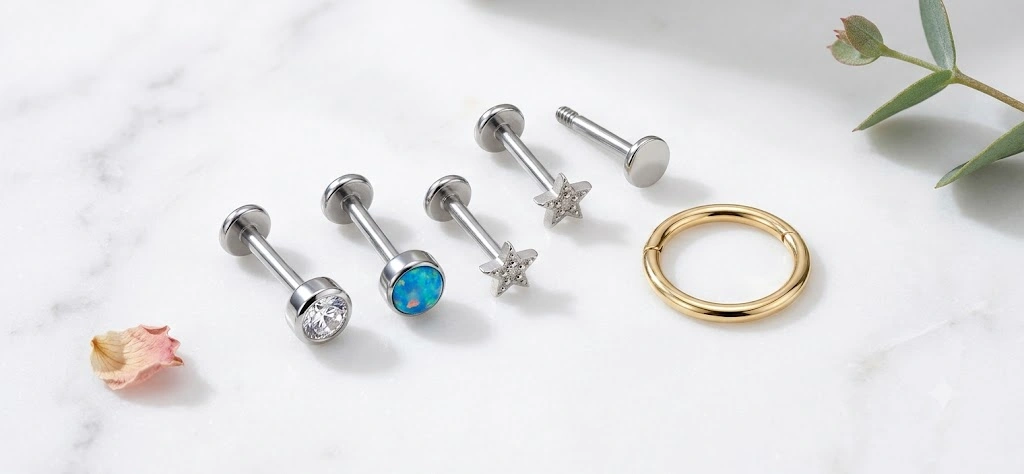
The flat-back labret stud is the gold standard for helix piercing jewelry — both for initial healing and as a long-term choice for many piercees. It consists of three components: a flat disc back (the “labret” end, which sits flat against the inside of the helix rim), a threaded or threadless post (the bar), and a decorative end piece that attaches at the front.
Why it’s the best healing jewelry: The flat back creates zero pressure on the inside of the helix rim — it sits completely flush and flat, with nothing to snag, no curved surface to rotate, no movement under normal conditions. The post is rigid and straight, creating a stable wound channel. The decorative end screws or presses onto the front, away from the healing tissue.
Styles of decorative ends available: Round beads, flat discs, prong-set gems, bezel-set gems, opal cabochons, stars, hearts, floral clusters, multi-gem arrangements, bar shapes — essentially unlimited variety, all attaching to the same flat-back post system. This means you can change the look of your helix completely by just swapping the decorative end, without needing to remove or change the post itself (once healed).
Threading systems: Labret studs come in two threading systems — internally threaded (the thread is inside the post, the decorative end has a small post that screws in) and threadless/push-fit (the decorative end has a bent pin that presses into the hollow post under tension). Threadless systems are increasingly preferred by professional piercers because they have no exposed thread on the post itself — reducing the risk of thread catching on tissue during insertion or removal.
2. Seamless Hoop / Continuous Ring
A seamless hoop is a single continuous ring of metal with a small gap that is gently opened to insert and closed to secure. The gap is pushed back together so the ring appears completely seamless. Seamless hoops are one of the most popular helix jewelry choices after healing — they create a clean, minimalist look that works on almost every ear and pairs beautifully with other jewelry.
When appropriate: Only after full healing (9–12 months minimum). During healing, hoops rotate and swing with every head movement, hair touch, or sleep position — creating continuous micro-trauma to the fistula channel. The snag risk from a hoop’s open gap is also significantly higher than a labret stud.
Sizing matters enormously for hoops: The diameter of the hoop must match the diameter of your helix rim at the piercing point. Too small and the hoop presses into the skin on the back of the rim; too large and it hangs and swings rather than sitting close to the ear. A professional piercer can measure and recommend the correct diameter for your anatomy.
3. Clicker Ring / Hinged Ring
A clicker ring has a hinged segment that clicks securely into a notch — opening and closing with a satisfying click. This mechanism makes them much easier to insert and remove than seamless hoops (which require tools or practice to open cleanly) and more secure than segment rings. Clicker rings are particularly popular for forward helix and flat helix piercings where the visible face of the ring can feature decorative elements (gems, opal segments, ornate designs).
When appropriate: After full healing. The hinged mechanism creates a small seam which, while secure, has more surface complexity than a seamless ring — fine for healed piercings, not ideal for healing ones.
4. Segment Ring
Similar to a seamless ring but with a removable segment — a section of the ring that physically detaches to allow insertion. The segment fits back into place with snapping pressure. Segment rings give a completely uninterrupted circular appearance when closed and are available in a wide range of diameters and gauges. They require more dexterity to insert than clickers but look cleaner when fitted correctly.
When appropriate: After full healing. The segment removal process requires some handling of the jewelry in ways that are inappropriate for healing piercings.
5. Captive Bead Ring (CBR)
A circular ring with a small gap that is held closed by a captive bead — a ball or gem that is held under pressure in the gap. The traditional piercing ring style. CBRs require ring-opening pliers to insert and close correctly — doing it by hand risks warping the ring or inadequately seating the bead. They are less popular for helix piercings than seamless hoops and clickers in 2026 because of the handling requirement and the slightly more visible bead gap.
When appropriate: After full healing, and ideally with a piercer helping with insertion and removal until you’re comfortable with the technique.
6. Circular Barbell / Horseshoe
A horseshoe-shaped bar with a bead or ball screwed onto each open end. Not commonly chosen for helix piercings aesthetically (the U-shape protrudes significantly from the ear rim), but occasionally used. More common in industrial piercings and other cartilage placements.
7. Curved Barbell / Banana Bell
A curved post with screw-on ends. Rarely used for standard helix piercings but occasionally chosen for specific placement types. Not recommended for healing helix piercings — curved posts create slight angular pressure inside the fistula channel.
Jewelry Type Comparison Table
| Jewelry Type | Healing? | Healed? | Snag Risk | Visibility |
|---|---|---|---|---|
| Flat-back labret stud | ✅ Best | ✅ Excellent | Very low | Decorative end visible from front |
| Seamless hoop | ❌ No | ✅ Excellent | Low when fitted | Full ring visible — classic look |
| Clicker ring | ❌ No | ✅ Excellent | Low | Full ring + decorative front |
| Segment ring | ❌ No | ✅ Good | Low | Clean full ring |
| Captive bead ring | ❌ No | ⚠️ OK | Moderate | Ring with visible bead |
| Circular barbell | ❌ No | ⚠️ Situational | Moderate | U-shape protrudes |
Helix Piercing: Hoop or Stud — Which Is Better for Healing?
This is one of the most frequently asked helix jewelry questions — and the answer is unambiguous for the healing phase, and more nuanced for after healing. Let’s cover both stages in full.
During Healing: Stud, Always
A flat-back labret stud is categorically better than a hoop for a healing helix piercing. This is not a matter of aesthetic preference — it’s a matter of biology and wound mechanics. Here’s why:
The consequences of getting pierced with a hoop or switching to a hoop too early are predictable and consistent: delayed healing, increased irritation bump formation, chronic soreness, and significantly higher infection risk. The statistical evidence from professional piercing community surveys is overwhelming — piercees who use flat-back studs during healing have far better outcomes than those who use hoops.
Some studios — particularly chain stores and budget studios — pierce helix piercings with a small seamless hoop as the initial jewelry. This is not best practice. It’s done because hoops require no threading (faster for the piercer) and are cheaper than quality labret studs. If you were pierced with a hoop, visit an APP-certified professional piercer to have it changed to a correctly sized flat-back labret stud in implant-grade titanium as soon as possible. Your healing will improve measurably.
After Healing: The Choice Opens Up Beautifully
After full healing (9–12 months), you have complete freedom to wear either studs or hoops — and the choice becomes purely aesthetic. Many helix piercees keep a flat-back stud as their day-to-day jewelry (low maintenance, professional-friendly, minimal movement) and switch to a hoop for evenings, events, or when they want a different look. Others transition fully to hoops as their permanent jewelry once healed.
Choosing the Right Hoop for a Healed Helix
Hoop diameter is the most critical measurement for a healed helix piercing. The correct diameter creates a ring that sits close to the ear rim without pressing into the back of the cartilage or swinging away from the ear. Getting the diameter right requires knowing the distance from the center of the piercing hole to the back edge of the helix rim — this varies per individual anatomy. The typical helix hoop size range is 6mm–10mm diameter, with 8mm being the most common. Your piercer can measure your specific anatomy and recommend the correct size before you commit to a purchase.
| Hoop Diameter | Typical Use | Appearance |
|---|---|---|
| 6mm | Very close to rim, tight fit helix | Snug, minimal protrusion — almost flush |
| 8mm | Most common helix hoop size | Close-fitting, elegant, natural look |
| 10mm | Wider helix rims or layered look | Slightly more visible drop from the rim |
| 12mm+ | Statement/layered aesthetics | Clear hoop swing — very visible |
Implant-Grade Titanium Helix Jewelry: The Complete Explanation
If there is one piece of knowledge about helix jewelry material that matters above all others, it is this: implant-grade titanium (ASTM F136) is the best material for healing helix piercings, and understanding why helps you make confident, well-informed jewelry decisions for the life of your piercing.
What Is ASTM F136 Implant-Grade Titanium?
ASTM F136 is a specific metallurgical standard for titanium alloy used in medical and surgical implants. The designation comes from ASTM International — one of the world’s largest standards organizations — and specifies the exact chemical composition, mechanical properties, and purity requirements that the titanium must meet to qualify.
The ASTM F136 titanium alloy composition is: 90% titanium, 6% aluminum, 4% vanadium (Ti-6Al-4V ELI). The “ELI” designation stands for Extra Low Interstitials — referring to the extremely tight control over trace impurity levels (oxygen, nitrogen, carbon, hydrogen) that could affect biocompatibility. This is literally the same grade of titanium used in orthopedic implants, dental implants, and surgical bone screws.
Why Implant-Grade Titanium Is the Best Healing Jewelry Material
How to Identify Genuine Implant-Grade Titanium
The body jewelry market has significant quality variation — including sellers who market low-grade titanium or titanium-coated steel as “implant-grade” or “surgical titanium.” Here is how to identify genuine ASTM F136 titanium:
- Look for the ASTM F136 designation specifically — not just “titanium,” “surgical titanium,” or “titanium alloy.” The standard number matters.
- Buy from APP-approved vendors. The Association of Professional Piercers maintains a list of approved material suppliers. Brands stocked by APP members — Anatometal, BVLA, NeoMetal, Gorilla Glass, Intrinsic — are reliably implant-grade.
- Price is a rough indicator. Genuine ASTM F136 titanium labret studs (without gemstone ends) retail from approximately $15–$40 from reputable suppliers. Jewelry marketed as “titanium” for $3–$8 is extremely unlikely to be genuine implant-grade.
- Ask your piercer. A professional APP-certified piercer sources their jewelry from verified implant-grade suppliers. If they use something for initial piercing jewelry, you can trust the material quality.
- Genuine titanium is non-magnetic. A basic magnet test — if the jewelry is attracted to a magnet it’s not titanium — is a rough screening tool, though not definitive (some non-implant-grade materials are also non-magnetic).
Implant-Grade Titanium vs “Surgical Steel” vs Regular Titanium
| Material | Standard | Nickel? | Safe for Healing? |
|---|---|---|---|
| Implant-grade titanium | ASTM F136 | None | ✅ Best choice |
| “Surgical titanium” (unspecified) | Variable / unverified | Possible trace | ⚠️ Unverified |
| Implant-grade steel | ASTM F138 | Trace (2–3%) | ✅ Good (avoid if nickel-sensitive) |
| “Surgical steel” (316L) | Not a body jewelry standard | 12–14% | ⚠️ Not recommended |
| Regular stainless steel | None | Significant | ❌ Avoid |
All Helix Jewelry Materials Ranked — Best to Worst
Beyond implant-grade titanium, there are several other materials that range from excellent to actively harmful for helix piercings. Here is a complete ranking with full explanations for each.
⭐⭐⭐⭐⭐ Tier 1: Best Choices
Implant-Grade Titanium (ASTM F136) — Covered in full above. The best healing choice for the vast majority of piercees. Biocompatible, nickel-free, lightweight, colorable, durable. The first choice of almost every APP-certified professional piercer for initial jewelry.
Solid 14k or 18k Gold — The second gold-standard option (literally and figuratively). Solid gold is completely biocompatible, hypoallergenic at 14k and above (lower karats contain more reactive alloy metals), and has been used safely in body piercings for decades. The beautiful warm tone of yellow, white, or rose gold makes it the most popular choice for healed helix jewelry — particularly for curated ear aesthetics where a cohesive metallic look is desired across multiple piercings.
Important distinctions: Solid gold (the entire piece is gold alloy) is safe. Gold-filled (a thick layer of gold bonded to a base metal) is acceptable but not ideal for healing piercings. Gold-plated (a thin plating of gold over base metal) is not appropriate for healing piercings — the plating wears off, exposing the reactive base metal.
Karat guide: 14k (58.3% gold) is the minimum karat recommended for healing piercings. 18k (75% gold) is even more biocompatible. 9k (37.5% gold) contains too much reactive alloy metal for healing piercings and should be avoided during healing.
⭐⭐⭐⭐ Tier 2: Good Choices with Caveats
Implant-Grade Steel (ASTM F138) — Medical-grade steel to the ASTM F138 standard. Excellent biocompatibility, highly durable, and completely appropriate for healing piercings — with one caveat: it does contain trace amounts of nickel (approximately 2–3%) as part of its alloy composition. For the 85–90% of people without nickel sensitivity, this is not a problem. For those with documented nickel allergies or sensitivities, even this small amount can cause chronic irritation. Choose titanium if there’s any uncertainty about nickel sensitivity.
Niobium — A lesser-known but excellent option. Pure niobium is completely nickel-free, highly biocompatible, and can be anodized to various colors just like titanium. It is heavier than titanium (denser metal) and cannot achieve the same range of polished finishes. Niobium is an excellent choice for people who want a nickel-free alternative to titanium with color options, and for those who prefer a slightly heavier jewelry feel.
⭐⭐ Tier 3: Acceptable Only After Full Healing
316L “Surgical” Steel — Commonly marketed as safe for piercings, 316L surgical steel is actually not a body jewelry standard (it’s a general engineering steel grade). It contains 12–14% nickel by weight — a significant amount that can cause reactions in nickel-sensitive individuals and even mild ongoing irritation in others during the vulnerable healing period. It’s acceptable for fully healed piercings in non-nickel-sensitive individuals, but should not be used for healing piercings or by anyone with nickel sensitivity.
⭐ Tier 4: Avoid
Silver — Sterling silver (92.5% silver, 7.5% copper alloy) tarnishes when exposed to moisture, skin oils, and oxygen — which is unavoidable in a body piercing. Tarnished silver releases silver sulfide compounds that cause the piercing channel to turn grey/black (a phenomenon called argyria at the tissue level). It is also soft and can deform over time inside the fistula. Avoid for healing piercings; use cautiously if at all in healed piercings.
Gold-Plated / Gold-Filled Jewelry — The plating wears off over time (sometimes quickly, depending on plating thickness), exposing whatever base metal lies beneath — often brass, copper, or nickel-containing alloys. During the 6–12 month healing period, even a quality plating is likely to degrade. Not appropriate for healing piercings.
Brass / Copper — Both oxidize readily in moisture, releasing copper oxide compounds that cause green staining, irritation, and potential allergic reactions. Not appropriate for any piercing jewelry.
❌ Tier 5: Never Use
Acrylic / Plastic / BioFlex — Porous materials that trap bacteria and cannot be sterilized to the standard required for jewelry in a wound channel. Acrylic also leaches chemical compounds that are irritating to healing tissue. Despite being marketed as “flexible” and “comfortable,” acrylic is completely inappropriate for any healing piercing.
Mystery metals / Fashion jewelry — Jewelry from fast fashion retailers, costume jewelry suppliers, or unverified online sources with no material specification. May contain any number of reactive metals, coatings, and surface treatments that are entirely unsuitable for body piercings. Never use unverified jewelry in any piercing, healing or healed.
Helix Piercing Gauge Size: 18g vs 16g — Everything Explained
Gauge refers to the thickness of the jewelry post — the bar that passes through the piercing channel. In body jewelry, the gauge system works inversely: a higher gauge number means a thinner post. This counterintuitive system trips up many first-time jewelry buyers. Understanding gauge is essential for buying replacement jewelry that fits correctly.
The Gauge System Explained
| Gauge | Diameter in mm | Diameter in inches | Common Use |
|---|---|---|---|
| 20g | 0.8mm | 0.032″ | Nose piercings, very fine earrings |
| 18g | 1.0mm | 0.040″ | Helix, tragus, lobe (some studios) |
| 16g | 1.2mm | 0.047″ | Helix, conch, cartilage (most common professional) |
| 14g | 1.6mm | 0.062″ | Navel, industrial, stretched lobes |
| 12g | 2.0mm | 0.079″ | Stretched cartilage, gauged ears |
What Gauge Are Most Helix Piercings?
The majority of professional helix piercings in the UK, US, Australia, and most of Europe are pierced at 16 gauge (1.2mm). This is the APP-recommended standard gauge for cartilage piercings because it:
- Creates a fistula channel large enough to accommodate a range of decorative end sizes
- Is substantial enough to hold the jewelry stable without excessive flexibility
- Provides good surface area contact for secure threading of decorative ends
- Is widely available in all quality jewelry brands and styles
Some studios — particularly those in Asia and some European markets — pierce at 18 gauge (1.0mm), which creates a finer, more delicate piercing that suits smaller, more minimalist jewelry styles. Both 16g and 18g are completely appropriate for helix piercings — what matters is knowing which gauge your piercing was done at so you can buy matching replacement jewelry.
18g vs 16g: Which Is Better?
| Factor | 18g (1.0mm) | 16g (1.2mm) |
|---|---|---|
| Post thickness | Thinner (1.0mm) | Slightly thicker (1.2mm) |
| Jewelry availability | Good — widely available | Excellent — the most common standard |
| Decorative end options | Good — particularly fine/delicate styles | Excellent — widest range of styles |
| Healing | No difference with correct material | No difference with correct material |
| Aesthetic feel | More delicate, finer look | Slightly more substantial presence |
| Can I go from 18g to 16g? | No — this is upsizing (going to a thicker post). Requires stretching. Never force a larger gauge jewelry into a smaller gauge fistula. | |
| Can I go from 16g to 18g? | Technically yes (smaller into larger), but the 18g post will be slightly loose in a 16g fistula and may not sit as stably. Not recommended. | |
How to Find Out What Gauge Your Piercing Is
If you weren’t told your gauge at the time of piercing, the most reliable way to find out is to:
- Ask your original piercer — they will have a record or can identify it from their standard practice.
- Use a gauge card or calliper — physical tools for measuring post diameter. Available cheaply from online jewelry suppliers.
- Take a piece of your current jewelry to a professional piercer — they can identify the gauge immediately by visual inspection or measurement.
Do not guess. Buying a 16g replacement for an 18g piercing and attempting to force it through is a painful mistake that can damage the fistula tissue and set healing back significantly.
Bar Length: The Other Critical Measurement
Beyond gauge, the length of the labret post matters enormously. The correct bar length for a healing helix is long enough that the flat back and decorative end are not pressing into swollen tissue, but not so long that excess post protrudes and creates a snagging hazard. Typical healing bar lengths are 8mm–10mm. Once initial swelling resolves (around 6–8 weeks), many piercees get a “downsize” to 6mm–8mm. Measurements are taken from the inner face of the flat back to the threading point at the decorative end.
Best Helix Piercing Studs in Titanium: What to Look For in 2026
The market for implant-grade titanium helix jewelry has grown significantly in 2024–2026, with more options at more price points than ever before. Navigating it requires knowing what quality markers to look for, which brands are reliably trustworthy, and which styles suit different healing stages and aesthetics.
What to Look for in a Quality Titanium Helix Stud
The most important criterion. The seller or brand should be able to confirm the material meets ASTM F136 specification — not just claim “titanium.” Reputable brands list this in their product descriptions and can provide material certification on request.
Threadless (push-pin) systems — where the decorative end has a bent post that presses into the hollow labret shaft — are the current professional standard. They have no exposed threads on the post that could snag tissue, and the tension-fit mechanism is secure without requiring screwing. Internally threaded systems (where the thread is inside the post) are also safe. Externally threaded posts (thread on the outside of the bar) should be avoided — the thread can drag through the fistula during changes.
If the decorative end contains a gem, the gem itself should also meet body-safe standards. Genuine faceted gems (CZ, sapphire, diamond) set in implant-grade prongs are safe. Synthetic opal (Lab Opal — the standard in quality body jewelry) is safe. Glass gems and acrylic gems are not appropriate for healing piercings. The setting should hold the gem securely with no sharp edges that could snag tissue.
The surface finish of the titanium should be either mirror-polished (highly reflective, smooth) or anodized to a stable color. Brushed or matte finishes on titanium are also fine for healed piercings but slightly more porous than mirror polish — stick to mirror-polished for healing piercings. Never accept painted or powder-coated finishes on body jewelry — these are not biocompatible surface treatments.
Correct gauge (16g or 18g matching your piercing) and correct bar length (typically 6mm for healed piercings, 8–10mm for healing). Decorative end diameter should suit your helix rim width — 3mm to 5mm ends suit most helix piercings; larger ends may overpower the narrow rim.
Trusted Brands for Implant-Grade Titanium Helix Studs
| Brand | Price Range | Known For | Where to Buy |
|---|---|---|---|
| Anatometal | $30–$150+ | Highest quality implant-grade; handcrafted; gem options | Through APP piercers only |
| BVLA (Body Vision Los Angeles) | $50–$500+ | Luxury solid gold and titanium; ornate designs | Through APP piercers |
| NeoMetal | $20–$80 | Threadless system pioneers; excellent titanium range | Piercing studios; website |
| Industrial Strength | $25–$100 | Wide titanium range; reliable quality | Piercing studios |
| Titanium by Design (TBD) | $15–$60 | Quality at accessible price; good anodized color range | Online; some studios |
| Implant Grade (various studios) | $20–$70 | Studio-curated implant-grade pieces | APP studios directly |
Popular Decorative End Styles for Helix Studs (2026)
Once you have your implant-grade titanium flat-back post, the decorative end is where personal style comes in. The most popular styles in 2026:
- Bezel-set CZ or genuine gem: A single round or oval stone set in a clean bezel — the most timeless and universally flattering helix style. Works in titanium or gold; available in white, rose gold, and yellow gold settings.
- Prong-set solitaire: A classic four or six prong setting holding a round CZ, diamond, or colored gem. Maximizes light reflection and creates a sparkle-forward look.
- Lab opal cabochon: Synthetic opals in body jewelry are striking — they display a distinctive color-play that shifts with light and angle. Highly popular for 2026 aesthetic piercing looks.
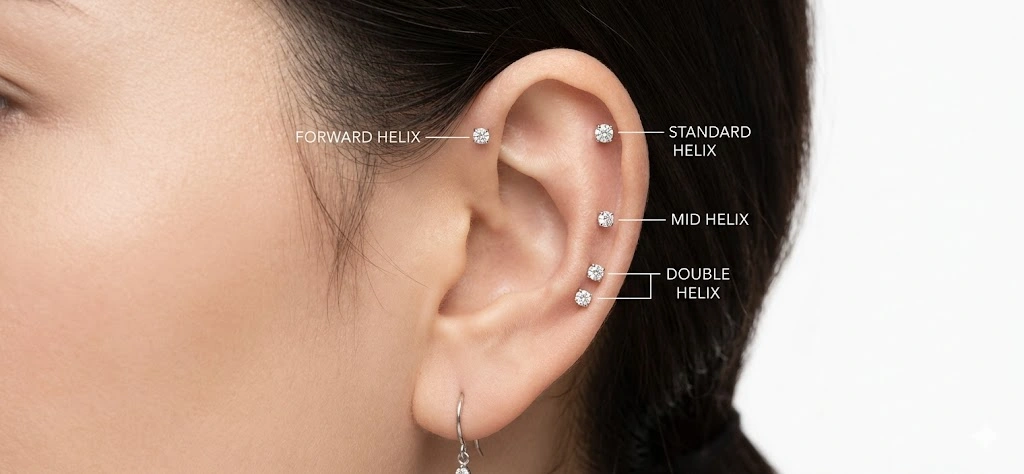
- Multi-gem cluster: Three to seven small gems arranged in a floral or geometric cluster. Creates more surface area and visual impact than a solitaire. Particularly popular for flat helix and forward helix piercings.
- Flat titanium disc: A simple, clean flat disc in mirror-polished or anodized titanium. Architectural, minimalist, and modern. Works beautifully in stacks where you want one understated piece among more decorative ones.
- Star or moon shape: Shaped decorative ends in titanium — stars, moons, hearts, tiny leaves — for a whimsical, personal aesthetic.
When to Change Helix Piercing Jewelry: Complete Safe Guide
The jewelry change question is one of the most important — and most frequently rushed — decisions in helix piercing. Getting this timing right is the difference between a smooth transition to your chosen permanent jewelry and a painful setback that can take months to recover from. Here is a comprehensive guide to knowing when you’re ready and doing it safely.
The Minimum Timeline: 6 Months
The absolute minimum wait before changing helix jewelry is 6 months — and only if all five healing signs are clearly and consistently present. The 6-month mark is the earliest possible point at which a helix fistula is mature enough to tolerate a jewelry change without significant risk of disruption. Many helix piercings take 9–12 months to reach this stage, particularly forward helix piercings, flat helix piercings, and any helix pierced with less-than-ideal initial jewelry.
The Five Signs You’re Ready to Change
A fully healed helix should feel no different from any other part of your ear when pressure is applied to the jewelry or surrounding tissue. Not just comfortable at rest — genuinely non-tender with deliberate gentle pressure. Any discomfort means internal healing is still ongoing.
Zero production of any white crust or fluid, consistently, for over a month. A few days of no crust followed by a return of crust means the piercing is still actively healing. True readiness is stable, sustained, complete absence of discharge.
When you very gently rotate or move the jewelry (one test — not a habit), it glides with zero resistance, zero sticking, and zero sensation. Any drag, sticking, or slight feeling of pulling means the fistula is not fully matured.
No redness, no raised tissue, no discoloration around the entry or exit points. The piercing holes should look like neat, clean, settled openings with no visible difference from surrounding ear skin.
All four signs above must be true simultaneously and consistently for at least one month. Healing piercings go through good phases — the test is sustained stability, not a temporary quiet period.
How to Change Helix Jewelry Safely (After Full Healing)
First change: always have your piercer do it. Even when you’re confident you’re healed, the first jewelry change should be done by your original piercer or another APP-certified professional. They confirm healing status visually, change the jewelry cleanly using proper tools, and advise on the correct replacement jewelry for your anatomy.
Subsequent changes at home (once comfortable):
20+ seconds with soap and water. No exceptions.
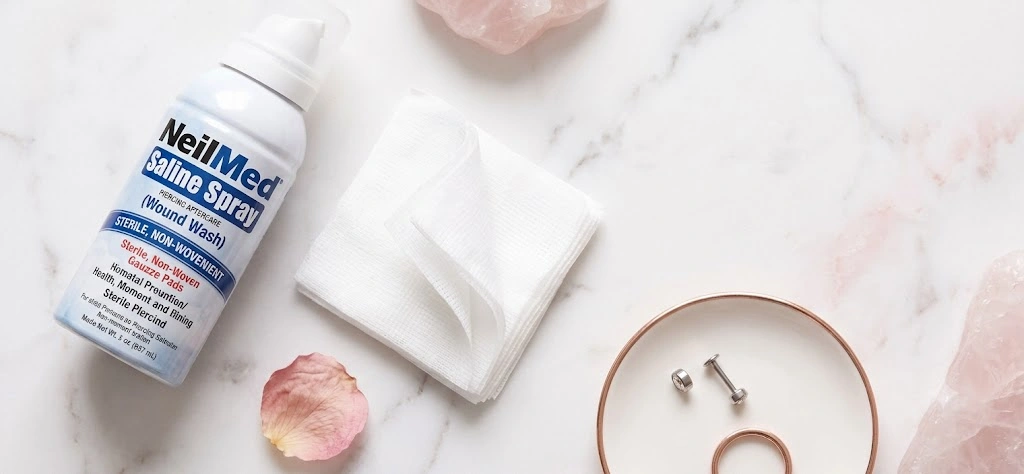
Spray sterile saline on the front and back, pat dry with gauze. Starting with a clean wound reduces infection risk during the change.
The new jewelry should be sterile. Soak in sterile saline for 60 seconds before use. Have it within reach before you start removing the existing piece.
For a flat-back labret, hold the flat back disc steady with a finger behind the ear and unscrew or pull the decorative end from the front. Work slowly and deliberately — rushing causes fumbling and dropped jewelry.
Don’t leave the hole without jewelry for more than a few minutes — even a healed fistula begins to contract quickly. Insert the new post through the front of the piercing, reach behind to receive it, and secure the back.
Rinse the freshly changed piercing with sterile saline and pat dry. Some light fluid production in the 24 hours after a jewelry change is normal — the fistula has been disturbed by the passage of new jewelry.
If jewelry doesn’t insert smoothly and easily, stop. Forcing jewelry through a fistula causes tissue tearing, pain, and potential infection. If you’re struggling with a change, see your piercer. Possible causes: wrong gauge jewelry (different from your piercing gauge), slight closure of the fistula if jewelry was removed for too long, or the piercing isn’t as fully healed as it appeared.
How Much Does a Helix Piercing Cost in 2026?
The cost of a helix piercing varies significantly based on your location, the studio type, the piercer’s experience level, and the jewelry you choose. Understanding the full cost breakdown — studio fee, jewelry cost, and ongoing costs — helps you budget accurately and avoid the false economy of choosing the cheapest option available.
Average Helix Piercing Cost in 2026 — By Region
| Region | Budget Studio | Mid-Range Studio | High-End / APP Studio |
|---|---|---|---|
| United States | $25–$40 | $50–$80 | $80–$150+ |
| United Kingdom | £20–£35 | £40–£70 | £70–£130+ |
| Australia | AUD $35–$60 | AUD $65–$110 | AUD $110–$200+ |
| Canada | CAD $30–$50 | CAD $55–$90 | CAD $90–$160+ |
| Europe (major cities) | €25–€45 | €50–€80 | €80–€150+ |
Helix Piercing Cost With Jewelry Included — What You Actually Pay
The price you see quoted at most studios includes both the piercing procedure fee and the initial jewelry. However, the jewelry included at different price points varies dramatically in quality — and this is where the real cost difference lies.
What’s Included in the Helix Piercing Cost?
| Cost Component | Budget | Mid-Range | High-End |
|---|---|---|---|
| Piercing procedure | ✅ | ✅ | ✅ |
| Initial jewelry | ✅ (low quality) | ✅ (good quality) | ✅ (premium quality) |
| Consultation / anatomy assessment | ❌ Minimal | ⚠️ Brief | ✅ Full |
| Aftercare instructions | ⚠️ Basic / verbal | ✅ Written | ✅ Detailed written |
| Follow-up / check-in | ❌ | ⚠️ Sometimes | ✅ Typically included |
| Downsize appointment | Charged extra | Often included | Usually included |
Additional Costs to Budget For
- Aftercare supplies: NeilMed Wound Wash or equivalent sterile saline — $8–$15 per bottle, typically lasting 4–6 weeks. Budget $50–$100 for the full healing year.
- Downsize appointment: If not included — typically $15–$30 at most studios. Strongly recommended at 6–8 weeks.
- First jewelry change (by piercer): Most studios charge $10–$25 for a professional jewelry change. Worth every cent for your first change.
- Replacement/upgrade jewelry: Quality implant-grade titanium studs: $15–$80. Solid gold pieces: $40–$200+. Hoops for healed piercings: $20–$80 titanium, $60–$250+ gold.
- Multiple piercings: Double helix at the same appointment — many studios offer a small discount (10–20%) for multiple piercings in one session.
Is It Worth Paying More for a Better Studio?
Almost universally, yes. The financial argument is straightforward: the cost difference between a budget studio ($30) and a quality APP studio ($80) is $50. A single complication from poor technique, gun use, or bad initial jewelry — a keloid requiring dermatology treatment, an infection requiring a GP visit and antibiotics, or a placement error requiring a retirement and re-pierce — costs significantly more than that difference in both money and months of healing time. The best value in helix piercing is not the cheapest upfront price — it’s the studio most likely to produce a complication-free result the first time.
Choosing a studio to save $20 that uses a gun or low-grade jewelry is, statistically, more likely to result in $50–$200 in complication treatment costs, multiple aftercare product purchases, the emotional cost of months of healing difficulties, and potentially a worse final aesthetic result. Spend the money on the right studio once. It is almost always cheaper in total than the alternative.
Helix Piercing Jewelry & Cost — Frequently Asked Questions
Ready to Get Pierced?
Read our full piercing guide before booking — make sure your piercer meets every safety standard.
Read the Guide →