Helix Piercing Problems & Infections
Bumps, keloids, infections, prolonged healing, bleeding, and soreness — identify exactly what’s wrong and learn step-by-step how to fix it.

Helix Piercing Problems & Infections: The Complete Guide
Jump to a section:
Helix Piercing Problems: What You Need to Know First
Helix piercings are one of the most popular ear piercings in the world — and also one of the most likely to develop complications during the healing period. This isn’t because helix piercings are inherently dangerous. It’s because the cartilage healing process is slow, demanding, and sensitive to disruption in ways that lobe piercing healing simply isn’t. A lobe piercing can tolerate fairly casual aftercare and still heal fine. A helix piercing does not offer that forgiveness.
The good news: the vast majority of helix piercing problems are either preventable or fully treatable. Most complications — bumps, mild infections, prolonged healing, soreness — resolve completely with the right intervention. Understanding what’s happening, why it’s happening, and what to do about it is the entire purpose of this guide.
Irritation bump: Most common. Small bump at piercing site from trauma or wrong jewelry. Treatable at home. | Keloid: Rare. Hard overgrowth beyond piercing site. Needs a doctor. | Mild infection: Common. Yellowish discharge, localized redness. Treatable with aftercare improvement. | Severe infection: Uncommon but serious. Spreading redness, pus, fever. Needs antibiotics. | Prolonged healing / won’t heal: Usually jewelry or aftercare issue. Fixable. | Sore after months: Almost always a mechanical cause. Identifiable and fixable. | Bleeding: Usually from trauma. Manageable; when to worry covered below.
Why Helix Piercings Are More Complication-Prone Than Lobe Piercings
The cartilage of the helix rim is avascular — it has almost no direct blood supply. Healing happens through slow nutrient diffusion from surrounding fluid rather than through the rapid blood-delivered repair response that heals soft tissue. This has several practical implications:
- Any disruption has a larger proportional impact. One bad night sleeping on your helix can set healing back by weeks — equivalent disruption to a lobe would be absorbed without significant consequence.
- Immune response is slower and less robust at the site. Bacteria that land on a healing lobe are quickly challenged by immune cells delivered via blood. At a helix piercing, that challenge is slower — giving bacteria more opportunity to establish.
- Recovery from complications is slower. An irritation bump on a lobe might resolve in a week with improved care. The same bump on a helix cartilage piercing can take 4–10 weeks to fully resolve even with perfect aftercare.
- False healing is common. The surface heals well before the interior cartilage fistula is mature — creating a window where jewelry changes or continued trauma cause deep complications despite surface appearances.
Before self-diagnosing and self-treating, visit your original piercer or an APP-certified piercer for an assessment. Professional piercers see these complications every week — they can identify what’s wrong, assess jewelry fit, and recommend specific steps far more accurately than any online guide. Most problems are much easier to resolve when caught and assessed early.
Helix Piercing Bump: Causes, Treatment & Prevention
A bump appearing near a helix piercing is the single most common complication reported by helix piercees worldwide. It looks alarming — a raised, sometimes reddish lump right at the piercing site — but in the overwhelming majority of cases it is a completely benign irritation bump (also called a piercing bump or hypertrophic scar), not an infection and not a keloid. Understanding what it actually is helps enormously with both treatment and peace of mind. you can more find out about helix piercing bumps in this guide Helix Piercing Bump.
What Is a Helix Piercing Bump?
An irritation bump is a localized buildup of tissue at or directly around the piercing entry or exit point. It forms when the healing piercing is subjected to repeated mechanical stress — pressure, movement, snagging — that disrupts the forming fistula tissue faster than it can repair. The body responds by producing excess collagen in the area, creating a small, raised lump. This is a protective response, not a pathological one.
Irritation bumps are typically:
- Small — 2–5mm in diameter
- Skin-colored, pale pink, or slightly reddish
- Located directly at the jewelry entry or exit point (on the side experiencing trauma)
- Soft to the touch and movable
- Painless or mildly tender when pressed
- Sometimes containing a small amount of clear or white fluid (lymph)
- Appearing within days to weeks of the traumatic trigger
What Causes Helix Piercing Bumps?
Every irritation bump has a cause — and identifying that cause is the most important step toward resolving it. The most common triggers:
Helix Piercing Bump Treatment: Step-by-Step
The good news about irritation bumps: they resolve completely with correct aftercare and cause removal in the vast majority of cases. Here is the full treatment protocol:
This is the most important step — the one most people skip by going straight to treatments. No topical remedy will resolve a bump if the causing stimulus is still present. Ask yourself: Have I been sleeping on it? Do I wear over-ear headphones? Is my jewelry too long or a questionable material? Have I been touching it? Is my cleaning routine correct? Identify the trigger and stop it immediately. Without this step, nothing else works long-term.
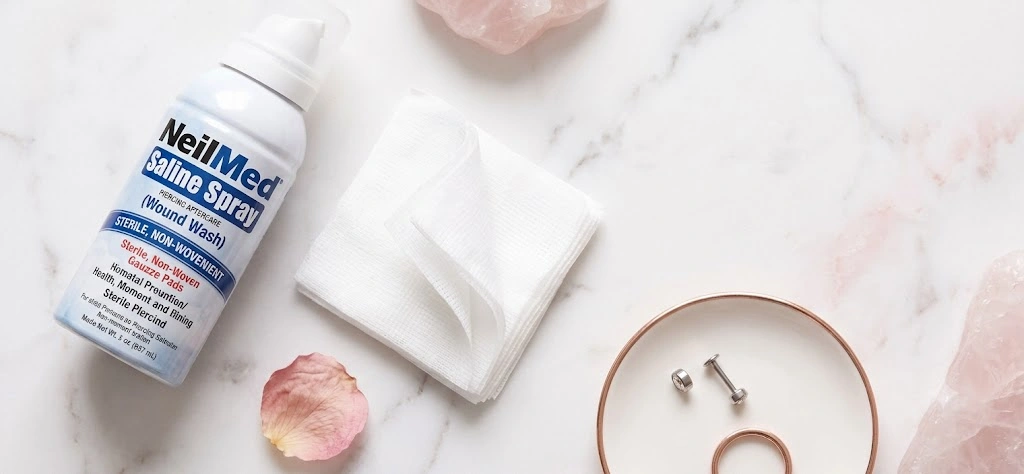
Return to strict twice-daily sterile saline (0.9% NeilMed Wound Wash or equivalent). Spray generously onto front and back of the piercing, let soak for 30 seconds, gently pat dry with non-woven gauze. If you’ve been using any antiseptics, soap, or other products on the piercing — stop immediately. The wound needs clean, undisturbed healing conditions, not chemical treatments.
Visit your piercer for a jewelry check. If the bar is still the longer initial healing bar and it’s been 6+ weeks, ask about a downsize. A properly fitted, shorter bar eliminates most of the movement-related trauma that sustains bump formation. Also have the piercer check the jewelry material — if it’s anything other than implant-grade titanium, solid gold, or implant-grade steel, change it immediately.
ASTM F136 titanium is the gold standard for healing piercing jewelry. It is completely biocompatible, contains no nickel, is as light as possible (minimizing movement), and is available in every color through anodization. If there’s any doubt about your current jewelry material, switching to verified implant-grade titanium is the single highest-impact change you can make for bump resolution.
Even with perfect aftercare and cause removal, an irritation bump takes 4–10 weeks to fully resolve. This is a consistent timeline across the piercing community. The bump may appear to worsen slightly before it begins to improve. Don’t panic and don’t introduce new treatments mid-process. Maintain the correct aftercare consistently and give the bump time to respond. Weekly progress photos can help you track improvement objectively.
Tea tree oil: Causes chemical irritation and often makes bumps worse. Aspirin paste: Unproven and acidic — can damage healing tissue. Popping or squeezing: Introduces bacteria and causes scarring. Removing jewelry: Traps any underlying issue inside and closes the fistula around it. Changing to a hoop: Hoops move far more than studs and almost always worsen bumps. Stay with a properly sized flat-back stud.
How Long Does a Helix Bump Take to Go Away?
With the cause identified and eliminated plus consistent correct aftercare, most irritation bumps show measurable improvement within 2–3 weeks and full resolution within 4–10 weeks. Bumps caused by sleeping trauma that has been ongoing for months may take longer to resolve because the stimulus has been repeated over an extended period. If a bump shows no improvement at all after 8 weeks of correct aftercare, see your piercer or a dermatologist to rule out a true keloid or hypertrophic scar requiring different treatment.
Helix Piercing Keloid vs Irritation Bump: How to Tell the Difference
One of the most anxiety-provoking moments for anyone with a helix bump is the question: “Is this a keloid?” The fear is understandable — keloids are difficult to treat, can recur, and require medical intervention. The reassurance: the vast majority of helix bumps — estimated at 90–95% — are irritation bumps, not keloids. But knowing the genuine differences helps you assess your own situation accurately and seek the right help if needed.
What Is a Keloid?
A keloid is an overgrowth of scar tissue that extends beyond the boundaries of the original wound. Unlike normal scars that stay within the wound site, keloids grow outward into surrounding healthy tissue. They are the result of an abnormal fibroblast response — certain individuals’ bodies produce far too much collagen during wound healing, and this excess collagen builds up into a raised, firm, often darkened scar tissue mass that continues growing long after the wound has closed.
Keloids are a genuinely genetic phenomenon. If you don’t have a personal or family history of keloid scarring, your chances of developing a true keloid from a helix piercing are very low. Keloids are more common in people with darker skin tones, though they can affect anyone. They most commonly form on the earlobes, chest, shoulders, and upper back — areas with high skin tension. The helix rim is less typical for keloid formation than the earlobe.
What Is a Hypertrophic Scar? (The Middle Ground)
There is a third type of bump that sits between an irritation bump and a true keloid: the hypertrophic scar. Like a keloid, it involves excess collagen production and produces a raised, firm bump. Unlike a keloid, it stays within the wound boundaries rather than growing outward. Hypertrophic scars are more common than true keloids and can develop even in people without a keloid history, particularly after significant wound trauma (such as a gun piercing on cartilage, or chronic mechanical irritation).
Complete Comparison: Three Types of Helix Bumps
| Feature | Irritation Bump | Hypertrophic Scar | True Keloid |
|---|---|---|---|
| Size | Small (2–5mm), at hole | Small–medium, at wound site | Medium–large, grows beyond wound |
| Location | Directly at jewelry entry/exit | Within wound boundaries | Extends beyond wound into healthy skin |
| Texture | Soft, fluid-feeling, movable | Firm but not hard | Very firm, rubbery, almost cartilage-like |
| Color | Skin-toned or pink-red | Pink to red | Often darker than surrounding skin (pink, purple, or brown) |
| Growth pattern | Stable — does not grow | Stable after initial formation | Continues to grow months or years after wound heals |
| Appears when? | Days to weeks after trigger | Weeks to months post-trauma | Months to years after wound |
| Pain/itch? | Usually painless or mildly tender | Occasionally itchy or tender | Often itchy, may be tender or painful |
| Genetic component? | No | Mild predisposition | Strong genetic predisposition |
| How common? | Very common — most helix bumps | Moderately common | Rare — ~5–10% of people genetically |
| Treatment | Aftercare correction + cause removal | Aftercare + possible silicone gel | Medical: steroids, laser, surgery |
| Resolves with good aftercare? | Yes — fully, in 4–10 weeks | Partially — may need treatment | No — requires medical intervention |
Do I Have a Keloid? — Self-Assessment
Ask yourself these questions honestly:
- Is the bump growing beyond the piercing hole into surrounding healthy skin? (Key keloid indicator)
- Has the bump been present and growing for more than 3–4 months? (Keloids develop slowly)
- Is the bump very firm or rubbery — like a hard lump rather than a soft swelling? (Keloid texture)
- Is the bump darker than your surrounding skin? (Common in true keloids)
- Do you or your close family members have a personal history of keloid scarring? (Genetic factor)
- Has the bump shown zero improvement after 8–10 weeks of correct aftercare and cause elimination? (Rules out irritation bump)
If you answered yes to multiple questions above — particularly the first two — see a dermatologist. If you answered no to most, you almost certainly have an irritation bump that will respond to the treatment protocol above.
Keloid Treatment Options (Medical)
True keloids require professional medical treatment. Do not attempt to treat a suspected keloid at home. Medical options include:
- Intralesional corticosteroid injections: The first-line treatment. Triamcinolone injected directly into the keloid every 4–6 weeks. Flattens and shrinks keloids significantly in most patients. Multiple sessions usually required.
- Silicone gel or sheets: Applied over the keloid continuously for months. Evidence-based preventive and treatment measure, particularly effective for newer keloids.
- Cryotherapy: Freezing the keloid tissue. Effective for smaller keloids, often combined with steroid injections.
- Laser therapy (pulsed dye laser): Reduces redness and helps flatten keloids — most effective on newer, redder keloids.
- Surgical removal: Used for larger keloids but carries a significant recurrence risk (keloids often grow back after excision). Usually combined with steroid injections post-surgery to reduce recurrence.
- Radiation therapy: Used post-surgically in severe cases to prevent recurrence. Reserved for large, recurring keloids.
Infected Helix Piercing: Signs, Severity Levels & When to See a Doctor
Helix piercing infections range from mild localized irritation (very common and manageable at home) to serious spreading infections (uncommon but requiring urgent medical attention). The critical skill is knowing which level you’re dealing with — and acting appropriately at each level.
Understanding Infection in a Helix Piercing
A helix piercing is an open wound channel through cartilage. Bacteria can enter this channel from multiple sources — unwashed hands touching the jewelry, contaminated bedding, water exposure, inadequate cleaning, or improper technique during the original piercing. Once bacteria establish in the wound, the body’s immune response produces the classic signs of infection: redness, heat, swelling, pain, and discharge (pus).
The challenge with cartilage infections specifically is that the avascular nature of cartilage makes it harder for the immune system to clear infections than in soft tissue. This is why helix infections can progress more quickly and be more stubborn than lobe infections, and why early recognition and action matters more.
Three Levels of Helix Piercing Infection
🟡 Level 1: Mild Localized Irritation (Treat at Home)
Signs: Slight redness confined to immediate piercing area. Small amount of yellowish or cloudy discharge (more than normal clear lymph fluid). Mild tenderness when touched. No fever. No spreading redness.
What it means: Bacterial presence at the wound surface, triggering a localized immune response. Very common during cartilage healing, particularly after aftercare mistakes.
Action: Improve aftercare immediately — twice daily sterile saline, strictly no touching, fresh pillowcase, identify and eliminate any triggers. Monitor for 48–72 hours. If improving, continue. If not improving or worsening, escalate to Level 2 response.
🟠 Level 2: Moderate Infection (See Piercer + Consider Doctor)
Signs: More significant redness beginning to extend slightly beyond immediate piercing site. Noticeable yellow-green discharge. Increasing tenderness. Possible small swelling around the piercing. Jewelry feels tighter than usual. No fever yet, but condition is not improving with 48 hours of improved aftercare.
What it means: Bacteria have established more significantly in the wound. The body’s local immune response isn’t sufficient to clear it with aftercare alone.
Action: See your piercer for assessment and then visit your GP or a walk-in clinic. At this level, topical or oral antibiotics may be needed. Do not remove jewelry. Maintain saline cleaning. Avoid all irritants.
🔴 Level 3: Severe Infection (Urgent Medical Attention)
Signs: Spreading redness extending 1cm or more beyond the piercing. Significant swelling of the entire ear area. Green, grey, or dark yellow pus — thick, opaque, possibly foul-smelling. Skin hot to the touch. Significant pain. Possible fever (temperature above 38°C / 100.4°F). Feeling generally unwell.
What it means: Systemic bacterial infection that has moved beyond localized wound response. In cartilage, this can develop into perichondritis — infection of the cartilage tissue itself — which is a serious condition requiring urgent treatment.
Action: Go to a doctor or urgent care today. Do not wait. Cartilage infections can progress to perichondritis rapidly, which is painful, destructive to the ear’s shape, and requires IV antibiotics in severe cases. Do not remove jewelry. Do not attempt home treatment at this level.
What Is Perichondritis?
Perichondritis is an infection of the perichondrium — the tissue layer that surrounds and nourishes cartilage. Since cartilage itself has no direct blood supply, the perichondrium is its only nutritional source. When bacteria infect and damage the perichondrium, the cartilage beneath is deprived of nutrients and can begin to die (cartilage necrosis). Visible signs include significant ear swelling that obscures the normal ear contours, intense pain, warmth, and the appearance of the cartilage beginning to change shape or soften. This is the most serious complication of a helix piercing infection and requires IV antibiotics, sometimes hospitalization, and occasionally surgical drainage.
The takeaway: a helix infection that is spreading or not responding to improved aftercare within 48 hours needs a doctor. Don’t wait to see if it resolves on its own.
This is the most dangerous common mistake people make with infected piercings. When you remove the jewelry from an infected piercing, the skin entry and exit holes begin to close within hours. This traps the infection — and all the bacteria — inside the closed tissue channel. The result is an abscess: a pocket of infection sealed inside the body with no drainage route. Abscesses are far more serious and painful than the original infection and often require surgical incision and drainage. Keep jewelry in during any infection. Let a doctor advise on jewelry removal if it becomes necessary.
How to Treat an Infected Helix Piercing at Home
Home treatment is appropriate only for Level 1 mild infections — localized redness, small amount of yellowish discharge, mild tenderness, and no fever or spreading redness. If any signs of Level 2 or Level 3 infection are present, skip home treatment and see a medical professional. With that caveat clearly stated, here is the complete home treatment protocol for mild helix piercing infections.
Before touching anything near the piercing — including to spray saline — wash your hands with soap and water for 20 seconds minimum. This is non-negotiable. Your hands are the primary vector for introducing new bacteria to an already compromised wound.
Use sterile 0.9% saline wound wash (NeilMed Wound Wash or equivalent). Spray generously onto both the front and back of the piercing. Let it soak for 30–60 seconds to soften any discharge and allow the saline to reach the wound channel. Gently pat dry with non-woven gauze. Do this exactly twice per day — morning and evening. Not more (over-cleaning disrupts healing), not less.
If you’ve been using hydrogen peroxide, alcohol, Dettol, tea tree oil, Bactine, or any antiseptic product on the piercing — stop today. These products kill bacteria, but they also damage the healing cells your body is using to fight the infection naturally. Sterile saline is the only cleaning agent appropriate for a healing or infected piercing. Antiseptics make infections worse by disrupting the tissue repair process.
Warming sterile saline slightly (body temperature — not hot) and holding a gauze pad soaked in it against the piercing for 5–10 minutes during each cleaning session can help. The gentle warmth slightly increases local blood circulation (limited as it is in cartilage), which helps the immune response. It also softens discharge and reduces mild tenderness. Never use hot water — heat that’s too intense can cause additional irritation.
While treating a mild infection, remove every possible source of additional disruption: stop sleeping on the ear immediately (use a travel pillow); remove over-ear headphones; keep all hair products, makeup, and sprays away from the ear; change pillowcases daily; stop touching or checking the piercing between cleans; avoid swimming or water exposure entirely.
Take a daily photo of the piercing in consistent lighting. A mild infection treated correctly should show clear improvement within 48–72 hours — redness reducing, discharge decreasing, tenderness easing. If there is no improvement at 48 hours, or any sign of worsening (spreading redness, increasing discharge, new swelling), escalate immediately to a doctor. Home treatment is not appropriate for anything beyond the mild localized stage.
Ibuprofen is both a pain reliever and an anti-inflammatory. Taking it as directed during the first 2–3 days of a mild infection can reduce the inflammatory swelling and tenderness while your aftercare improvement takes effect. Do not use aspirin (blood thinning effect). Do not use ibuprofen as a substitute for medical treatment if the infection is not responding or is worsening.
Within 48–72 hours of correct home treatment you should see: discharge reducing in amount and becoming clearer; redness fading back toward the immediate piercing site; tenderness decreasing; no new spreading of any symptoms. If all of these are trending positively, continue the protocol until fully resolved. If any are worsening — seek medical attention that day.
Helix Piercing: Infected or Still Healing? How to Tell
This is one of the most searched helix piercing questions — and for good reason. Many of the signs of active normal healing can superficially resemble early infection. Getting the distinction right matters enormously: treating a healing piercing as infected (and reaching for antiseptics) can damage the healing tissue, while dismissing an actual infection as “just healing” allows it to progress. Here is a complete, clear guide to telling them apart.
Normal Healing: What to Expect
These signs are completely normal during helix piercing healing and do not indicate infection:
| Sign | Normal Healing Appearance |
|---|---|
| Discharge | Clear to slightly white/pale yellow when fresh. Dries to white or off-white crust. Small amount — mostly overnight. |
| Redness | Mild pink directly at the piercing entry/exit points. Confined to the immediate area. Fades gradually over weeks. |
| Tenderness | Present when touched or pressed, especially in the first 1–3 months. Gradually diminishing. Not throbbing at rest. |
| Swelling | Mild puffiness around the jewelry in the first 1–2 weeks. Resolves as healing progresses. |
| Warmth | Slight warmth at the site in the first 1–2 weeks. Not spreading, not persistent after the inflammatory phase. |
| Itching | Occasional mild itching during the proliferative healing phase (months 1–3) — a sign of tissue repair, not infection. |
Infection: Warning Signs That Are Different
| Sign | Infection Appearance — Different From Normal |
|---|---|
| Discharge | Yellow-green, opaque, thick, possibly creamy. Foul smell. Increasing in amount rather than decreasing. Not drying to white crust — remaining liquid or pussy. |
| Redness | Deeper red, extending beyond the immediate piercing site into surrounding skin. Spreading outward over hours or days. |
| Tenderness | Increasing rather than decreasing. Throbbing at rest, not just when touched. Waking you up at night. |
| Swelling | Significant, increasing. Jewelry feels tighter. Ear visibly puffy beyond normal healing levels. |
| Warmth | Noticeably hot to the touch. Spreading warmth beyond the piercing site. |
| Systemic signs | Fever (temperature above 38°C/100.4°F). Feeling unwell. Swollen lymph nodes near the ear. |
| Timeline | Symptoms worsening rather than improving over days. |
Normal healing symptoms generally improve gradually over time with consistent aftercare. Infection symptoms worsen over time even with aftercare. If you’re honestly unsure whether you’re looking at healing or infection, take daily photos and compare them after 48 hours. If things are getting better — healing. If things are staying the same or getting worse — infection requiring assessment.
Why Is My Helix Piercing Still Sore After Months?
Persistent soreness months into the healing period — after the initial acute inflammatory phase should have passed — is one of the most frustrating helix piercing experiences. It’s not dangerous in most cases, but it’s a clear signal that something is disrupting healing and the cause needs to be identified and addressed. Prolonged soreness almost always has a specific, fixable cause.
The Six Most Common Causes of Ongoing Soreness
If you’re a side sleeper on the same side as your helix piercing, you may be accumulating hours of pressure trauma every single night without realizing it. The soreness pattern for this cause is characteristic: the piercing feels fine during the day but is sore in the mornings, or after nights when you slept on the wrong side. The bump (if present) will be on the pillow-contact side of the jewelry. Fix: strict travel pillow use or opposite-side sleeping, immediately and consistently.
The longer initial healing bar has excess movement once first-week swelling resolves. A 10mm bar in a healed channel that only needs 6mm has 4mm of excess bar length that catches on pillowcases, hair, and clothing throughout the day and night. Each snag is a micro-trauma event. Hundreds of micro-traumas per week create continuous soreness. Get a downsize from your piercer — this is one of the most impactful single interventions for prolonged soreness.
Low-quality jewelry metals leach irritant compounds into the healing tissue continuously. This doesn’t cause the dramatic acute response of an infection — instead, it creates a smoldering, low-grade irritation that prevents proper healing indefinitely. The soreness is typically diffuse and consistent rather than acute and event-triggered. If your jewelry is anything other than implant-grade titanium, solid 14k/18k gold, or implant-grade steel — change it. This single change resolves many cases of prolonged soreness within weeks.
Many people wear over-ear headphones for hours every day at work, during commuting, or for gaming. The headphone cushion pressing against the helix area for 4–8 hours daily is a significant and highly repetitive trauma to a healing piercing. Most people don’t make the connection between headphone use and helix soreness because the soreness feels like a healing issue rather than a headphone issue. Switch to in-ear earphones for the entire healing period.
Hair strands catching on the jewelry end — particularly with hoops or longer bar ends — create micro-snagging events that are often too subtle to notice consciously. If you have long hair and wear it down, strands can catch on the jewelry repeatedly throughout the day. The pattern: soreness that comes and goes without obvious cause, often worse after wearing hair down. Solution: wear hair tied back during the healing period; if using a hoop, switch to a flat-back stud.
Occasional soreness during healing is normal. But if the soreness is accompanied by any discharge, localized redness, or warmth, a low-grade bacterial presence may be sustaining the inflammatory response. This is particularly possible if aftercare has been inconsistent or products other than saline have been used. Return to strict twice-daily saline cleaning, eliminate all other products, and monitor for 2 weeks. If the soreness continues, see your piercer or a doctor.
Helix Piercing Healing Issues: Common Problems During the Healing Period
Beyond the acute problems already discussed, several specific healing-phase complications are worth covering in depth. These include the false heal trap, jewelry migration, piercing rejection, granulomas, and embedding — each with distinct characteristics and responses.
The False Heal: Why It Leads to Complications
The false heal is not a complication itself — it’s a normal phase of cartilage healing — but it is the most common trigger for complications caused by premature jewelry changes. Around months 2–4, the surface skin heals over, crust production stops, and tenderness fades. Everything looks healed. People change their jewelry. The internal fistula tissue — which is still fragile and immature — tears and introduces bacteria. The result: sudden return of discharge, new bumps, soreness, and sometimes infection, all occurring several months after the piercing with no obvious recent cause. Prevention: never change jewelry before 6 months minimum, regardless of how healed it looks.
Piercing Migration
Migration occurs when the jewelry gradually shifts position from its original placement. The body, treating the jewelry as a foreign object, slowly moves it toward the surface of the skin. Signs of migration include: the jewelry looking like it’s sitting more shallowly than it did originally; the skin over the jewelry appearing thinner or more translucent; the jewelry channel being visibly shorter than at placement. Migration is more common with surface piercings but can occur in helix piercings with heavy, poorly fitted jewelry or placement through thin tissue. If migration is occurring, see your piercer — the piercing may need to be retired before it rejects completely to avoid significant scarring.
Piercing Rejection
Rejection is the end stage of migration — the body has treated the jewelry as a foreign object throughout and ultimately pushes it completely out of the tissue. The skin in front of the jewelry becomes increasingly thin and red; the jewelry visibly moves outward over days or weeks; eventually it may exit through the skin surface. Rejection in helix piercings is less common than in surface piercings because the cartilage provides more structural support, but it can occur — particularly with heavy jewelry, wrong placement, or nickel allergies creating a chronic inflammatory rejection response. If rejection is suspected, see your piercer immediately. Removing the jewelry before complete rejection reduces scarring significantly.
Granuloma
A granuloma is a specific type of bump — a small, red, often shiny nodule that can appear at the piercing site, sometimes with a wet or weeping surface. Unlike the dry, skin-toned irritation bump, a granuloma looks more like a raw, angry red nodule. It forms when the immune system walls off tissue it can’t eliminate — creating a chronic inflammatory mass. In piercing, granulomas are often triggered by allergic reactions to jewelry metals (particularly nickel). Treatment: switch to implant-grade titanium, maintain strict saline aftercare. If it doesn’t improve, a dermatologist can treat it with topical or injected corticosteroids.
Embedding
Embedding occurs when a piece of jewelry — usually the disk end of a labret stud or the ball end of a barbell — begins to sink into the swelling tissue around it, eventually becoming partially or fully surrounded by skin. This happens when initial swelling is greater than anticipated and the bar length is not long enough to accommodate it, or when swelling occurs during healing due to trauma or infection. Signs: the end of the jewelry disappearing into the skin; redness and tightness around that end; pain when the area is pressed. If embedding is suspected, see your piercer immediately — do not attempt to push it back yourself. The jewelry may need to be changed to a longer bar until swelling resolves. In severe cases, a dermatologist or doctor may need to assist with removal.
Helix Piercing Won’t Heal After 1 Year: Causes & What to Do
Most helix piercings should reach full internal healing within 6–12 months with good aftercare. If yours is still producing discharge, feeling tender, or showing recurring bumps after 12 months, you are dealing with a chronic healing problem that needs specific diagnosis and intervention — not just more patience. Here are the most common causes and what to do about each.
Systematic Diagnosis: Work Through This Checklist
| Cause | Signs That This Is Your Issue | Fix |
|---|---|---|
| Wrong jewelry material | Chronic low-level irritation despite good aftercare; possible persistent redness or subtle discharge; never fully settles | Switch to ASTM F136 implant-grade titanium immediately. See improvement within 4–6 weeks. |
| Bar still too long | Jewelry visibly protrudes significantly beyond the tissue; recurring snagging; bump on the exit side | Visit piercer for downsize to correctly fitting bar length. Often dramatic improvement. |
| Chronic sleeping trauma | Soreness most pronounced in mornings; bump on pillow-contact side; fine during day but worsens overnight | Travel/donut pillow use — consistent and permanent for the remainder of healing. |
| Over-ear headphones | Soreness correlates with work days/gaming sessions; pressure mark or flattening visible | Switch to in-ear earphones completely until fully healed. |
| Jewelry change too early | Healing was progressing then suddenly regressed after a jewelry change; current symptoms started after change | Return to implant-grade titanium flat-back labret. Restart healing protocol as if new piercing. |
| Wrong gauge replacement jewelry | Jewelry was changed to a different gauge; now feels tight or unusual; discharge restarted after change | See piercer to confirm correct gauge and fit. Change back to correct gauge jewelry. |
| Nickel allergy | Chronic itching alongside soreness; redness is primary symptom; jewelry material is uncertain or steel-based | Allergy testing with a dermatologist. Switch to nickel-free implant-grade titanium. |
| Placement issue | Jewelry always looks angled incorrectly; persistent problems regardless of jewelry or aftercare changes | Consult an experienced APP piercer about whether the placement is viable. May need to retire and repierce at a better angle. |
See a professional piercer for an in-person assessment. An experienced APP-certified piercer can identify jewelry fit issues, placement problems, and aftercare mistakes in a single appointment that might have been sustaining the problem for months undetected. This visit should be your first step if you haven’t already done it — not a last resort.
Helix Piercing Bleeding: Causes, When It’s Normal & When to Worry
Bleeding from a helix piercing — whether fresh or established — can be alarming, but it is not always a cause for serious concern. Context is everything. Here is a complete guide to helix piercing bleeding at different stages.
Bleeding Immediately After Piercing (Normal)
A small amount of bleeding immediately after a helix piercing is completely normal. The needle creates a wound through tissue that has some blood supply (particularly at the entry and exit points where the skin is well-vascularized). Most cartilage piercings produce a small amount of blood at the time of piercing and sometimes for a few minutes afterward. Your piercer will clean this up. Minimal bleeding for up to 30 minutes after the procedure is within normal range.
Occasional Minor Bleeding During Healing (Usually Normal)
Small amounts of bleeding can occur during the healing period if the piercing is snagged, knocked, or significantly traumatized. If you catch your jewelry on something and experience a sharp pain followed by minor bleeding — this is a trauma response. Clean the area with saline, apply gentle pressure with clean gauze until bleeding stops (usually within 5 minutes), and treat the event as a potential setback to healing (increased aftercare care for the next 1–2 weeks). Minor trauma-caused bleeding is not a reason to remove jewelry or panic.
Helix Piercing Bleeding After a Year — When to Be Concerned
Bleeding from a helix piercing that is a year old — especially without a clear traumatic cause — is more unusual and warrants attention. Possible causes include:
- Snagging event: Even an established helix can bleed if the jewelry is caught and pulled. If there was a clear snagging moment, this is the explanation.
- Jewelry change trauma: Self-changing jewelry, particularly for the first time, can cause minor tearing and bleeding if not done carefully. See your piercer for future changes.
- Granuloma: The wet, raw surface of a granuloma can bleed easily when touched or caught. If the bleeding comes from a reddish, shiny nodule at the piercing site, this is likely the cause.
- Skin breakdown from chronic irritation: Long-term mechanical trauma (sleeping on jewelry for months) can cause the skin at the jewelry entry point to break down and bleed from friction.
- Unexplained bleeding from an established piercing: If there is no obvious cause and bleeding is recurrent or significant, see a doctor to rule out a skin condition at the piercing site.
Managing a Bleeding Helix Piercing
Using a clean piece of non-woven gauze, apply gentle, steady pressure to the bleeding area for 5–10 minutes without lifting to check repeatedly. Most piercing bleeding stops within this time frame.
Once bleeding has stopped, rinse the area gently with sterile saline to clean away dried blood and any surface bacteria introduced during the event.
Even if bleeding is distressing, do not remove the jewelry. Keep it in place and manage the bleeding externally with pressure.
Any trauma event that causes bleeding should be followed by at least 2 weeks of enhanced aftercare — strict twice-daily saline, no sleeping on it, no unnecessary contact — as the tissue recovers from the disruption.
If bleeding from a helix piercing doesn’t stop within 15–20 minutes of sustained pressure, or if it is significantly heavier than a minor bleed, seek medical attention. This is uncommon but possible if a blood vessel near the piercing site has been significantly damaged.
Helix Piercing Problems & Infections — FAQ
Ready to Get Pierced?
Read our full piercing guide before booking — make sure your piercer meets every safety standard.
Read the Guide →