How Long Does a Helix Piercing Take to Heal?
Complete week-by-week healing stages, what crusty and swollen means at each phase, sore after months explained, and the 5 definitive signs you’re fully healed.

Helix Piercing Healing Time & Stages: Complete Guide
Jump to a section:
Helix Piercing Healing Time: The Complete Answer
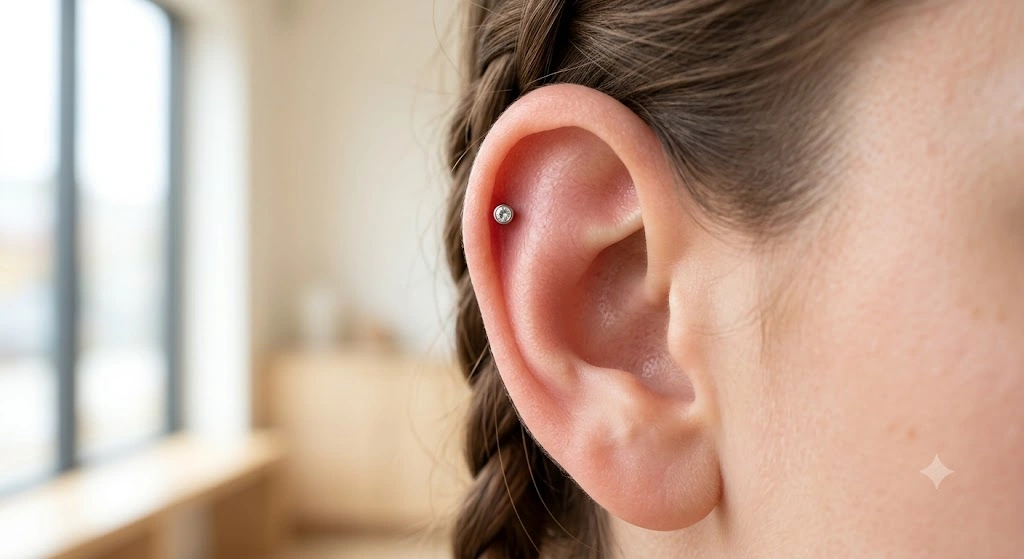
A helix piercing takes 6 to 12 months to fully heal internally. This is the most important fact about helix healing — and the one most people underestimate. The surface of a helix piercing can look and feel completely healed by 2–4 months, but the cartilage fistula running through the inside of the piercing continues to mature and strengthen for many more months after the surface appears normal.
This gap between surface healing and internal healing is what makes helix piercings so prone to late-stage complications. When people change their jewelry at 3 or 4 months because it “looks healed,” they tear the still-fragile internal tissue, introduce bacteria to an unfinished wound channel, and trigger complications that seem mysterious because they appear months after the original piercing.
Days 1–14: Acute inflammation — swelling, redness, heat, discharge | Month 1–3: Active healing — daily crust, occasional soreness | Month 3–6: False heal phase — looks healed but isn’t | Month 6–9: Deep cartilage healing — fistula maturing | Month 9–12+: Full internal healing — safe for jewelry change
Why Helix Takes So Much Longer Than a Lobe
The fundamental reason is biology. Your earlobe is made of soft fatty tissue threaded with blood vessels — it heals the way a cut on your finger heals, with a rich blood supply delivering oxygen, immune cells, and healing proteins to the wound site. A lobe piercing benefits from all of this, which is why it heals in 4–6 weeks.
The helix, by contrast, is made of elastic cartilage — a dense, firm connective tissue with almost no direct blood supply. Cartilage receives its nutrients not through blood vessels but through slow diffusion from surrounding fluid. This means the entire biological healing process operates at a fraction of the speed of soft tissue healing. The same wound that takes 4 weeks in a lobe takes 6–12 months in cartilage.
Healing Time by Helix Type
| Helix Type | Average Healing | Why |
|---|---|---|
| Single standard helix | 6–9 months | Outer rim — most accessible cartilage |
| Double helix (staged) | 6–9 months each | Each piercing heals independently |
| Double helix (same session) | 9–12 months | Two simultaneous wounds share healing resources |
| Triple helix | 9–12+ months | Three wounds — maximum healing burden |
| Forward helix | 9–12 months | Thicker crus cartilage, more nerve density |
| Flat helix (scapha) | 9–12 months | Broader wound channel through flat tissue |
| Hidden helix | 9–12 months | Folded position — harder to clean thoroughly |
Factors That Speed or Slow Healing
Helix Piercing Healing Stages: Week by Week
Every helix piercing goes through the same biological healing phases. Knowing exactly what to expect at each stage helps you distinguish normal healing from warning signs — and helps you avoid the most common mistakes that set healing back.
Days 1–3: The Acute Inflammatory Phase
Your body’s immediate response to the piercing is inflammation — the first line of defense against any wound. During these first days you will notice:
- Swelling: Tissue around the jewelry puffs up noticeably. This is why your piercer uses a longer bar for initial jewelry — to prevent the ends from embedding in swollen tissue. The swelling may make the jewelry look different than you expected — this resolves as inflammation reduces.
- Redness: Pink to red skin around the entry and exit points. Blood is being directed to the area to support the healing response.
- Warmth: The ear feels warm to the touch. Mild, localized warmth is normal inflammatory heat. Spreading warmth extending beyond the piercing site warrants monitoring.
- Clear or pale yellow discharge: Lymph fluid begins weeping from the piercing wound. This is your immune system’s cleaning and barrier fluid — entirely normal. It will dry to form the white crust discussed below.
- Tenderness: The piercing will be sore when touched, brushed by hair, or accidentally knocked. Sleeping on it will be uncomfortable — use a travel pillow from night one.
Ibuprofen (not aspirin — aspirin is a blood thinner) is appropriate for the first few days if discomfort is significant. Take as directed. Applying a clean ice pack wrapped in a thin cloth for 10-minute intervals can reduce initial swelling. Do not apply ice directly to the piercing or jewelry.
Week 1–2: Settling and Stabilizing
By day 7, the acute inflammatory response begins to subside. Swelling reduces, redness softens, and the worst of the initial tenderness eases. Key things happening during this phase:
- White or off-white crust forms around the jewelry — dried lymph fluid. This is completely normal and will continue throughout healing. See the crusty section below for full details.
- The jewelry may feel slightly looser as swelling reduces — normal, not a problem.
- Occasional throbbing, particularly in the evenings, is normal and gradually diminishes.
- The tissue immediately around the jewelry begins forming new cells — the early stages of the fistula channel building.
This is also the time when your aftercare routine becomes a daily habit — morning and evening saline spray, gentle pat dry, leave it alone the rest of the day. Building this habit now determines healing quality for the next 6–12 months.
Weeks 3–6: Early Stabilization
By week three most of the dramatic visible changes have occurred and the piercing enters a more stable, quieter phase. Swelling is largely resolved. Crust formation continues but becomes more predictable — a small, consistent amount each morning. Tenderness is now only present when the piercing is directly disturbed.
Week 6 is an important milestone — this is when many piercers recommend a downsize appointment. The initial healing bar was sized longer to accommodate first-week swelling. With swelling resolved, that extra bar length creates a constant low-level snagging hazard throughout the day. A shorter, better-fitting bar eliminates much of the mechanical irritation that drives bump formation and prolonged soreness. This single appointment makes a significant positive difference to the rest of your healing journey.
Month 2–3: Active Internal Healing
During months two and three the piercing’s surface continues to look progressively more normal while the deeper cartilage healing intensifies. Inside the tissue, fibroblasts (specialized healing cells) are building new collagen to line the fistula channel. The wound is transitioning from the active inflammatory and proliferative phases into the early remodeling phase.
External signs: daily crust continues, occasional sensitivity when disturbed, otherwise increasingly comfortable. The piercing “behaves itself” most of the time during this phase, which creates a false sense of how far along healing actually is.
Month 3–6: The False Heal — The Most Dangerous Phase ⚠️
Between months three and six, a helix piercing typically undergoes what piercers call the false heal — one of the most important concepts in cartilage aftercare. During this phase:
- The surface skin at the entry and exit points has fully closed and looks completely normal.
- Crust production has dramatically reduced or stopped entirely.
- The piercing feels comfortable throughout the day with little to no tenderness.
- Jewelry moves with minimal resistance.
From the outside, by every visible indicator, the piercing looks healed. It is not. The internal cartilage fistula — the tissue channel built through the cartilage itself — is still thin, fragile, and incompletely matured. A jewelry change at this stage tears this delicate tissue, allows bacteria access to an unfinished wound, and typically triggers a cascade of complications (discharge returns, bumps form, soreness comes back) that can set healing back by months.
Changing jewelry at the false heal phase is the most common cause of “late stage” helix complications — problems appearing months after the initial piercing with no obvious recent cause. The rule: do not change jewelry before 6 months, regardless of how healed it looks or feels at the surface. The fistula needs months more maturation even after the surface appears perfect.
Month 6–9: Deep Fistula Maturation
By month six, a well-cared-for helix piercing with implant-grade jewelry has progressed to genuine deep healing. The fistula is now a reasonably mature tissue channel — sturdy enough to tolerate a careful jewelry change performed by a professional piercer, though not yet at full strength.
What to expect at this stage:
- Zero daily tenderness or discharge under undisturbed conditions
- Jewelry moves freely with minimal resistance
- Skin around holes looks completely normal
- Accidental minor bumps cause brief pain but quickly settle
Month 9–12+: Full Internal Healing
By 9–12 months, a helix piercing cared for correctly from the start reaches full internal healing. The fistula is mature, stable, and robust. Jewelry can be changed safely — either by a professional piercer for the first time, or at home with clean hands and correct technique for subsequent changes.
The range is important — some people reach full healing at 9 months, others at 12 or slightly beyond. Forward helix, flat helix, and triple helix piercings consistently trend toward the longer end. Piercings that experienced complications or had aftercare issues during healing may take longer to reach genuine full stability.
Visual Healing Timeline Table
| Timeline | What’s Normal | Your Action |
|---|---|---|
| Days 1–3 | Swelling, redness, warmth, clear/white discharge, tenderness | Saline 2x daily. Travel pillow. No touching. |
| Week 1–2 | Swelling reducing, white crust forming daily, throbbing | Continue routine. Change pillowcase every 2 days. |
| Weeks 3–6 | Stable crust routine, tenderness only when disturbed | Book downsize appointment at week 6. |
| Month 2–3 | Surface looking increasingly normal, low-level background healing | Continue twice-daily saline. Do not reduce aftercare. |
| Month 3–6 | FALSE HEAL — looks healed, feels healed, is NOT healed internally | Maintain aftercare. DO NOT change jewelry. |
| Month 6–9 | Deep healing — no tenderness, minimal crust, jewelry moves freely | Can have first jewelry change by piercer at 6+ months. |
| Month 9–12 | Full internal healing — stable, symptom-free | Safe for self-managed jewelry changes. |
Helix Piercing Crusty: What’s Normal and What Isn’t
Crusty discharge around a healing helix piercing is one of the most universally experienced and most frequently misunderstood aspects of the healing process. Understanding exactly what it is — and the difference between normal crust and concerning discharge — prevents unnecessary panic and helps you respond correctly.
What Is the Crust? The Biology Explained
The white or off-white crust forming around your helix jewelry is dried lymph fluid. Lymph is a clear, protein-rich biological fluid that your immune and lymphatic systems use to flush debris, dead cells, and potential pathogens away from wound sites during healing. It weeps continuously from healing wounds — including piercing fistulas — particularly overnight when you’re still and the area is undisturbed.
When this lymph fluid is exposed to air, it oxidizes and dries — turning from clear or pale yellow to the white, chalky, slightly crystalline crust you find on your jewelry and surrounding skin in the morning. It is essentially dried biological fluid — the same process that produces the “sleep” in the corners of your eyes overnight, just at a healing wound site.
Normal Crusty Piercing: What to Expect at Each Stage
- Weeks 1–4: Most abundant crust production. Fresh wound = highest lymph output. Expect noticeable crust every morning, sometimes twice daily. This is completely normal.
- Month 1–3: Crust continues but becomes more predictable — mainly overnight buildup. Amount gradually reducing as the surface heals.
- Month 3–5: Crust significantly reducing. Many people see very minimal crust most days during this phase.
- Month 5+: Crust should be minimal to absent in a well-healing piercing. If crust returns after a period of being crust-free, something has irritated or disturbed the healing — identify the cause.
Normal Crust vs Infection Discharge
| Feature | Normal Crust (Lymph) | Infection Discharge (Pus) |
|---|---|---|
| Color | White, off-white, pale yellow when fresh | Bright yellow, yellow-green, grey-green |
| Texture when fresh | Thin, watery to slightly viscous | Thick, opaque, creamy |
| When dried | Chalky, white, slightly crystalline | Remains yellow or greenish, does not dry to white |
| Smell | Mild or odorless | Noticeable, unpleasant, sometimes foul |
| Amount | Small, predictable, mostly overnight | Increasing, present throughout the day |
| Associated redness | Mild pink at site only | Spreading redness beyond piercing site |
| Action needed | Clean gently with saline as normal | See a doctor — possible antibiotics needed |
How to Remove Crust Safely
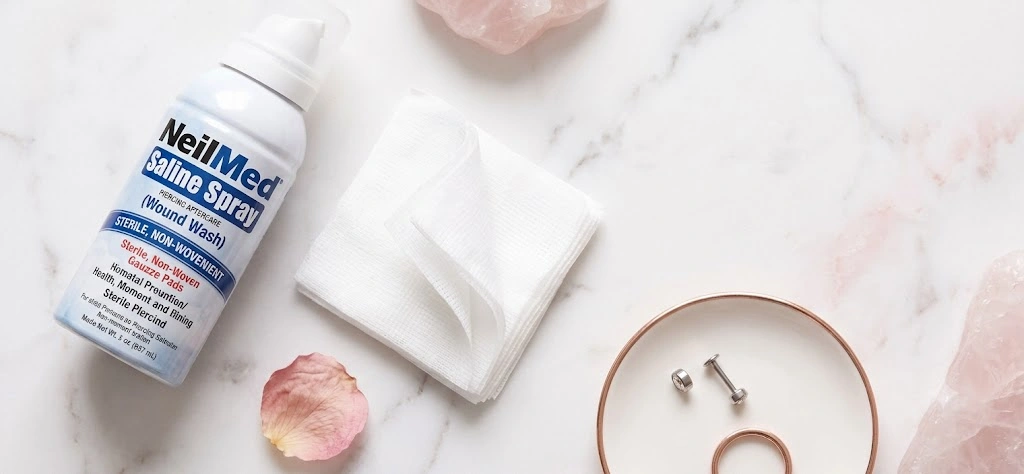
Hold the bottle 2–3cm away and saturate the crusty area. The saline softens and loosens the dried lymph from the skin surface.
Give the saline time to work. Don’t rush. Forcing dry crust off immediately causes micro-tears at the piercing entry point.
Softened crust wipes away easily with minimal pressure. Never use cotton wool (leaves fibres) or cotton buds (too harsh and also leaves fibres).
Moisture left around the piercing creates a bacterial growth environment. Dry thoroughly after every clean, paying attention to the helix rim fold where water collects.
Pulling dry crust away from the skin tears the delicate healing tissue at the piercing entry point, causing micro-bleeding and micro-scarring. This micro-trauma, repeated daily, accumulates into significant healing setbacks and increases bump formation risk. Always soften with saline first.
Helix Piercing Swollen: Normal Swelling vs Warning Signs
Swelling after a helix piercing is expected and normal — but the pattern, timing, and extent of swelling matters. Here is a complete guide to distinguishing normal healing swelling from swelling that needs attention.
Normal Swelling: What to Expect
First 72 hours: Noticeable swelling around the jewelry is normal and expected. The piercing site looks puffy, the jewelry may appear to have less clearance than when initially inserted, and the entry points may appear more raised than they will look once healed. This is the acute inflammatory swelling as your body rushes resources to the wound site.
Week 1–2: Swelling should be gradually and visibly reducing. By day 10–14, most of the initial swelling resolves in a well-healing piercing.
Week 6: By the 6-week mark, initial swelling should be fully resolved. If significant swelling persists beyond 6 weeks, there is an ongoing inflammatory trigger — usually sleeping on the piercing, wrong jewelry material, or low-grade bacterial presence.
Concerning Swelling: Warning Signs
| Type of Swelling | What It Might Mean | Action |
|---|---|---|
| Swelling returning after resolving | New trauma (snag, sleep), new irritation trigger, or low-grade infection flare-up | Identify and eliminate trigger. Enhance aftercare. |
| Jewelry feeling increasingly tight / embedded | Persistent swelling causing jewelry ends to sink into tissue (embedding) | See a piercer immediately for bar length assessment. |
| Swelling spreading beyond immediate piercing site | Spreading infection or allergic response | See a doctor if spreading or accompanied by increasing redness and warmth. |
| Entire outer ear visibly swollen | Possible perichondritis (serious cartilage infection) if accompanied by significant heat, pain, and fever | Urgent medical attention required. |
Jewelry Embedding: A Swelling-Related Emergency
One specific swelling complication worth special attention is jewelry embedding — when swelling causes the flat back disc or end bead of the jewelry to begin sinking into the tissue until it’s partially or fully covered by skin. This happens most often in the first 2 weeks when initial swelling is greatest and the bar was not sized with sufficient clearance.
Signs: you cannot see or feel the back disc when feeling behind the ear; the front decorative end appears to be sitting flush with or below the skin surface rather than sitting on top of it; the area around the jewelry end looks red and compressed.
Action: see your piercer immediately. Do not attempt to push embedded jewelry out yourself. The piercer will change to a longer bar and in severe cases may refer you to a medical professional. An embedded piece of jewelry is not something to wait and monitor.
Helix Piercing Still Sore After 6 Months: All Causes Explained
If your helix piercing is still noticeably sore at the 6-month mark — beyond the normal background tenderness that occurs throughout cartilage healing — there is almost always a specific, identifiable, fixable cause. Persistent soreness is not simply “slow healing” — it is your body signaling that something is continuously disrupting the healing process.
The 7 Most Common Causes of Prolonged Soreness
If you’re a side-sleeper on the pierced ear side, you may be accumulating 6–8 hours of pressure trauma every single night. The pattern is diagnostic: soreness worse in mornings, bump on the pillow-contact side, fine during the day. Fix: strict travel pillow use or back-sleeping immediately and consistently. Even one or two nights per week of sleeping on the piercing is enough to perpetuate soreness indefinitely.
If you’ve never had a downsize and are still wearing the longer initial healing bar, the excess post length catches on hair, pillowcases, and clothing constantly throughout the day and night. Each snag is a micro-trauma event. Hundreds of micro-traumas per week create sustained soreness. Solution: visit your piercer for a downsize to a properly fitted bar. This single intervention resolves a large proportion of “persistent soreness” cases.
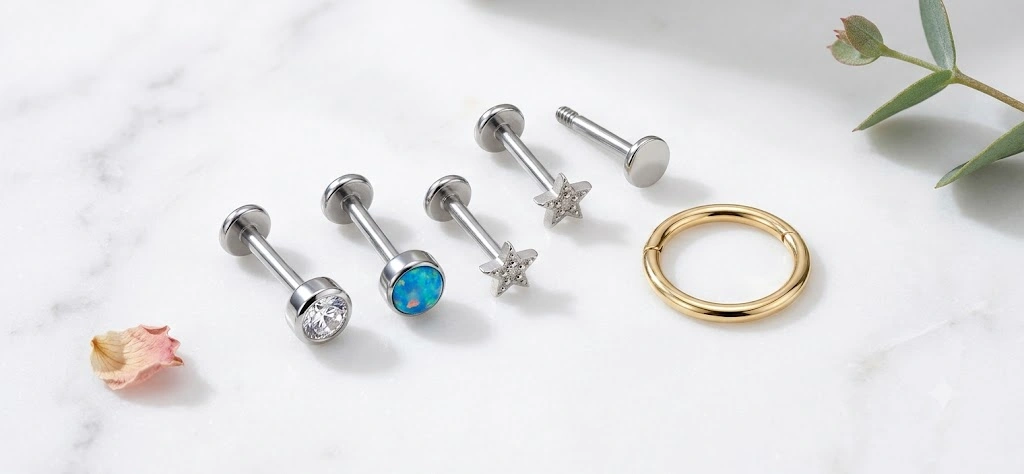
Non-implant-grade metals leach chemical compounds into the healing tissue continuously. This doesn’t cause acute infection — it creates a smoldering, low-level chronic irritation that prevents proper healing indefinitely. The soreness is diffuse and consistent rather than event-triggered. If your jewelry is anything other than ASTM F136 titanium, solid 14k/18k gold, or ASTM F138 steel — change it now. Improvement typically appears within 2–4 weeks of switching to correct material.
Daily wear of over-ear headphones applies sustained pressure to the helix area for hours — creating the same type of pressure trauma as sleeping on the piercing, just during waking hours. Soreness pattern: worse on work days or gaming sessions; correlates with headphone use. Fix: switch completely to in-ear earphones for the remainder of the healing period.
Long hair catching on the jewelry end — particularly on studs with larger decorative ends or any hoop — creates micro-snagging events throughout the day that are often too subtle to register consciously. Pattern: soreness worse when wearing hair down; better on days when hair is tied up. Fix: tie hair back consistently during healing; if wearing a hoop, switch back to a flat-back stud.
If jewelry was changed at the false heal phase (months 2–4), the internal fistula tissue was torn and essentially needs to rebuild from a more advanced starting point. Symptoms: soreness started or intensified after a jewelry change that happened before 6 months. Fix: return to implant-grade titanium flat-back stud in correct gauge, treat the healing as if starting fresh with a new piercing, maintain strict aftercare.
If aftercare has been inconsistent or wrong products were used, a low-level bacterial presence can maintain a chronic inflammatory state without ever progressing to obvious infection. Signs: mild discharge alongside the soreness, occasional redness that doesn’t clear completely. Fix: return to strict twice-daily sterile saline (nothing else), eliminate all irritants, and maintain for 4 weeks minimum. If no improvement, see your piercer or a doctor.
Helix Piercing Not Healing: Diagnosis & What to Do
If your helix piercing has been showing no improvement — or actively cycling between apparent improvement and setbacks — beyond 9–12 months, you are dealing with a chronic healing failure that needs targeted diagnosis and intervention rather than simply more patience.
Diagnostic Checklist: Work Through Every Cause
| Possible Cause | Diagnostic Signs | Fix |
|---|---|---|
| Wrong jewelry material | Chronic irritation despite correct aftercare; never fully settles; diffuse redness | Switch to ASTM F136 implant-grade titanium immediately |
| Bar too long | Jewelry visibly protrudes; bump on exit side; snagging constantly | Piercer downsize to correct-length bar |
| Jewelry gauge wrong | Jewelry was changed and replacement gauge doesn’t match original | Have piercer confirm gauge and replace with correct size |
| Chronic sleep pressure | Worst in mornings; bump on pillow side | Strict travel pillow — every single night without exception |
| Premature jewelry change | Problems began after a change made before 6 months | Correct gauge implant titanium stud; restart aftercare protocol from scratch |
| Nickel allergy | Itching alongside soreness; redness prominent; jewelry material uncertain | Dermatologist allergy testing; switch to nickel-free ASTM F136 titanium |
| Anatomy or placement issue | Jewelry always looks angled wrong; persistent problems despite perfect aftercare and correct jewelry | APP piercer assessment — may need to retire and re-pierce at better angle |
| Piercing rejection | Jewelry visibly moving toward surface over weeks; skin over jewelry becoming thin/translucent | See piercer immediately — early removal prevents severe scarring |
If your helix piercing isn’t healing after 12 months of good-faith aftercare, visit an APP-certified professional piercer for an in-person assessment before doing anything else. They can identify jewelry fit issues, placement problems, and aftercare mistakes in a single appointment — issues that are impossible to diagnose accurately from photos or descriptions alone. This visit is step one, not a last resort.
5 Signs Your Helix Piercing Is Fully Healed
Knowing with confidence that your helix is fully healed — not just surface-healed, not in the false heal phase, but genuinely and completely healed internally — requires meeting specific, objective criteria. All five of these signs must be true simultaneously and consistently for a minimum of 4–6 weeks before you consider a jewelry change or reduce aftercare.
A fully healed helix feels no different from any other part of your ear when pressure is applied. Not just comfortable at rest — completely non-tender when you deliberately apply gentle pressure to the jewelry and surrounding tissue. Any residual tenderness when pressed means the fistula is still healing internally, regardless of what the surface looks like.
Complete absence of any white crust or discharge, sustained consistently for over a month. Not just “mostly clean with occasional crust” — genuinely zero production. A few good days followed by a return of crust means the piercing is still actively healing. Stable, sustained, complete absence of discharge is the sign of a mature fistula that has finished its lymph-producing active healing phase.
When you very gently move the jewelry (one deliberate test, not a habit), it glides with zero resistance, zero sticking, and zero sensation of pulling. Any drag, stickiness, or feeling of slight catching means the fistula tissue is still forming and the channel hasn’t fully matured to a smooth, lined tube.
The skin at the jewelry entry and exit points looks indistinguishable from the surrounding ear cartilage surface — no redness, no raised tissue ring, no discoloration, no visible difference from neighboring skin. The holes themselves look like clean, settled, smooth-edged openings rather than active wound sites.
This is the most critical criterion of all. Healing piercings go through quiet phases that can feel like full healing followed by minor setbacks. True full healing is stable and doesn’t fluctuate — all four signs above must be simultaneously and consistently true for at least one month with no dips or bad days. Only then is a professional jewelry change appropriate.
Even when you meet all five criteria, have your first helix jewelry change performed by your piercer (or another APP-certified professional). They confirm healing status visually, change the jewelry without unnecessary trauma using proper tools, and advise on appropriate replacement styles. After this first professional change, subsequent self-managed changes at home are safe with clean hands and correct technique.
Healing Time FAQ
Need the Full Aftercare Routine?
Read our complete Aftercare & Cleaning guide — step-by-step daily routine, saline instructions, dos and don’ts, and sea salt soaks.
Aftercare Guide →