Types of Helix Piercings
Single, double, triple, forward, mid, flat — compare every helix type to find what’s right for your ear.

All Types of Helix Piercings — Complete 2026 Guide
Jump to a section:
Helix Piercing Types: The Full Picture
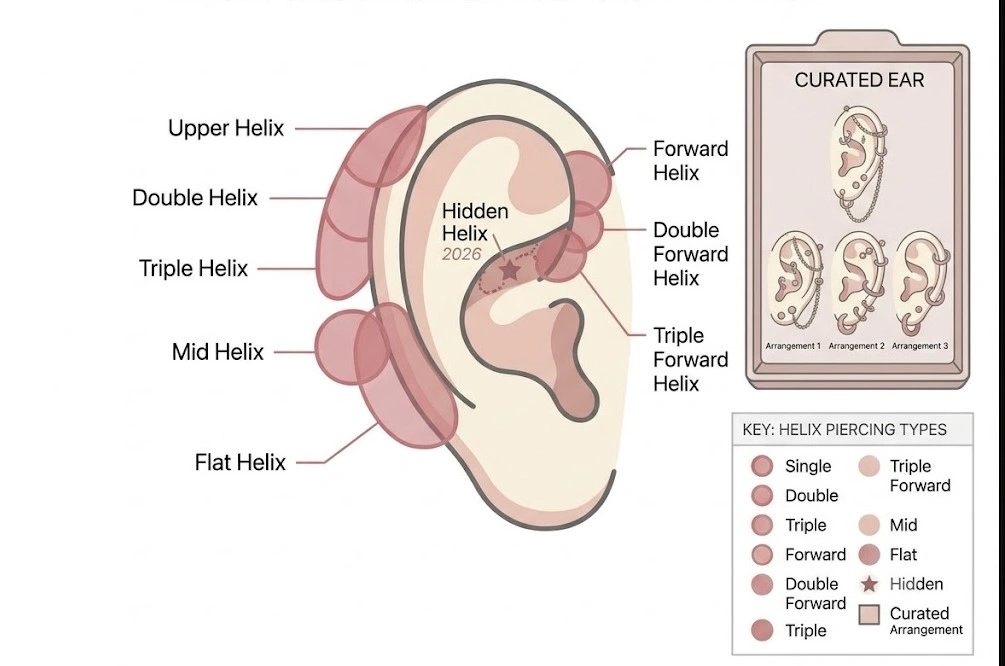
The helix rim is one of the most versatile canvases in all of ear piercing. Unlike the tragus or daith — which have a single, fixed placement — the helix spans a long, curved stretch of cartilage that runs from just in front of the ear (the crus of helix) all the way around the top and down the back. This generous length, combined with the existence of the flat scapha area just inside the rim, gives piercers and clients an extraordinary range of placement possibilities.
In 2026, helix piercings are more popular and more varied than ever. The rise of the curated ear aesthetic, the influence of jewelry-focused social media content, and increasingly sophisticated studio techniques have all contributed to a genuine expansion in helix piercing styles — from the classic single stud to architectural triple stacks, and from the mainstream forward helix to emerging trends like the hidden helix. Whether you want something subtle and minimalist or bold and layered, there is a helix type for you.
This guide covers every helix type in detail — placement, anatomy, pain levels, healing timelines, jewelry choices, and the specific things you need to know before committing to each one. Following you’ll find a link to that type’s dedicated page for even deeper reading.
Single: 4/10 pain, 6–9mo | Double: 4/10, 6–12mo | Triple: 4/10, 9–12mo | Forward: 6/10, 9–12mo | Double Forward: 6/10, 9–12mo | Mid: 4/10, 6–9mo | Flat: 4/10, 9–12mo | Hidden: 5/10, 9–12mo
Heal: 6–9 months
Heal: 6–12 months
Heal: 9–12 months
Heal: 9–12 months
Heal: 9–12 months
Heal: 6–9 months
Heal: 9–12 months
Heal: 9–12 months
Not every helix type is possible on every ear. The flat helix requires a wide enough scapha. The forward helix needs adequate cartilage thickness at the crus. The hidden helix requires a pronounced rim fold. Before falling in love with a specific type online, visit an APP-certified piercer who can assess your anatomy and tell you what’s genuinely possible for your ear.
1. Single Helix Piercing — The Classic Foundation
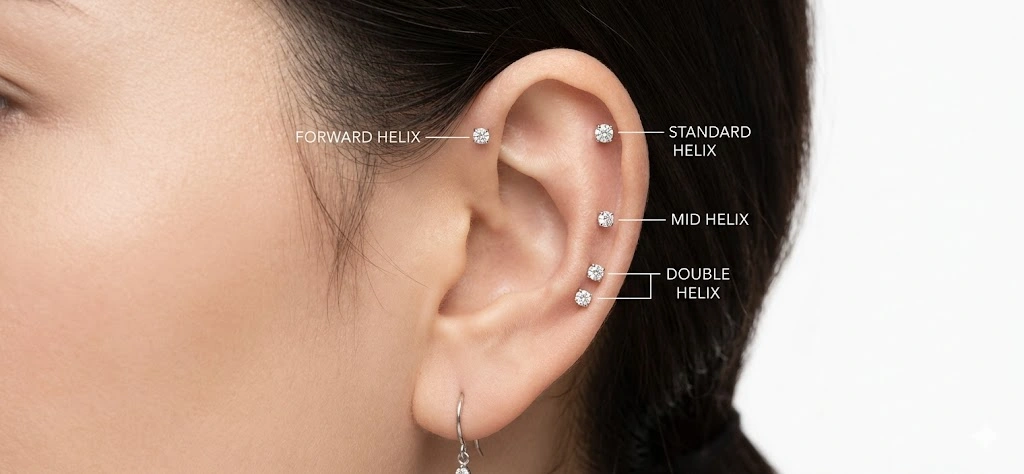
The single helix piercing is the foundational helix type — one piercing placed anywhere along the outer curved rim of the upper ear. It is the most popular entry point for cartilage piercing, the most widely recognized, and the most versatile. When someone says “I want a helix piercing,” this is almost always what they mean unless they specify otherwise.
Placement Details
The outer helix rim runs from just above the ear canal (where it meets the crus) all the way around to where the ear connects to the skull at the back. A single helix can technically be placed anywhere along this entire length. In practice, the most common positions are:
- Upper helix: Near the very top of the ear, where the curve is most pronounced. The most classic and recognizable position.
- Mid-upper helix: Slightly lower than the top, in the middle portion of the rim. A good position for future stacking — it leaves room above and below.
- Lower helix: In the lower portion of the rim, approaching where cartilage meets the lobe area. Less common as a solo piercing but popular as the lowest piece in a stack.
Your piercer will recommend the ideal position based on your ear’s specific anatomy, how high or tight your helix curves, and whether you plan to add more piercings later. Planning ahead for a future stack is smart — spacing matters enormously when you’re building multiple helix piercings.
Pain Level: 4 out of 10
The single helix consistently rates as one of the more manageable cartilage piercings in terms of pain. The initial needle sensation is a sharp, brief pinch — most people describe it as less painful than they expected. The cartilage offers resistance (which you’ll feel as pressure), but the procedure is over in under a second. Post-piercing, expect mild throbbing for a few hours. This is normal and well-managed with ibuprofen.
Healing: 6–9 Months
A well-cared-for single helix with implant-grade jewelry typically reaches full internal healing in 6–9 months. The surface may appear healed and feel comfortable much earlier — often by month 3 — but the internal fistula (the healed channel through the cartilage) continues developing for months after the surface looks fine. This “false heal” phase is the most dangerous time for setbacks. Do not change jewelry until the full healing period is complete.
Best Starting Jewelry
A flat-back labret stud in implant-grade titanium (ASTM F136), sized 16g or 18g, with a bar length of 8–10mm to accommodate initial swelling. After full healing, you can switch to hoops, clickers, seamless rings, or more decorative studs. For healing, studs are always safer than hoops — hoops move constantly and cause irritation.
2. Double Helix Piercing — Complete Guide
The double helix piercing consists of two helix piercings stacked vertically along the same section of the outer cartilage rim, typically spaced 6–12mm apart. It is one of the most sought-after cartilage looks in modern ear styling — striking enough to be a genuine statement, yet still clean and wearable in everyday professional settings. The double helix is a natural next step for anyone who already has or wants a single helix and wants to build their ear aesthetic further.
Placement: How to Space a Double Helix
The most important decision in a double helix is spacing. Too close (under 5mm) and the piercings crowd each other, restrict blood flow to the tissue between them, and increase the risk of healing complications. Too far apart (over 15mm) and they lose the visual cohesion that makes a double helix look intentional rather than random.
The sweet spot for most ears is 7–10mm between the centers of each piercing. This gives enough clearance for the jewelry ends to sit comfortably without overlapping, while keeping the piercings visually connected as a pair. Your piercer will mark both positions and show them to you in a mirror before anything is pierced — take this moment seriously and don’t rush it.
The standard approach is to place the lower piercing first (nearer the base of the helix) and the upper piercing above it. Lower helix positions are slightly more accessible and often heal a touch easier, making them a sensible starting point if you’re staging the piercings.
At Once or Staged? The Critical Decision
This is the question almost every double helix client asks. The honest answer involves trade-offs on both sides.
| Factor | Both at Once | Staged (3–6 months apart) |
|---|---|---|
| Studio visits | One visit | Two visits |
| Healing period | One shared healing period | Two sequential healing periods |
| Trauma to ear | Higher — two fresh wounds together | Lower — one wound at a time |
| Symmetry precision | Easier — marked together | Requires careful re-marking |
| Risk of irritation | Higher | Lower |
| Cost upfront | Higher | Spread across visits |
| Recommended for? | Experienced piercees with excellent aftercare habits | Beginners and anyone prioritizing easy healing |
Most experienced APP piercers lean toward staging, particularly for first-time cartilage clients. The body heals one wound at a time far more efficiently than two simultaneously. That said, getting both at once is a legitimate choice — many thousands of people do it successfully each year. The key factor is your commitment to aftercare. If you know you’ll be consistent with twice-daily saline cleaning, careful sleeping, and avoiding snagging, getting both at once is very manageable.
Jewelry Ideas for Double Helix
The double helix opens up beautiful jewelry pairing possibilities. During healing, you’ll wear matching flat-back labret studs — typically the same gauge and material. After full healing, some popular combinations include:
- Matched minimalist studs: Two identical flat-back titanium studs with the same gemstone — clean, symmetrical, professional.
- Graduated sizes: A slightly larger decorative end on the upper stud and a smaller one lower down — creates visual flow.
- Mixed metals: One in rose gold, one in white gold — works beautifully when the pieces are from the same collection.
- Stud + hoop combination: Once healed, a seamless hoop on the upper and a stud on the lower (or vice versa) is an increasingly popular look.
- Seasonal swaps: Keeping the lower stud as a permanent anchor and changing the upper piece more frequently for variety.
Pain Level: 4/10 Each
Each individual piercing in a double helix rates the same as a single helix — around 4 out of 10. If done in the same session, the second piercing is typically comparable to the first, though some people find the ear is slightly more sensitive and reactive after the first piercing. The area has been stimulated, the adrenaline spike from the first pierce is wearing off, and the ear may be slightly more aware of the second stimulus. Still entirely manageable — most people report the second feels “about the same” as the first.
Healing: 6–12 Months
When both piercings are done simultaneously, expect the longer end of the healing range — up to 12 months, sometimes slightly beyond. When staged properly, each individual piercing follows its own 6–9 month healing timeline. The critical rule for staged double helix piercings: never add the second piercing until the first is fully healed — not just surface-healed. This means a minimum of 6 months, ideally 9, with zero signs of tenderness or discharge at the original site.
3. Triple Helix Piercing — Healing, Placement & Full Guide
The triple helix piercing is exactly what it sounds like: three helix piercings placed in a vertical line along the outer cartilage rim. It is bold, unmistakably intentional, and one of the most striking ear piercing configurations available. A well-executed triple helix — with carefully chosen, complementary jewelry — is genuinely one of the most beautiful ear styling outcomes in modern piercing culture. It also requires the most planning, patience, and aftercare commitment of any helix option.
Is a Triple Helix Right for You?
Before getting excited about the aesthetic, be honest with yourself about three things. First, ear anatomy — do you have enough helix rim length to accommodate three piercings with appropriate spacing? Most ears do, but some have a shorter, tighter rim that physically cannot hold three well-spaced piercings. A professional piercer will tell you immediately. Second, commitment to aftercare — the triple helix healing period is long (9–12+ months for the full stack) and requires unwavering consistency. Third, lifestyle — do you wear over-ear headphones, play contact sports, or sleep in positions that would put repeated pressure on that ear? Any of these significantly complicate triple helix healing.
Spacing and Placement for Three Piercings
With three piercings, spacing is even more critical than with two. You need consistent spacing between all three — piercings that are unevenly distributed look accidental rather than curated. The ideal gap is 6–9mm between each piercing center, giving a total stack height of 12–18mm. This means the bottom of your helix rim needs enough length to accommodate the stack without pushing the lowest piercing too close to the lobe or the highest piercing off the ear entirely.
Your piercer should mark all three positions simultaneously and show you the full layout in the mirror before any needle touches your ear. Minor adjustments at this stage are completely normal and expected — perfecting the spacing takes a few tries on the marker alone. This is also the moment to confirm whether the jewelry sizes you want will fit without overlapping once swelling resolves.
Healing a Triple Helix: What to Expect
Triple helix piercings have a reputation for being challenging to heal, and that reputation is partly deserved. Three simultaneous cartilage wounds in close proximity creates a higher healing burden than a single or double helix. Here is what to realistically expect:
- Weeks 1–4: All three piercings will be swollen, tender, and crusty. The ear will feel warm and look noticeably red. This is normal — three fresh wounds is significant trauma for the ear.
- Months 2–4: Swelling reduces significantly. Crust formation settles into a predictable daily pattern. The piercings should not be particularly painful during this phase unless snagged or irritated.
- Months 4–6: The surface may start looking and feeling healed. This is the most dangerous phase — the “false heal.” Do not be tempted to change jewelry. The cartilage is still actively healing internally.
- Months 6–12+: Full internal healing. All three piercings should feel completely comfortable, produce no discharge, and allow jewelry to move freely without any sticking.
The most experienced piercers strongly recommend staging a triple helix rather than getting all three at once. The ideal sequence: get the middle piercing first. Once healed (6–9 months), add the lower piercing. Once that heals, add the upper piercing. This approach dramatically reduces healing complications, gives you time to refine spacing preferences, and is far less traumatic for your cartilage. Yes, it takes 18–24 months total. The result is worth it.
Triple Helix Jewelry: Creating Visual Harmony
With three pieces of jewelry in close proximity, achieving visual harmony is both more important and more complex than with a single or double. A few principles that work reliably:
- Consistent metal: Keep all three pieces in the same metal family (all titanium, all gold, or all rose gold) to avoid a clashing, mismatched look.
- Graduated gemstone sizes: Many people use the largest decorative end on the upper piercing and progressively smaller ones below — this creates a natural cascading effect.
- Mix of shapes: Combining a round gem, a flat disc, and a tiny star or charm in the same metal creates visual interest without disorder.
- The “anchor” approach: Choose one statement piece (usually the upper or middle) and keep the other two smaller and more understated — this directs the eye to a focal point.
Pain Level: 4/10 Each — With a Catch
Each individual piercing in a triple helix sits at around 4/10 pain. However, if all three are done in one session, fatigue sets in by the third. By the time the third needle goes through, your ear has already experienced two fresh wounds, adrenaline levels are shifting, and the surrounding tissue is more sensitized. Most people who get all three at once describe the third as “noticeably more uncomfortable than the first.” Still not extreme — rarely above 5/10 — but worth knowing.
4. Forward Helix Piercing — Complete Guide
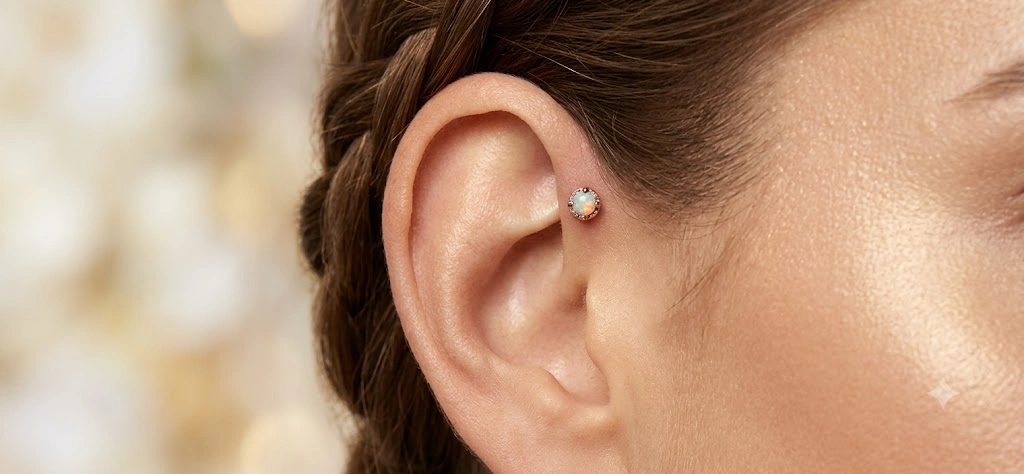
The forward helix piercing is placed at the very front section of the helix rim — specifically at the crus of helix, the ridge where the helix cartilage begins just above the ear canal and near the temple/side of the head. Unlike a standard helix (which faces sideways and backward), the forward helix faces forward — toward your face — making it one of the most visible piercings in face-on interactions and photographs.
Why the Forward Helix Looks So Different
The visual difference between a standard helix and a forward helix is more significant than many people realize until they see both in person. The standard helix is best seen from the side — it shows up clearly in profile photos and when your hair is behind your ears. The forward helix is one of the first things visible when someone looks directly at you in conversation. It sits in a prominent, face-framing position that gives it enormous visual impact in everyday interactions, video calls, and front-facing photos.
This directional difference makes the forward helix a particularly good choice if you:
- Spend significant time on video calls or in face-to-face professional/social settings
- Want a piercing that photographs beautifully from the front
- Often wear your hair down or swept back, framing the face
- Want to complement tragus or anti-tragus piercings, which share similar front-facing visibility
Anatomy of the Forward Helix Position
The crus of helix — where forward helix piercings sit — is anatomically distinct from the outer rim. The cartilage here is typically thicker and denser than the outer rim cartilage, and there is a higher concentration of nerve endings in the tissue because of its proximity to the auriculotemporal nerve. This is why the forward helix consistently rates more painful than a standard helix — it’s not an arbitrary difference, it has a clear anatomical explanation.
The tissue at the crus is also less flexible than the outer rim, meaning there is more resistance to the needle and the fistula (healed channel) takes longer to establish properly. The area is also more prone to snagging on hair, headphone cords, and anything near the side of the head — all factors that affect the healing experience.
Pain Level: 6 out of 10
The forward helix averages 5.5–6.5 out of 10 on pain scales across consistent survey data from piercing communities. This is noticeably more than a standard helix (4/10) but still well within the manageable range for most people. The sensation is similar — a sharp pinch with pressure — but the resistance is greater and the immediate post-piercing throbbing tends to be more pronounced than with a standard helix. The area may feel tender and sore for 48–72 hours after the procedure rather than the few hours typical of a standard helix.
Healing: 9–12 Months
Forward helix piercings are among the slower-healing helix variants. The combination of denser cartilage, lower blood supply in that specific area, and higher likelihood of snagging and accidental trauma during daily life means healing takes longer. Budget for 9–12 months of consistent aftercare, and do not assume you’re healed simply because it feels fine. Many forward helix piercings that feel healed at 6 months are still fragile internally — jewelry changes attempted too early are a very common cause of setbacks.
Jewelry for Forward Helix Piercings
Because the forward helix faces forward and is highly visible face-on, jewelry choice has a significant aesthetic impact. During healing, you’re limited to a flat-back labret stud — ideally with a decorative end that you love, since you’ll be wearing it for many months. Popular decorative end choices include small gem clusters, opal stones, stars, flowers, and clean round beads.
After full healing, most forward helix piercings transition to small flat-back studs or small hoops. Traditional hoops can work in a healed forward helix, but they must be correctly sized (diameter matters here more than almost anywhere else) to sit comfortably without pressing into the skull. Segment rings and clicker hoops are popular healed options.
The forward helix and tragus are natural companions — both face forward, both visible in face-on view, and both located near the front of the ear. Pairing them with complementary jewelry (matching metals, complementary shapes, or pieces from the same jewelry collection) creates a genuinely beautiful front-ear aesthetic that has become one of the most popular curated ear combinations of 2025–2026.
5. Double Forward Helix Piercing — Pain, Placement & Guide
The double forward helix piercing takes the forward helix concept and doubles it — two piercings stacked vertically at the crus of helix, one above the other. It is a more advanced configuration that requires specific anatomy (sufficient crus width and length to accommodate two spaced piercings), a skilled and experienced piercer, and a serious commitment to aftercare. When it works, the double forward helix is one of the most striking forward-facing ear configurations available.
Anatomy Requirement: Can Your Ear Handle It?
The crus of helix is narrower than the outer rim — it’s a ridge rather than a broad curved surface. This limits how many piercings can be comfortably spaced there. A double forward helix requires the crus to be long and wide enough to accommodate two piercing channels with at least 5–6mm between them. Some ears simply don’t have enough anatomy here for two safe placements, and a good piercer will tell you honestly if yours is one of them. Never pressure a piercer to attempt a placement they’ve told you isn’t anatomically viable.
Pain Level: 6/10 Each — One of the Highest in Helix Piercings
The double forward helix shares the forward helix’s pain profile — approximately 6/10 per piercing — which already makes it the most painful helix type. Getting two in the same session means going through that experience twice, with the ear becoming increasingly sensitized between piercings. Most people who have gotten a double forward helix in one session describe the second as noticeably more uncomfortable than the first. A pain level of 6.5–7/10 for the second in a same-session double is not unusual. Staging the two piercings several months apart is a very sensible approach for this reason.
Healing: 9–12 Months (Potentially Longer)
Double forward helix piercings are among the most demanding helix configurations to heal. The combination of denser cartilage, two wounds in close proximity, and the high snagging risk of the forward position means healing can extend to 12 months or beyond, particularly if both are done simultaneously. Staged piercings each follow individual healing timelines, with the second not added until the first is fully healed — this typically means 18+ months before the full double forward helix is complete, but with significantly better healing outcomes.
Jewelry: Small and Flat-Back is Essential
With two piercings on the narrow crus, jewelry sizing is critical. The decorative ends must be small enough that they don’t overlap or press against each other. Most double forward helix piercings use 3mm or 4mm decorative ends maximum. Matching pieces (same size, same gem, same metal) create the cleanest visual impact. After healing, very small clicker hoops can work on individual forward helix piercings, but require careful fitting.
6. Mid Helix Piercing vs Standard Helix — What’s the Difference?
The mid helix piercing sits on the helix rim between the standard upper helix position and the forward helix — roughly in the middle section of the rim as it transitions from the outer curve toward the front of the ear. It is less frequently discussed as a distinct type compared to the forward helix or triple helix, but it is a genuinely different placement with its own characteristics and visual profile.
Mid Helix vs Standard Helix: Key Differences
| Feature | Standard Helix | Mid Helix |
|---|---|---|
| Position on rim | Upper section (top of ear) | Middle section of rim |
| Visibility direction | Primarily side/back view | Side view with slight forward visibility |
| Pain level | 4/10 | 4/10 |
| Healing time | 6–9 months | 6–9 months |
| Suitable for stacking? | Excellent — room above and below | Excellent — bridges forward and upper |
| Anatomy requirements | Standard helix anatomy | Standard helix anatomy |
| Jewelry options | Studs and hoops (healed) | Studs and hoops (healed) |
When Is a Mid Helix the Right Choice?
The mid helix is often the smart choice when you’re planning a curated ear stack. If you want a forward helix, a standard upper helix, and a third piece in between, the mid helix fills that gap beautifully — visually connecting the front and top of the ear in a smooth, graduated line. It also works well as the sole helix piercing if your ear anatomy makes the very top of the helix less accessible (some ears have a tighter upper curve that doesn’t sit well with jewelry).
The mid helix has no meaningful disadvantage compared to a standard helix — same pain level, same healing timeline, same jewelry options. It simply sits lower on the rim. If you want versatility for future stacking and don’t want to commit fully to either a forward helix (higher pain) or the very top of the ear, the mid helix is an excellent, underrated choice.
A popular 2025–2026 stack: forward helix (front) + mid helix (middle) + upper helix (top). This creates a clean three-point diagonal line across the upper ear that is elegantly proportioned and highly photographable. Ask your piercer to plan all three positions at once, even if you’re getting them staged over time — the spacing decisions made at the start determine how beautiful the finished stack looks.
7. Flat Helix Piercing — Placement, Pain & Jewelry Guide
The flat helix piercing — sometimes called a scapha piercing — is placed through the flat, broad area of cartilage that sits just inside the helix rim, rather than through the rim itself. This area is anatomically called the scapha (from the Greek word for boat, referring to its concave shape). The flat helix has a distinctly different visual profile from a rim-based helix, and it opens up unique jewelry possibilities that aren’t available on the narrow outer rim.
Where Exactly Is the Flat Helix?
Stand in front of a mirror and look at your ear. The curved outer edge is the helix rim — that’s where standard helix piercings go. Just inside that rim, between the rim and the anti-helix (inner ridge), there is a relatively flat or gently curved surface. This is the scapha. On some ears, this area is broad and well-defined — ideal for flat helix piercings. On others, it is narrow or tightly curved, making flat helix piercings difficult or impossible. Your ear’s anatomy determines candidacy.
Why Choose a Flat Helix Over a Rim Helix?
The main aesthetic advantage of the flat helix is jewelry size. On the narrow outer rim, decorative jewelry ends need to be quite small to sit without overhanging awkwardly. On the broader flat of the scapha, larger, more elaborate jewelry ends are not only possible but look excellent — flat discs, multi-gem clusters, large opals, and ornate designs all sit beautifully on the flat surface without looking oversized. The flat helix is the perfect placement for anyone who wants more dramatic, statement-piece jewelry on their upper ear.
Pain Level: 4 out of 10
The flat helix shares the standard helix’s pain profile — around 4/10. The scapha cartilage is similar in density and nerve supply to the outer rim, so there’s no meaningful pain difference. The procedure is identical to any other helix piercing: a single-use hollow needle, a brief sharp pinch, done in under a second.
Healing: 9–12 Months
Flat helix piercings tend toward the longer end of the helix healing range — 9–12 months rather than 6–9. There are two reasons for this. First, the flat surface of the scapha can make it easier for the jewelry to get snagged on hair and clothing, particularly if the decorative end is larger. Second, the broader tissue surface means the fistula channel is slightly longer. With careful aftercare and appropriate jewelry sizing, healing within 9 months is very achievable.
Flat Helix Jewelry: What Works Best
The flat helix’s defining advantage is its jewelry options. Flat-back labret studs with larger decorative ends are the go-to choice — both during healing and after. Popular styles include:
- Flat opal discs: The broad flat surface shows off large-diameter opal pieces beautifully.
- Multi-gem cluster ends: Floral clusters, constellation designs, and geometric gem arrangements — all look proportionally excellent on the scapha.
- Ornate flat-top designs: Intricate metalwork ends that would look oversized on a narrow rim sit perfectly on the flat helix.
- Simple flat discs: A clean, understated gold or titanium disc is a minimalist alternative that looks modern and architectural.
Hoops are generally not suitable for flat helix piercings — the geometry doesn’t work well on a flat surface. Stick with labret studs for the best aesthetic outcome.
9. Curated Ear Helix Piercing Ideas — 2026 Inspiration Guide
The curated ear is the defining aesthetic of modern ear piercing — a carefully planned, intentional arrangement of multiple piercings across the ear that work together as a unified composition. Helix piercings almost always feature centrally in curated ear projects, both because of their visual prominence on the upper ear and because of the range of helix types available for different positions in the composition. Here are the most popular curated ear ideas featuring helix piercings in 2026, arranged by complexity.
Level 1: The Minimalist Foundation (2–3 Piercings)
Perfect for beginners or those who want a clean, understated look. A single helix paired with one or two lobe piercings. The simplicity lets the helix jewelry be the star. Keep metals consistent (all gold or all titanium) and choose one small statement piece for the helix — an opal, a tiny gem cluster, or a clean bezel-set stone. This look is eternally wearable, professional-environment-friendly, and easy to build on later.
Level 2: The Classic Trio (3–4 Piercings)
One of the most universally flattering curated ear configurations. Combine a single helix or double helix at the top with a tragus piercing and two lobe piercings. The upper helix provides height and the tragus adds front-facing dimension — together they frame the entire ear vertically without overwhelming it. Use complementary jewelry: the helix and tragus in matching metals, lobe piercings in a slightly more relaxed style.
Level 3: The Forward Helix Stack (4–5 Piercings)
A forward helix combined with a standard or mid helix creates a beautiful diagonal line across the upper ear. Add a tragus below and two lobe piercings and you have a cohesive, moderately complex curated ear. The forward helix/standard helix diagonal is one of the most photographed curated ear combinations on social media in 2026. Use matching flat-back studs across the helix piercings for visual unity, and allow the tragus jewelry to be slightly different (a small hoop or a contrasting gemstone) for gentle variety.
Level 4: The Full Upper Stack (5–6 Piercings)
A forward helix, mid helix, and upper helix in a graduated triple line — plus a conch or flat helix for width, and standard lobe piercings. This configuration uses the full height and depth of the upper ear, creating a genuinely architectural result. The three helix piercings form the vertical backbone; the conch or flat helix adds horizontal depth. Keep the three helix pieces in graduated sizes (largest at top, smallest at forward position) and the conch as a clear statement piece in a complementary style.
Level 5: The Editorial Maximalist (7+ Piercings)
Full curated ear projects involve planning multiple piercings across the entire ear canvas — lobes (multiple), helix (double or triple), forward helix, conch, tragus, and potentially daith or rook. This level of curation should always be planned in full with a professional piercer before the first needle goes in. The order of piercings, spacing decisions, healing sequencing, and jewelry coordination all matter enormously at this scale. The payoff — a fully realized, intentionally composed ear — is one of the most beautiful things that modern piercing culture produces.
General Curated Ear Principles
- Metal consistency: Keep all pieces in the same metal family (all gold, all titanium, all rose gold). Mixing metals randomly looks chaotic; mixing them intentionally in a 2:1 ratio can work, but requires deliberate planning.
- Size variation: A mix of larger statement pieces and smaller accent pieces creates visual rhythm. A composition where every piece is the same size looks flat.
- Spacing and breathing room: Piercings placed too close together look crowded. Work with your piercer to ensure each piece has enough space to be appreciated individually while contributing to the whole.
- Plan the full project, pierce in stages: Even if you want 7 piercings, map the whole project first. Then pierce one or two at a time, letting each heal before adding more. This produces the best healing outcomes and gives you time to refine your vision as you go.
- Invest in quality jewelry: Curated ears live or die by jewelry quality. Implant-grade titanium and solid gold pieces hold their finish, sit beautifully, and last for years. Cheap mystery metals tarnish, cause reactions, and ruin the entire aesthetic.
Helix Piercing Types — Frequently Asked Questions

Ready to Get Pierced?
Read our full piercing guide before booking — make sure your piercer meets every safety standard.
Read the Guide →