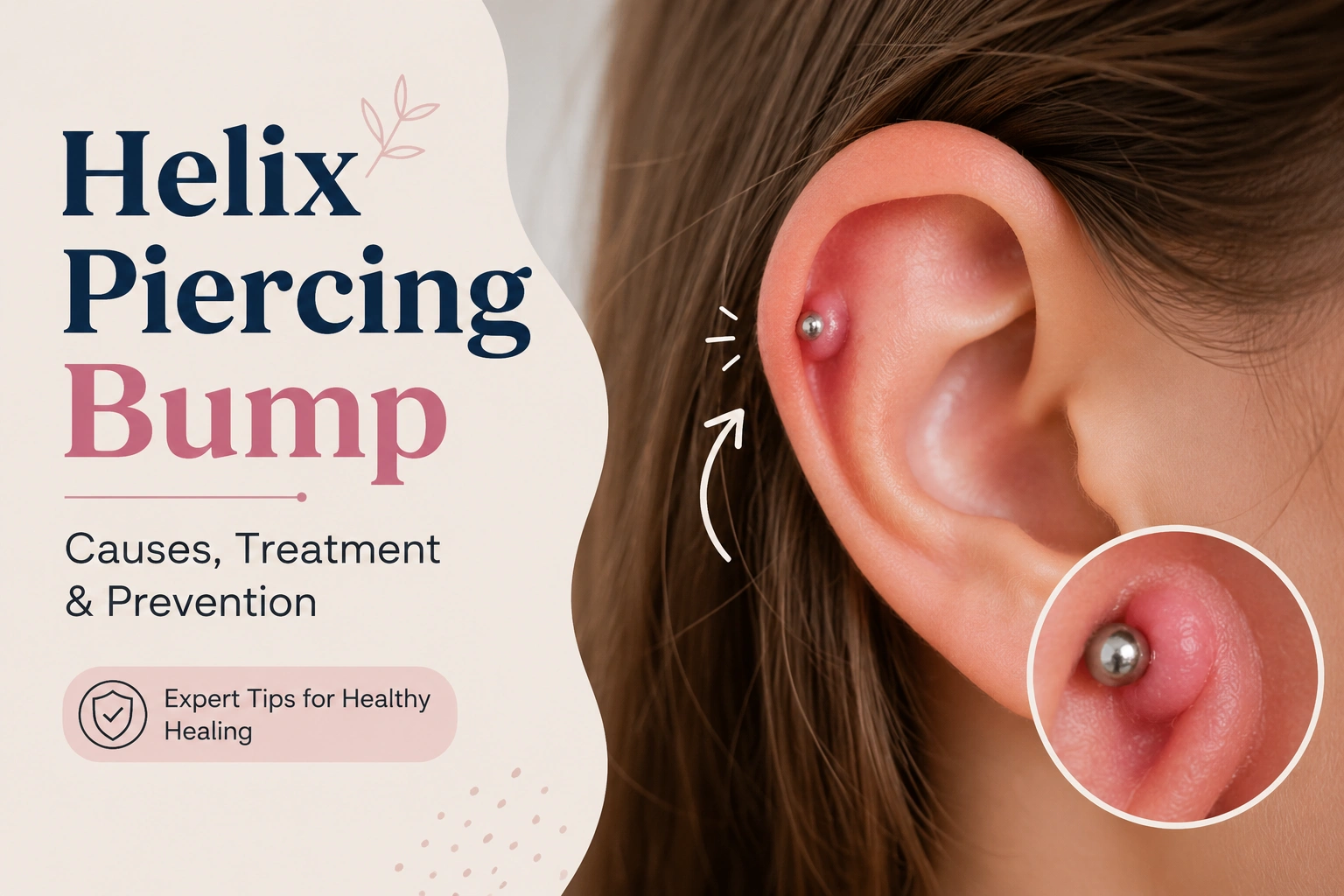
Helix Piercing Bump
What Is It and How Do You Get Rid of It?
A bump appeared on your helix piercing. Before you panic — 9 out of 10 are simple irritation bumps, not keloids. Here is exactly what it is, why it happened, and the step-by-step treatment that actually works.

Helix Piercing Bump — What Is It and How Do You Get Rid of It?
Jump to a section:
Let me say this immediately, because it is the thing most people need to hear: the bump on your helix piercing is almost certainly not a keloid. I know the word keloid gets thrown around constantly in piercing communities, but true keloids are rare, genetic, and look very different from what most people are experiencing. What you have is almost certainly an irritation bump — and it will go away.
I had an irritation bump on my second helix that lasted nearly three months. I tried everything wrong: tea tree oil, squeezing it, changing my jewelry to check it, poking it to see if it was soft. Every single one of those things made it worse. The moment I stopped doing all of it and just followed the correct routine, it resolved in four weeks. Here is exactly what that routine is.
✅ The One-Sentence Answer
Your helix piercing bump is almost certainly an irritation bump caused by something specific — sleeping on it, snagging, bad jewelry, or over-cleaning. Find that cause, remove it, clean twice daily with sterile saline, and leave it completely alone. It will go away in 4–8 weeks.
What Is a Helix Piercing Bump?
A helix piercing bump is a raised area of tissue that appears next to or around the entry or exit point of a helix piercing. It is one of the most common piercing complications — and one of the most misunderstood. The word “bump” is actually an umbrella term that covers several distinct things, which is why treatment advice online is so contradictory: different bumps need different responses.
The vast majority of helix piercing bumps — somewhere around 80–90% based on the professional piercing community’s experience — are irritation bumps. These are your body’s localized inflammatory response to repeated mechanical trauma or irritation at the piercing site. They are not scars, not infections, and not keloids. They are temporary, and they resolve completely when the source of irritation is removed and proper aftercare is resumed.
An irritation bump is not the same as a keloid. A keloid is a rare, genetically-driven overgrowth of scar tissue that extends beyond the wound boundary and continues growing for months or years. Most people do not develop keloids. If your bump appeared after an identifiable trigger, is soft, and stays near the piercing hole — it is an irritation bump.
4 Types of Helix Bumps — Which One Do You Have?
Identifying your specific bump type is the first step — because each has a slightly different treatment approach and timeline.
⚠️ Irritation Bump
- Small, soft, near the piercing hole
- Skin-toned or slightly pink/red
- Appeared after a specific trigger
- Stable size — does not grow
- Resolves in 4–8 weeks with care
- Most common type — 80%+ of cases
🧒 Hypertrophic Scar
- Slightly firmer than irritation bump
- Pink-red, raised, at wound edge
- Forms over weeks after repeated trauma
- Stays within piercing boundary
- Slower to resolve — 6–16 weeks
- Needs cause removal + saline + patience
🚨 Infected Bump
- Yellow-green pus with smell
- Spreading redness beyond hole
- Hot to touch, throbbing pain
- Gets worse despite aftercare
- Possible fever or feeling unwell
- See a doctor — do not remove jewelry
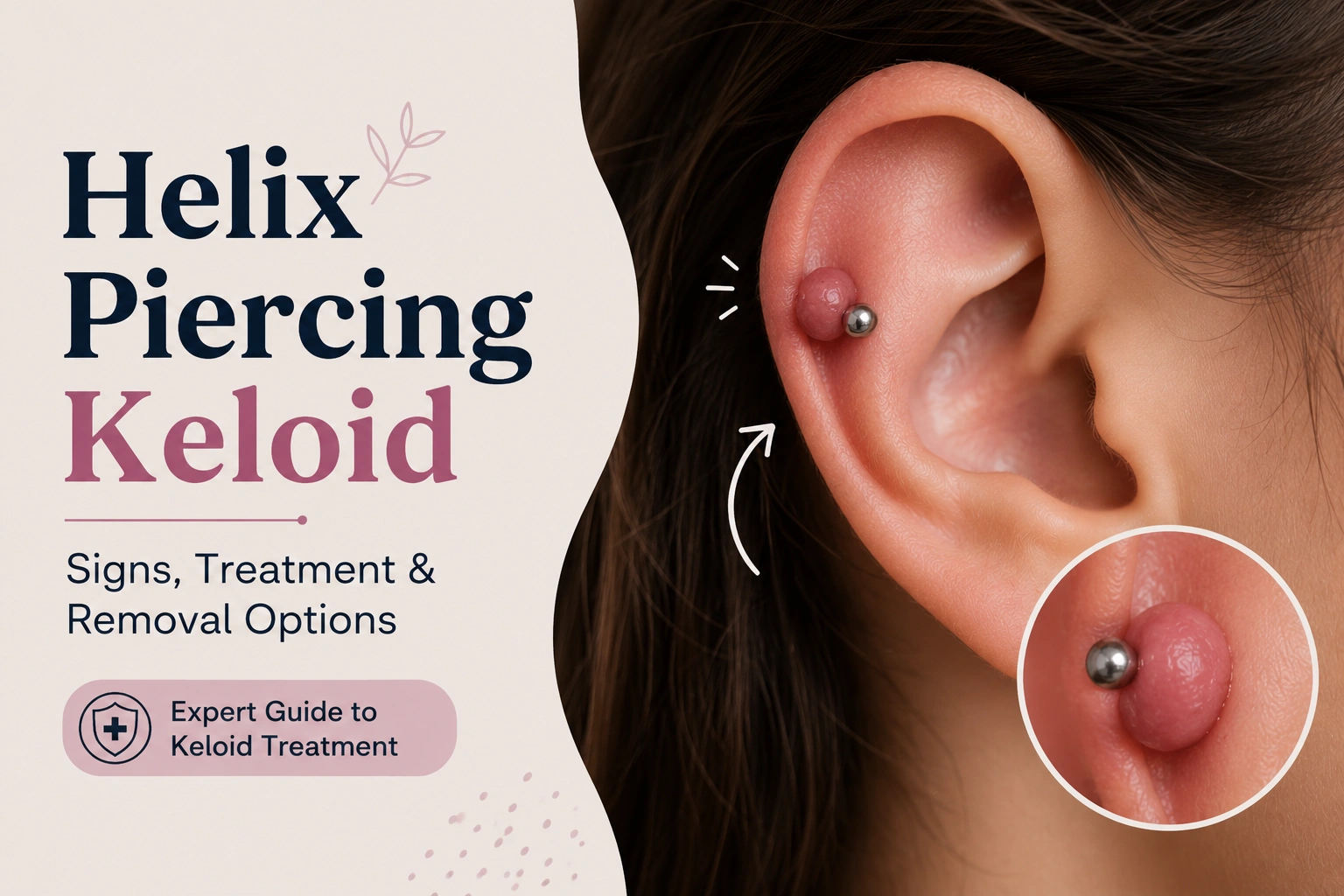
🔵 True Keloid (Rare)
- Grows beyond piercing boundary
- Firm or rubbery — not soft
- Continues growing over months
- Darker than surrounding skin
- Family history of keloids usually present
- Requires a dermatologist
If your bump appeared within days or weeks of an obvious trigger (sleeping on it, snagging, changing jewelry), is soft when pressed, and stays within the piercing site — you have an irritation bump. Read the treatment section below. If it is firm, growing beyond the hole, and has been present and expanding for months — see a dermatologist.
What Causes a Helix Piercing Bump?
Every irritation bump has a cause. Finding yours is 80% of the treatment. Here are the most common triggers, in order of frequency:
| Cause | How Common | How to Fix It |
|---|---|---|
| Sleeping on the piercing | #1 most common | Travel/donut pillow every night, no exceptions |
| Snagging on hair, clothing, towels | Very common | Tie hair back, be deliberate with towels and clothing |
| Low-quality jewelry metal | Very common | Switch to ASTM F136 implant-grade titanium immediately |
| Changing jewelry too early | Common | Do not change jewelry before 6 months minimum |
| Touching with unwashed hands | Common | Hands off — completely |
| Over-cleaning | Moderate | Maximum 2× daily — more is not better |
| Post too long after swelling resolved | Moderate | Book a downsize appointment with your piercer |
| Using harsh products | Moderate | Stop all products except sterile saline |
| Over-ear headphones | Less common | Switch to earbuds or headphones that avoid the helix |
I had a bump for two months and tried everything — tea tree oil, saline soaks, changing to a smaller stud. Nothing worked. Then my piercer pointed out I was sleeping on my right side every night and my pillow was pressing directly on the helix. I bought a travel pillow that week. The bump was gone in three weeks. I had been fighting the symptom the whole time instead of the cause.
Helix Piercing Bump Treatment — The Exact Step-by-Step Routine
This is the treatment that works. Not tea tree oil. Not popping it. Not a salt soak every hour. This routine — done consistently — resolves the vast majority of irritation bumps within 4–8 weeks.
This is the most important step and the one most people skip. Ask yourself honestly: Am I sleeping on this side? Did I snag it recently? Is the jewelry from a chain store or of unknown metal? Did I change it too early? You cannot treat an irritation bump while the irritation is still happening. Fix the cause first.
If your jewelry is from a fashion store, a chain retailer, or of unknown metal, switch to ASTM F136 implant-grade titanium immediately. Nickel-containing metals cause a persistent low-grade reaction that prevents bumps from resolving no matter how well you clean. Your piercer can do this swap safely.
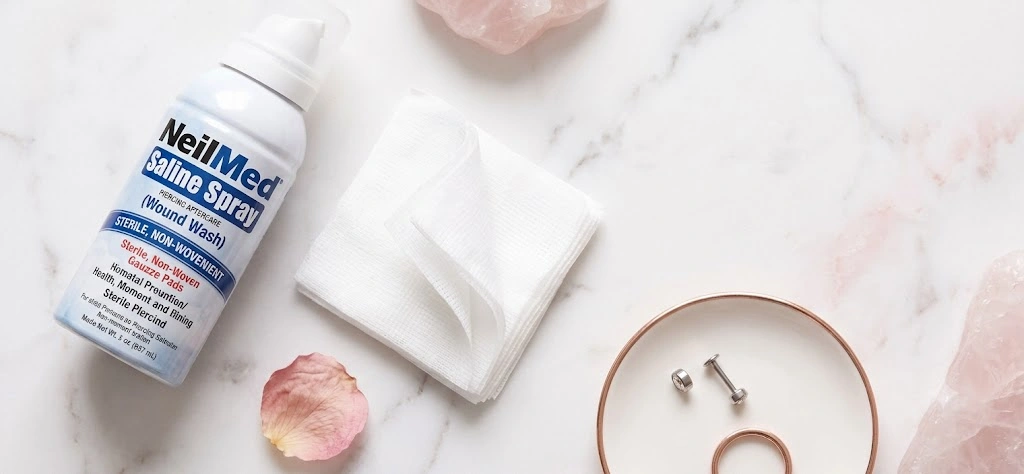
Use sterile 0.9% sodium chloride wound wash spray (NeilMed Wound Wash is the professional standard). Spray front and back of the piercing. Leave for 30 seconds. Pat dry with a clean paper towel. Do this morning and evening. That is the complete cleaning routine — no additions, no extras.
Every touch introduces bacteria and creates mechanical trauma. The urge to check whether it has changed, press it to see if it is softer, or rotate the jewelry — resist all of it. The bump needs consistent non-interference to heal. This is the hardest part of the treatment and also one of the most important.
A donut-shaped travel pillow keeps the ear from touching the pillow surface. Even one night of direct pressure can reset your bump progress. This is non-negotiable if sleeping on the pierced side was the original cause — and it often is even when people do not realise it.
The initial jewelry post is intentionally longer to accommodate swelling. Once swelling resolves, this extra length can move and snag, directly causing bumps. Your piercer replaces it with a shorter, better-fitting post — often called a “downsize.” This single appointment resolves many persistent bumps.
Bumps do not disappear overnight. With the cause removed and this routine in place, most irritation bumps reduce noticeably within two weeks and resolve fully within four to eight weeks. If there is zero improvement after six weeks of correct care, visit your piercer for an in-person assessment.
Sterile saline 2× daily · Paper towel dry only · Travel pillow every night · Implant-grade titanium jewelry · Hands completely off · No products except saline · No rotating · No changing jewelry · No swimming · No headphones on that ear
How Long Does a Helix Piercing Bump Take to Go Away?
The timeline depends entirely on two things: how quickly you remove the cause, and how consistently you maintain correct aftercare. Here is the realistic progression:
- The most common reason: the cause has not been fully removed. If you are still sleeping on it even occasionally, the bump will not resolve.
- Second most common: the jewelry metal is still reacting. Fashion store jewelry causes persistent reactions that saline alone cannot override.
- Third: the post is still too long. A longer post moves within the channel and creates ongoing micro-trauma. Book a downsize.
Bump After Specific Triggers — Targeted Advice
Helix Piercing Bump After Changing Jewelry
Changing helix jewelry too early is one of the most reliable ways to cause a bump — and one of the most common reasons people message us. The external skin may look healed at 3–4 months, but the internal cartilage channel is still forming. Removing and reinserting jewelry at this stage tears new tissue and triggers an immediate inflammatory bump.
Treatment: Resume the strict aftercare routine above. If you switched to an unknown metal, change back to implant-grade titanium — have your piercer do this, do not do it yourself right now. Give the bump 4–6 weeks to resolve before attempting any further jewelry changes.
Bump on the Back of the Helix Piercing
A bump specifically on the exit point of the piercing — behind the flat disc — is usually caused by one of two things: the flat disc being too small and pressing into the skin as the jewelry moves, or the post being too short so the disc is pulling against the exit channel. Both are jewelry fit issues your piercer can resolve at a downsize appointment. If the disc appears to be sinking into the skin, see your piercer promptly — this is embedding and needs prompt attention.
Bubble Appeared Suddenly Overnight
A bump that appears suddenly — often described as a fluid-filled bubble — typically means one acute traumatic event happened: snagging on a hairbrush, a pillow pressing at the wrong angle overnight, or a towel catching the jewelry. The body responds to sudden cartilage trauma with a rapid inflammatory bump. Apply the full treatment routine above and identify what the one-off trauma was to prevent it repeating.
Saline Is Not Getting Rid of the Bump
This is the most common misunderstanding about bump treatment: saline does not remove bumps on its own. Saline supports healing once the irritation source is removed. If you are cleaning consistently with saline but the bump persists, saline is not the problem — the ongoing cause is. Go back through the causes list above and ask honestly whether any of them are still happening.
What NOT to Put on a Helix Piercing Bump
The internet is full of home remedy advice for piercing bumps that ranges from useless to actively damaging. Here is the complete list of what to avoid and why:
✓ Use These
- ✓ Sterile 0.9% saline wound wash spray
- ✓ Clean paper towels for drying
- ✓ Ibuprofen for pain/swelling (short-term)
- ✓ Travel/donut pillow at night
- ✓ Your piercer’s professional assessment
✕ Never Use These
- ✕ Tea tree oil — chemical burns, makes bumps worse
- ✕ Hydrogen peroxide — kills healing cells
- ✕ Rubbing alcohol — destroys tissue
- ✕ Neosporin or antibiotic cream — traps bacteria
- ✕ Aspirin paste — folk remedy, no evidence
- ✕ Toothpaste — chemical irritant
- ✕ Bactine — not appropriate for piercings
- ✕ Any piercing “keloid cream” — not evidenced
- ✕ Squeezing or popping — introduces bacteria
- ✕ Homemade salt mixes — concentration inconsistent
Popping, squeezing, draining, or cutting open a helix piercing bump introduces bacteria directly into the healing piercing channel, dramatically increases infection risk, causes trauma that triggers a larger bump, and often creates permanent scarring. The bump contains lymph fluid and inflammatory cells — not pus that needs draining. Leave it completely alone.
Helix Piercing Bump vs Keloid — How to Tell the Difference
Because “keloid” is so frequently misused in piercing communities, it is worth being very clear about how these two things actually differ. If you are unsure which one you have, this comparison will tell you:
| Feature | Irritation Bump | True Keloid |
|---|---|---|
| How it appeared | After an identifiable trigger | Gradually, over many months |
| Size and boundary | Small, stays at piercing site | Grows beyond the wound boundary |
| Texture when pressed | Soft, may feel fluid-filled | Firm, rubbery, almost hard |
| Growth behaviour | Stable size | Continues growing over months |
| Colour | Pink, red, or skin-toned | Often darker than surrounding skin |
| Family history needed? | No — anyone can get an irritation bump | Yes — strong genetic component |
| Responds to aftercare? | Yes — resolves fully | No — needs medical treatment |
| How common? | Very common — 80%+ of cases | Rare — ~10% genetic predisposition |
| Treatment | Remove cause + saline aftercare | Dermatologist: injections, laser, surgery |
If you answered “soft, stays near the hole, appeared after something specific, stable size” — you have an irritation bump. Follow the treatment above.
If you answered “firm or rubbery, has been growing beyond the hole for months, family history of keloids” — see a dermatologist. Do not rely on home remedies for a true keloid. Read our dedicated Helix Piercing Keloid Guide for the full picture on causes, diagnosis, and treatment options.
Helix Piercing Bump FAQ
Still Have a Bump After 6 Weeks?
If your bump is not improving after consistent correct care, it is time for a professional in-person assessment. Read our full problems guide for next steps.
Full Problems Guide →