What Is a Helix Piercing?
Everything you need to know before your first appointment — placement, pain, healing, and what to expect.

What Is a Helix Piercing? The Complete Guide
Jump to a section:
What Is a Helix Piercing?
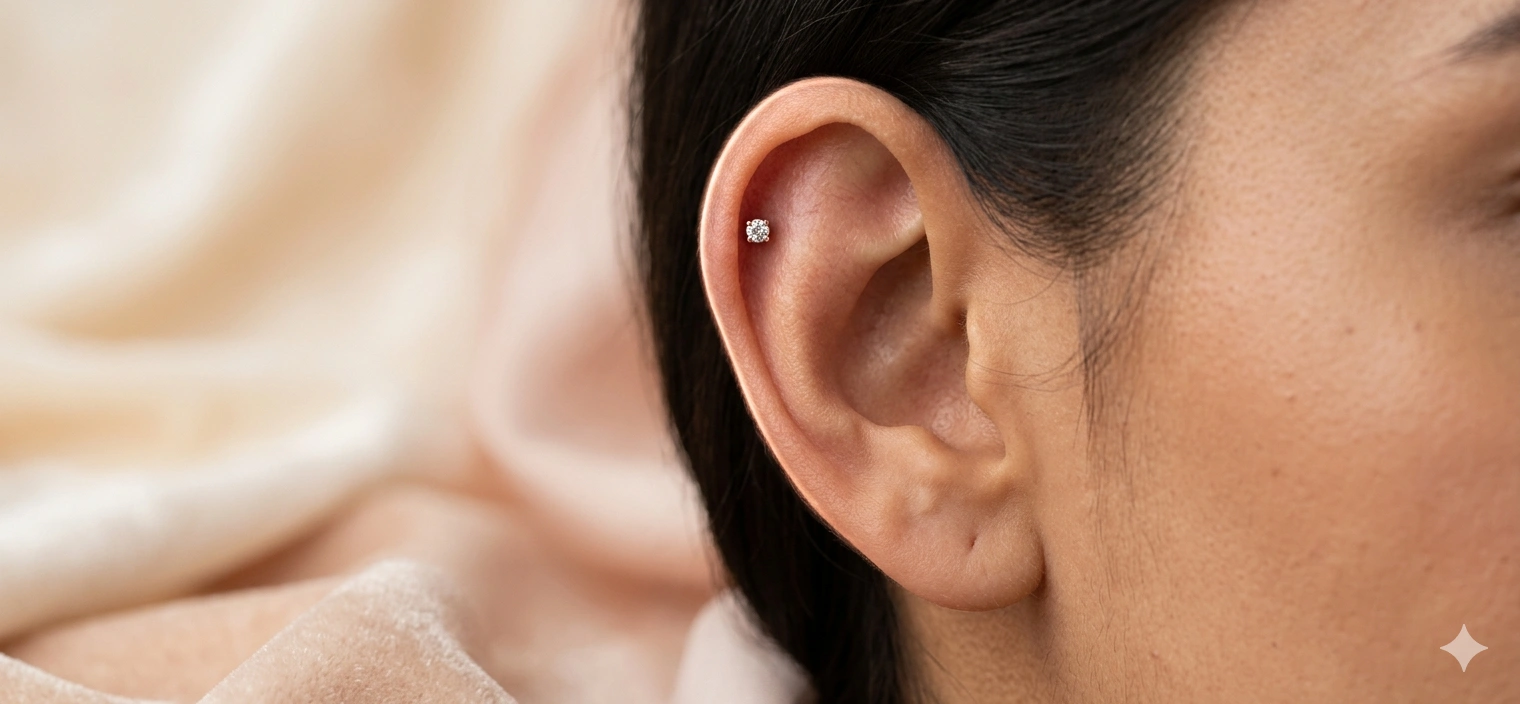
A helix piercing is a body piercing that passes through the outer upper rim of the ear — a curved fold of cartilage anatomically known as the helix. It is consistently one of the most popular ear piercings in the world, second only to the standard lobe piercing in global demand. On social media, aesthetic platforms, and in professional piercing studios, the helix remains the go-to choice for anyone looking to elevate their ear styling without committing to something extreme.
Unlike a lobe piercing, which goes through soft, fatty tissue, a helix piercing passes through firm cartilage. This is the same stiff, flexible connective tissue that gives your ear its structure and shape. Because cartilage has a significantly lower blood supply than soft tissue, helix piercings take considerably longer to heal — typically between six and twelve months — but they are completely safe and straightforward when done correctly.
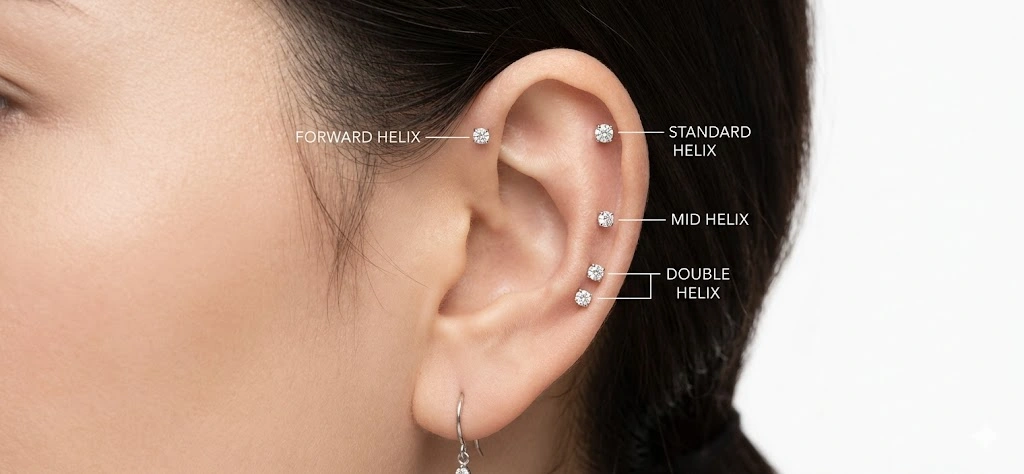
What makes the helix so appealing is its sheer versatility. The helix rim spans a large portion of the upper ear, which means your piercer has a wide range of placement options to work with. You can position a helix near the top of the ear, midway down the rim, toward the front near the face, or even stack two or three piercings in a row for a curated, editorial look. Almost every ear — regardless of shape or size — has enough anatomy to accommodate at least one helix piercing.
Location: Outer upper cartilage rim of the ear | Healing Time: 6–12 months | Pain Level: 4 out of 10 | Average Cost: $30–$90 | Starting Jewelry: Flat-back labret stud | Best Material: Implant-grade titanium (ASTM F136)
Why Is the Helix Piercing So Popular?
The helix occupies a uniquely attractive position in the world of ear piercings. It is visible enough to make a genuine style statement — anyone standing next to you will notice it — but subtle enough that it fits in professional environments, conservative families, and everyday life without causing friction. This balance is rare in body piercing, and it is a major reason the helix consistently tops piercing popularity charts.
Beyond practicality, the helix has become the anchor of the “curated ear” trend — one of the biggest aesthetics in modern jewelry culture. A curated ear involves carefully planning multiple piercings across the ear so they complement each other visually, creating a cohesive, intentional look. The helix almost always features prominently because of its central, highly visible position on the upper ear. From minimalist single-stud looks to fully stacked editorial ear projects, the helix is almost always part of the conversation.
The helix also pairs exceptionally well with other ear piercings. It sits naturally close to the tragus, rook, conch, daith, and multiple lobe positions. A skilled piercer can help you map a jewellery plan where each piece complements the others in size, metal, and gemstone style — something the helix is perfectly positioned for. For more on building a stack, see our complete types guide.
Quick Comparison: Helix vs Other Popular Ear Piercings
| Piercing | Location | Pain | Healing Time | Good for Beginners? |
|---|---|---|---|---|
| Helix | Outer upper cartilage rim | 4/10 | 6–12 months | ✅ Yes |
| Forward Helix | Front cartilage near temple | 6/10 | 9–12 months | ⚠️ Moderate |
| Tragus | Small cartilage flap at ear canal | 4/10 | 6–12 months | ✅ Yes |
| Conch | Inner cartilage bowl | 5/10 | 9–12 months | ⚠️ Moderate |
| Rook | Inner upper cartilage fold | 6/10 | 12–18 months | ❌ Experienced |
| Lobe | Soft lower earlobe | 2/10 | 4–6 weeks | ✅ Yes |
| Industrial | Two helix points connected | 6/10 | 9–12 months | ⚠️ Moderate |
Helix Piercing on Ear Anatomy: Where Exactly Does It Go?
To fully understand a helix piercing, it helps to understand the anatomy of the outer ear — the visible part of your ear known medically as the auricle or pinna. The outer ear is a remarkably complex structure made up of multiple ridges, folds, and hollows, each with a specific anatomical name. Piercers use this terminology every day, and knowing it helps you communicate clearly about what you want and where.
The Key Structures of the Outer Ear
Where Exactly on the Helix Does the Piercing Go?
The helix rim is long — it runs from just above and behind the ear canal (called the crus of helix) all the way around the top and down the back of the ear toward the lobe. A standard helix piercing typically sits in the upper third of this rim, often at the very top of the ear where the curve is most pronounced. This is the most recognizable position when someone says “I have a helix piercing.”
However, piercers have the flexibility to place a helix piercing at almost any point along this rim. The exact position is determined by your ear’s unique anatomy, the look you want to achieve, and whether you plan to add more piercings in the future (spacing needs to be accounted for when planning multiple helix piercings).
Some ears have a significant flat area of cartilage just inside the helix rim — this is called the flat or scapha. A “flat helix” piercing goes through this flat section rather than the curved rim itself. It looks slightly different and suits specific jewelry styles (particularly flat-top labrets with decorative ends).
Why Anatomy Matters So Much for Helix Piercings
No two ears are exactly alike. The helix rim can be thick or thin, tightly curled or broadly curved, high on the skull or lower. This matters enormously for piercing placement, jewelry sizing, and even which types of helix piercings are possible on a given ear. A professional APP-certified piercer will examine your specific ear anatomy before recommending any placement.
Some ears have a very tight, narrow helix rim that limits jewelry options. Others have a broad, flat helix ideal for decorative flat-back studs. Some forward helix positions require a minimum of cartilage thickness to heal correctly. This is why you should never choose your piercing placement based purely on a photo — what works on someone else’s ear may not be possible or advisable on yours.
Helix Ear Piercing Meaning: Cultural History & Modern Significance
The word helix comes from ancient Greek — ἕλιξ (hélix) — meaning a spiral, coil, or curl. In anatomy, the term was adopted to describe the outer curved rim of the ear because of its characteristic spiral shape as it wraps around the auricle. The name is both precise and poetic: it describes exactly what it is — a curved edge, a structural spiral that defines the ear’s silhouette.
Historical Origins of Ear Cartilage Piercing
Ear piercing in general is one of the oldest forms of body modification in human history, with archaeological evidence dating back over 5,000 years. The most famous historical example is Ötzi the Iceman — a naturally preserved mummy discovered in the Alps in 1991 — whose ears showed evidence of stretching that suggests sophisticated piercing practices existed in prehistoric Europe.
In ancient Egypt, ear piercing was associated with wealth and status. Elaborate gold earrings found in royal tombs show that ear adornment was considered a mark of beauty and power. In ancient Rome and Greece, ear piercings were common among both men and women of all social classes, though certain styles were associated with specific roles or identities.
Cartilage piercing specifically — the kind required for a helix piercing — has a rich tradition in many South Asian, Southeast Asian, and Latin American cultures. In India, for example, the upper ear piercing known as kundal or kaan ki bali has been practiced for thousands of years, often with significant spiritual and ceremonial meaning. In many Hindu traditions, ear piercing (known as Karnavedha) is one of the sixteen rites of passage (samskaras), performed on children as a blessing for long life and intelligence.
Modern Cultural Meaning
In contemporary Western culture, the helix piercing carries several layers of meaning — though none are fixed or universal. Unlike some piercings that have historically been associated with specific subcultures (such as nose rings with punk movements, or tongue piercings with alternative fashion), the helix has become broadly mainstream. It is as common in conservative professional settings as it is in alternative fashion circles.
For many people, getting a helix piercing represents personal expression and self-ownership — a way of decorating and personalizing the body that feels meaningful without requiring explanation to others. For others, it is purely aesthetic — a beautiful piece of jewelry that enhances their look. And for a growing number of people, it is part of a wider ear-curation project — a deliberate, artistic arrangement of multiple piercings that reflects personal style.
The helix piercing also carries a subtle symbolism of confidence and individuality. It requires commitment — it takes months to heal and demands consistent care. People who have helix piercings often note that the process of caring for the piercing during healing builds a kind of respect for their own body, creating a more intentional relationship with self-care and personal aesthetics.
The helix is consistently among the top 3 most-searched piercing types globally, alongside the tragus and the septum. On Pinterest and Instagram, helix piercing content generates hundreds of millions of impressions per year — making it one of the most influential aesthetic trends in body modification.
Is a Helix Piercing a Cartilage Piercing?
Yes — a helix piercing is definitively a cartilage piercing. This is one of the most important things to understand before you get one, because cartilage piercings behave fundamentally differently from soft tissue piercings like lobe piercings in almost every way that matters: healing time, aftercare requirements, pain profile, and complication risks.
What Is Cartilage?
Cartilage is a firm but flexible connective tissue found throughout the body — in your nose, ears, joints, ribcage, and trachea. Unlike bone, cartilage is not hard or brittle. Unlike soft tissue (fat and skin), it is not pliable or squishy. It occupies a middle ground: structural enough to hold shape, but with enough flexibility to bend slightly without breaking.
The cartilage in your outer ear is specifically elastic cartilage — the most flexible type, rich in elastin fibers. This is what allows your ear to bend without snapping. Elastic cartilage is found only in the ear (auricle), the epiglottis (the flap covering your airway during swallowing), and the Eustachian tubes.
Why Does Cartilage Take Longer to Heal Than Lobe?
This is the single most important practical implication of the fact that helix piercings are cartilage piercings. Cartilage heals more slowly than soft tissue for a very specific biological reason: cartilage has almost no direct blood supply.
Most tissues in your body receive oxygen, nutrients, and immune cells through a dense network of blood vessels. This vascular supply is what drives healing — it delivers the building blocks needed to repair damaged tissue. Your earlobe, for example, has a reasonable blood supply, which is why a lobe piercing heals in just four to six weeks.
Cartilage, by contrast, is avascular — it receives nutrients not through blood vessels but through a slow process of diffusion from surrounding fluid. This means the healing process is dramatically slower. A helix piercing that looks and feels completely healed at three months may still be actively healing internally at twelve months. Changing jewelry too early is the single most common mistake helix piercees make — and it almost always causes setbacks.
Around the 2–4 month mark, most helix piercings go through a “false heal” phase — the surface looks clean, there’s minimal crust, and it barely feels tender. Many people assume they’re healed and change their jewelry. This almost always causes a setback. True cartilage healing takes 6–12 full months. The surface heals first; the internal fistula takes much longer.
Cartilage Piercing: Key Differences from Lobe
| Factor | Lobe Piercing | Helix / Cartilage Piercing |
|---|---|---|
| Tissue Type | Soft fatty tissue | Elastic cartilage |
| Blood Supply | Well vascularized | Avascular (diffusion only) |
| Healing Time | 4–6 weeks | 6–12 months |
| Pain During Healing | Minimal after 1–2 weeks | Occasional tenderness for months |
| Jewelry Options | Wide (hoops, studs, dangles) | Start with studs only; hoops after full healing |
| Infection Risk | Lower | Higher (but avoidable with correct aftercare) |
| Gun Safe? | Generally safe (though still not ideal) | Never — guns can shatter cartilage |
Why Guns Are Never Used on Cartilage
This point cannot be overstated. A piercing gun works by forcing jewelry through tissue using blunt pressure. On soft lobe tissue, this causes minimal damage. On cartilage, which is a rigid structure, the blunt force of a gun can literally fracture or shatter cartilage tissue at a microscopic level. This damage is invisible to the naked eye but creates a compromised, irregular wound channel that takes far longer to heal, has a significantly higher infection rate, and is much more likely to produce irritation bumps, keloids, and long-term complications.
Every major professional piercing body, including the Association of Professional Piercers (APP), explicitly prohibits guns on cartilage. If a studio offers to use a gun on your helix (including chain stores like Claire’s or Lovisa for cartilage), walk out and find a professional.
Helix Piercing Types: Every Variation Explained
One of the most appealing things about the helix is the sheer variety of placement options. The helix rim is a long, curved structure that offers numerous distinct positions, each with its own name, visual effect, and healing characteristics. Understanding the different types of helix piercings helps you make the right choice for your ear and your aesthetic goals.
1. Standard Helix Piercing (Single Helix)
The most classic version. A single piercing placed anywhere along the outer curved rim of the upper ear — most commonly near the top of the ear. This is what most people mean when they say “a helix piercing” without any qualifier. It suits virtually every ear shape, works with both studs and hoops (hoops only after healing), and is the ideal entry point for anyone new to cartilage piercings. Pain: 4/10. Healing: 6–9 months.
2. Double Helix Piercing
Two helix piercings stacked vertically along the same section of the helix rim, usually spaced 6–10mm apart. The double helix creates an immediately striking, curated look and is one of the most popular combinations in modern ear styling. You can match the jewelry (two identical flat-back studs, for example) or mix styles for contrast. The key question is whether to get both at once or stage them — most experienced piercers recommend staging them 3–6 months apart for easier healing. Pain: 4/10 each. Healing: 6–12 months.
3. Triple Helix Piercing
Three piercings in a vertical line along the helix rim. The triple helix is bold, editorial, and visually striking — it dominates the ear and signals serious commitment to ear curation. It requires good ear anatomy (enough rim length) and ideally an experienced piercer who can plan the spacing correctly. Getting all three at once is not recommended; most piercers suggest building up one at a time. Pain: 4/10 each. Healing: 9–12 months for the full stack.
4. Forward Helix Piercing
Placed at the very front of the helix rim — specifically at the crus of helix, where the helix meets the head near the temple. The forward helix faces forward rather than outward, giving it a completely different visual profile from a standard helix. It shows up beautifully in photos and from the front rather than the side. The forward helix area has thicker, denser cartilage and more nearby nerve endings, making it slightly more painful and slower to heal. Pain: 6/10. Healing: 9–12 months.
5. Mid Helix Piercing
Positioned in the middle section of the helix rim — between the standard top helix position and the forward helix position. The mid helix is a versatile choice that works well on most ear shapes and can bridge the visual gap between a forward helix and upper helix if you’re building a stack. Pain: 4/10. Healing: 6–9 months.
6. Flat Helix Piercing
Rather than going through the curved outer rim, the flat helix piercing passes through the flat cartilage area just inside the rim — called the scapha. This flat area allows for larger decorative jewelry ends (like cluster gems or ornate flat-tops) that would look oversized on the narrow rim itself. The flat helix requires specific ear anatomy (a broad enough scapha) and has slightly different healing characteristics from rim piercings. Pain: 4/10. Healing: 9–12 months.
7. Hidden Helix Piercing
A 2025–2026 breakout trend. The hidden helix is placed in the folded crease of the helix — tucked just underneath the rim so that it’s only visible from certain angles. It appears as a discreet sparkle that comes and goes as you move, making it ideal for people who want something subtle. Not all ears have the anatomy for a hidden helix; your piercer will tell you if yours does. Pain: 5/10. Healing: 9–12 months.
Many people use multiple helix types as the foundation of a curated ear — for example, a forward helix at the front, a standard helix in the middle, and a third helix near the top. Add a tragus or conch lower down, and you have a full editorial ear stack. A good piercer can help you plan the entire project before you start, including which order to get the piercings in for optimal healing.
Helix vs Forward Helix: The Key Differences Explained
The confusion between a standard helix and a forward helix is one of the most common questions first-timers ask. They sound similar, they’re both on the helix rim, and they’re often mentioned together — but they are distinctly different piercings in terms of placement, visual effect, pain, and healing. Understanding the difference helps you make the right choice.
Placement: Where Each Sits on the Ear
A standard helix piercing sits on the outer curved rim of the upper ear — the part of the ear that faces sideways and backward. When you look at someone’s ear from the side, the helix is the curved edge closest to you. A standard helix piercing is most visible when someone is facing away from you or in profile.
A forward helix piercing sits at the front section of the helix rim — specifically at the crus of helix, which is the ridge where the helix begins at the front of the ear near the temple. The forward helix faces forward (toward the face) rather than outward. When you look at someone from the front, their forward helix is one of the first piercings you notice. It sits very close to where the ear meets the side of the head.
Visual Difference
The most important practical difference is visibility direction. A standard helix is most visible from the side and back. A forward helix is most visible from the front. If you spend a lot of time on video calls, in meetings, or in situations where people are facing you, a forward helix will have far more visual impact. If you want a piercing that shows up in profile photos or when your hair is behind your ears, a standard helix is the stronger choice.
Pain Level Comparison
The forward helix is consistently rated more painful than the standard helix. The standard helix averages around 4 out of 10 on the pain scale. The forward helix averages 5.5–6.5 out of 10. There are two reasons for this. First, the cartilage at the crus of helix (where the forward helix sits) is generally thicker and denser than the cartilage along the outer rim. Second, the front of the ear — near the temple — has a higher density of nerve endings than the outer rim, making it more sensitive to any kind of stimulus including piercing pressure.
Healing Time Comparison
Standard helix piercings typically heal in 6–9 months with good aftercare. Forward helix piercings take 9–12 months on average, sometimes longer, because of the denser cartilage and the higher stress placed on the area (it’s closer to the head, more susceptible to snagging on hair, headphones, and pillows). Forward helix piercings also have slightly higher rates of irritation bumps and require more careful sleeping habits during the entire healing period.
| Feature | Standard Helix | Forward Helix |
|---|---|---|
| Anatomical location | Outer upper rim (sideways-facing) | Front rim at crus of helix (forward-facing) |
| Most visible from | Side / back view | Front / face-on view |
| Pain level | 4/10 | 6/10 |
| Average healing time | 6–9 months | 9–12 months |
| Jewelry options (healed) | Studs and hoops | Studs primarily; small hoops possible |
| Risk of snagging | Moderate | Higher (near hairline) |
| Suitable for beginners? | Yes ✅ | Preferably after first helix heals ⚠️ |
| Works for curated ear? | Excellent anchor piece | Beautiful front accent |
Which One Should You Get?
If you’re new to cartilage piercings, start with the standard helix. It is easier to heal, less painful, more forgiving of minor aftercare mistakes, and gives you a strong foundation of experience before attempting a forward helix. If you already have a healed standard helix and want to build your ear stack, the forward helix is a natural and beautiful next step — particularly if you want a piercing that shows up from the front.
Helix Piercing for Beginners: Everything You Need to Know First
If you’re considering your first helix piercing, you’ve probably already seen them everywhere — on social media, on colleagues, on friends — and you want to know if it’s right for you. The good news is that the helix is one of the most beginner-friendly cartilage piercings available. Here is a comprehensive beginner’s guide to everything you need to know before, during, and after your first helix piercing.
Am I a Good Candidate for a Helix Piercing?
The vast majority of people are suitable candidates for a helix piercing. There are very few genuine contraindications. However, there are some situations where you should discuss your specific circumstances with both a piercer and a doctor first:
- Keloid history: If you or close family members have a history of keloid scarring, cartilage piercings carry a higher risk of keloid formation. This doesn’t mean you can’t get pierced, but it’s important context for your decision.
- Blood thinners or clotting disorders: Medications like warfarin or conditions like haemophilia affect healing. Consult your doctor before piercing.
- Autoimmune conditions: Conditions that affect the immune system can slow wound healing. A doctor’s guidance is wise.
- Active skin conditions: Eczema, psoriasis, or active infections near the piercing site need to be resolved first.
- Age: Most reputable studios require you to be 16+ with parental consent, or 18+ without. Requirements vary by country and studio.
How to Choose the Right Piercing Studio
This is possibly the most important decision you’ll make about your helix piercing. The quality of your piercer determines everything: the precision of the placement, the sterility of the equipment, the jewelry quality, and the aftercare guidance you receive. Here’s what to look for:
Look for a studio where the piercers are members of the Association of Professional Piercers (APP). APP membership requires piercers to meet strict standards for training, sterilization, and jewelry quality. It’s the gold standard for piercing safety.
A professional studio should have an autoclave — a medical-grade sterilization device that uses pressurized steam to sterilize instruments. Ask to see it. If a studio can’t show you their autoclave, leave.
The studio should use only implant-grade titanium (ASTM F136), implant-grade steel (ASTM F138), solid 14k/18k gold, or niobium for initial piercings. If they offer mystery metals, acrylic, or silver for initial jewelry, it’s a red flag.
A good piercer will have photos of their helix work. Look for clean, precisely placed piercings with appropriate jewelry. Poor placement or sloppy technique shows up immediately in photos.
The studio should be visibly clean. Single-use needles should be opened in front of you. Piercers should wash hands and wear gloves. If anything feels unhygienic, trust your instincts.
Chain jewelry stores (including Claire’s, Lovisa, and similar) use piercing guns on cartilage — which is explicitly not recommended by any professional piercing body. For a helix piercing specifically, always go to a dedicated professional piercing studio with an APP-certified piercer and a hollow needle. The extra cost (typically $10–$30 more) is completely worth it for your safety and healing outcome.
What to Do Before Your Appointment
- Eat a full meal 1–2 hours beforehand — low blood sugar increases pain sensitivity and can cause fainting
- Stay well hydrated — dehydration heightens discomfort
- Wear your hair away from your ears so the piercer can work comfortably
- Bring ID if you’re near the age threshold
- Do not take aspirin before piercing — it thins the blood
- Do not drink alcohol within 24 hours — alcohol also thins the blood
- Avoid caffeine on piercing day — it constricts blood vessels and increases sensitivity
What to Expect During the Piercing
First-timers often build up significant anticipation about the piercing moment itself. Here’s exactly what to expect so there are no surprises:
Your piercer will clean the area with an antiseptic solution, then mark the placement with a skin-safe marker. You’ll be asked to look in a mirror and approve the placement before anything happens — this is your moment to speak up if the placement doesn’t feel right. Piercers expect adjustments; don’t hesitate to ask.
When you’re happy with the placement, your piercer will position a receiving tube or cork behind the mark (to protect the ear canal) and pass a single-use hollow needle through the cartilage. The needle takes less than a second to pass through. What you’ll feel is a sharp, brief pressure — like a firm pinch — followed immediately by a sensation of heat in the ear. Most first-timers describe it as “less than I expected.”
After the needle, the jewelry is inserted through the same channel. This can feel slightly more uncomfortable than the needle itself because the jewelry end needs to be threaded and secured. Your piercer will check that the fit is correct — the bar should be long enough to accommodate swelling in the first few weeks. Total procedure time from needle to completed jewelry insertion is typically 20–45 seconds.
Afterwards, your ear will be warm, slightly pink, and may throb mildly for a few hours. This is completely normal. Most people go about the rest of their day completely fine after getting a helix piercing. Over-the-counter ibuprofen (not aspirin) handles any post-piercing discomfort effectively.
Helix Piercing Pain: Real Scale & 10 Ways to Reduce It
Pain is the number one concern for first-time helix piercers. The good news: most people consistently rate it lower than expected. Here’s the honest breakdown — and everything you can do to make it easier on yourself.
Where Does Helix Pain Actually Rate?
Standard Helix — 4/10
A sharp pinch lasting under 1 second. Mild throbbing for 1–3 hours after.
Forward Helix — 6/10
More pressure due to denser cartilage. Slightly longer throbbing post-procedure.
Triple Helix Stack — 4/10 each (cumulative fatigue)
Each individual piercing is manageable, but cumulative sensitivity increases with each additional one done in the same session.
10 Proven Ways to Reduce Helix Piercing Pain
Low blood sugar dramatically amplifies pain perception and increases the chance of feeling dizzy or faint. Eat a proper meal — not just a snack — 1–2 hours before your appointment.
Dehydration tightens your body’s stress response. Drink plenty of water in the 24 hours leading up to your appointment, not just right before.
Take a deep breath in as the needle is positioned, then exhale slowly and steadily as it passes through. This simple breathing technique measurably reduces perceived pain by relaxing the body at the critical moment.
Caffeine constricts blood vessels and heightens nerve sensitivity. Swap your morning coffee for water or herbal tea before your appointment.
An experienced piercer works with speed and precision — the needle passes through cleanly in under a second. Hesitant or inexperienced technique prolongs the process and increases pain. Experience matters more than price.
Most people find that looking away during the needle pass reduces anxiety and perceived pain. Some people prefer to watch — know yourself. There’s no wrong answer.
Research consistently shows that pain sensitivity increases during menstruation due to hormonal fluctuation. If you menstruate, plan your piercing appointment for the first half of your cycle when pain tolerance is highest.
Over-the-counter ibuprofen (not aspirin — aspirin thins blood) taken 30 minutes before your appointment reduces inflammation and mild pain. Check with your doctor if you take any medications. Do not take more than the recommended dose.
Have a conversation with your piercer, listen to music, or squeeze something in your opposite hand. Active distraction engages the brain’s attention resources and genuinely reduces pain signal intensity.
Each consecutive piercing in the same session hurts progressively more as your nervous system becomes sensitized. If you want multiple helix piercings, stage them 3–6 months apart for the easiest experience.
Your ear will be warm, slightly pink, and may throb mildly for a few hours — this is completely normal. Take ibuprofen if needed (not aspirin), apply a cool clean compress if the area feels hot, and avoid sleeping on the pierced ear for the first few nights. Most people feel completely normal within 24 hours. For ongoing healing support, read our complete aftercare guide.
For a full deep-dive on pain by piercing type, healing phase pain patterns, and a week-by-week pain timeline, see our dedicated helix pain guide.
Helix Piercing Jewelry: The Complete Guide for Every Stage
Jewelry choice is one of the most important decisions you’ll make for your helix piercing — not just for aesthetics, but for healing. The wrong metal, wrong size, or wrong style during the healing phase is the leading cause of complications, irritation bumps, and extended healing times. Here’s exactly what you need to know.
The Only Metals Safe for a Fresh Helix Piercing
During the healing phase (the full 6–12 months), your piercing channel is an open wound internally. Only biocompatible, implant-grade metals should be in contact with it. The four approved options are:
| Metal | Grade | Why It’s Safe | Cost Range |
|---|---|---|---|
| Implant-Grade Titanium | ASTM F136 | Completely nickel-free, extremely lightweight, anodized to any color without surface coating | $20–$60 |
| Solid 14k / 18k Gold | No alloys with nickel | Hypoallergenic, beautiful, long-lasting. Must be solid gold — not gold-plated or gold-filled | $50–$200+ |
| Implant-Grade Steel | ASTM F138 / ASTM F139 | Safe for most people; contains trace nickel so not ideal if you have nickel sensitivity | $15–$40 |
| Niobium | Pure niobium | Nickel-free alternative to titanium; slightly heavier but excellent biocompatibility | $25–$55 |
Never use silver, brass, copper, mystery “surgical steel,” acrylic, or any plated metals for a healing helix piercing. These leach chemicals into the healing wound channel, cause allergic reactions, and dramatically slow healing. Silver in particular tarnishes and can permanently stain your skin (argyria). Gold-plated jewelry is equally problematic as the plating wears away quickly, exposing base metals.
Jewelry Styles: What to Wear at Each Stage
Getting the Right Jewelry Size
Sizing matters enormously for healing. Your initial labret post must be long enough to accommodate swelling in the first 4–6 weeks — typically 8–10mm for most helix piercings. A post that’s too short will embed into the tissue as swelling increases (a painful and serious complication). After swelling subsides, you’ll be downsized to a shorter post — typically 6–8mm — for the remainder of healing.
For hoops (healed piercings only), the inner diameter needs to match your helix anatomy. Most helix positions take a 8mm or 10mm inner diameter ring. Your piercer will measure your helix thickness and select the correct size. Never guess ring sizing for a helix — too small causes pressure and irritation; too large snags constantly.
Your initial jewelry is deliberately longer than needed to allow for swelling. Once swelling subsides (usually 6–8 weeks), you need to return to your piercer for a downsize. Skipping the downsize is one of the most common mistakes healers make — the extra post length catches on hair, clothes, and pillows, causing constant micro-trauma that significantly extends healing time. Book your downsize appointment when you book your initial piercing. For full jewelry guidance through every healing stage, see our jewelry guide.
Normal Healing vs Infection: How to Tell the Difference
This is the section most people wish they’d read before getting pierced. Knowing the difference between normal healing activity and a genuine problem is one of the most valuable things you can learn — it prevents panic over normal symptoms and ensures you act quickly when something actually needs attention.
The Helix Healing Timeline
wks
Redness, warmth, mild swelling, and a small amount of clear or whitish fluid (lymph fluid) around the jewelry. Occasional throbbing. All completely normal — this is your immune system doing its job.
wks
Redness and swelling reduce. Crusty discharge (dried lymph fluid — not pus) around the jewelry ends. Mild itching as new tissue forms. The piercing may feel slightly tender when bumped. Still healing — do not change jewelry.
mo
The surface appears healed — minimal crust, little tenderness. The internal fistula is still forming. Most people mistakenly change their jewelry here. Don’t. The piercing is not healed.
mo
The fistula (piercing channel) matures and strengthens. Minimal external symptoms. Occasional flare-ups if bumped, slept on, or exposed to irritants. Downsizing to shorter jewelry happens in this phase.
mo
The piercing channel is fully formed and stable. No tenderness, no discharge, no redness. You can now safely switch to hoop-style jewelry with a piercer’s help. Congratulations — you’re fully healed.
Normal Healing Symptoms vs Warning Signs
✓ Normal Healing — No Action Needed
- Clear or whitish-yellow crusty discharge (dried lymph fluid)
- Mild redness in the first 2–4 weeks
- Warmth and mild swelling in the first few weeks
- Occasional throbbing after bumping the piercing
- Itching as new tissue grows
- Small, hard bump near the piercing entry/exit (irritation bump — not a keloid)
- Tenderness when sleeping on the piercing
- Slight color change in the skin immediately around the jewelry
! Warning Signs — Take Action
- Yellow, green, or foul-smelling discharge (true pus — sign of infection)
- Spreading redness beyond the immediate piercing site
- Severe or increasing pain after the first 2 weeks
- Hot, hard swelling that’s growing rather than reducing
- Fever, chills, or flu-like symptoms alongside piercing symptoms
- The jewelry appears to be sinking into or moving through the skin (embedding or rejection)
- A raised, rubbery bump that grows beyond the piercing site and doesn’t respond to saline (possible keloid)
- The piercing seems to be migrating from its original placement
This is a critical and counterintuitive point. If you suspect your helix piercing is infected, do not remove the jewelry. Removing jewelry from an infected piercing traps the infection inside the closed tissue, which can lead to abscess formation. Instead, clean gently with saline solution and see a doctor or your piercer within 24–48 hours. A doctor can assess whether antibiotic treatment is needed while keeping the channel open with the jewelry in place.
Irritation Bumps vs Keloids: The Key Difference
Many people panic when they see a bump near their helix piercing. The vast majority of helix bumps are irritation bumps — not keloids. Understanding the difference prevents unnecessary worry and helps you treat them correctly.
An irritation bump is a small, fluid-filled or tissue-filled bump right at the piercing entrance or exit, usually caused by trauma (sleeping on it, snagging it, changing jewelry too early, or using the wrong aftercare products). It is temporary and almost always resolves completely when the cause of irritation is removed. It responds quickly to improved aftercare and is not dangerous.
A keloid is an overgrowth of scar tissue that extends beyond the boundaries of the original wound. True keloids are firm, rubbery, raised scars that continue growing over time, do not go away on their own, and require medical treatment. They have a genetic component — people with a personal or family history of keloids are significantly more likely to develop them. True keloids are far rarer than most people think. For a full diagnosis guide, see our problems and complications guide.
10 Helix Piercing Mistakes That Ruin Your Healing
Most helix piercing problems aren’t bad luck — they’re predictable, avoidable mistakes. Here are the ten most common errors that extend healing, cause complications, and sometimes force piercings to be removed.
Clean twice daily with sterile saline. Don’t touch it. Don’t twist it. Don’t change it. Sleep off it. These five rules, followed consistently, give you the best possible healing outcome. For the full aftercare routine including daily cleaning steps, product recommendations, and what to do when things go wrong, see our complete aftercare guide.
Helix Piercing Cost: Complete Price Guide by Country (2026)
The cost of a helix piercing varies significantly by country, city, studio type, and the jewelry you choose. Understanding what you’re paying for — and what price ranges signal quality vs risk — is essential to making a smart decision.
What Does the Price Include?
At a reputable studio, your quoted price should include: the piercing procedure itself, the initial jewelry (at implant-grade standard), aftercare instructions, and typically a complimentary downsize appointment at 6–8 weeks. Some studios charge separately for jewelry — always ask before booking.
Helix Piercing Cost by Country
| Country | Budget Studio | Mid-Range Studio | Premium / APP Studio | Notes |
|---|---|---|---|---|
| 🇺🇸 United States | $25–$40 | $45–$75 | $75–$120+ | Includes jewelry. NYC/LA/SF higher. Tip 15–20%. |
| 🇬🇧 United Kingdom | £20–£35 | £35–£65 | £60–£100+ | London significantly higher. Tipping not expected but appreciated. |
| 🇦🇺 Australia | A$30–$55 | A$55–$95 | A$90–$150+ | Sydney/Melbourne higher. Jewelry often priced separately. |
| 🇨🇦 Canada | C$30–$50 | C$50–$90 | C$80–$130+ | Toronto/Vancouver higher. Tax included in most quoted prices. |
| 🇩🇪 Germany | €20–€35 | €35–€65 | €60–€110+ | High piercing culture. Berlin has many APP-certified studios. |
| 🇫🇷 France | €25–€40 | €40–€75 | €70–$120+ | Paris premium. Jewelry often included at mid-range and above. |
| 🇮🇳 India | ₹500–₹1,500 | ₹1,500–₹4,000 | ₹4,000–₹8,000+ | Varies enormously by city. Mumbai/Delhi/Bangalore much higher than tier-2 cities. |
| 🇵🇰 Pakistan | Rs 1,000–2,500 | Rs 2,500–6,000 | Rs 6,000–12,000+ | Professional studios in Karachi, Lahore, Islamabad. Always verify needle use. |
| 🇧🇷 Brazil | R$50–R$100 | R$100–R$200 | R$200–R$400+ | São Paulo/Rio higher. Strong piercing culture with high-quality studios. |
| 🇯🇵 Japan | ¥3,000–¥5,000 | ¥5,000–¥10,000 | ¥10,000–¥20,000+ | Tokyo has exceptional studio quality. Tipping is not customary. |
What Different Price Points Actually Mean
Often signals a gun-using chain store, unlicensed practitioner, or studio cutting corners on jewelry quality. These savings cost far more in complications, extended healing, and potential removal. Avoid.
A reputable professional studio with hollow needles, implant-grade starter jewelry, and proper sterilization. This is the sweet spot for most piercers — you get quality without paying luxury prices.
Highest level of training, curated implant-grade jewelry collections (often custom pieces), and the most experienced piercers. Worth it if you want premium starting jewelry (14k gold, gemstone tops) or have a complex placement in mind.
Beyond the initial price, budget for: a downsize appointment (often free at the studio, sometimes $10–$20 for the shorter bar), saline spray for the healing period ($8–$15 for a 3-month supply), and ideally a follow-up jewelry upgrade at 6–12 months when you switch to a shorter post or your first hoop. Total realistic cost over 12 months: add $25–$60 to your initial piercing price.
Step-by-Step: What Happens at the Studio
Your piercer examines your ear anatomy, discusses placement options, reviews your health history, and answers any questions. This is when they’ll tell you which helix types work for your ear.
You choose your initial jewelry from the studio’s selection of implant-grade pieces. Your piercer recommends a bar length that accounts for initial swelling. Most people start with a 8–10mm labret stud.
The piercer cleans the area thoroughly with antiseptic, then marks the exact piercing spot with a skin-safe marker. You approve the placement in a mirror.
A single-use hollow needle passes through the cartilage in under a second. Sharp pinch + brief pressure. Deep breath in, exhale as the needle goes through — this technique significantly reduces perceived pain.
The initial jewelry is threaded through the channel and secured. The piercer checks fit and alignment.
You receive full written and verbal aftercare instructions. This is arguably the most important part of the whole appointment — follow it carefully. The quality of your healing depends on what you do at home, not what happens in the studio.
Helix Piercing Basics — Frequently Asked Questions

Ready to Get Pierced?
Read our full piercing guide before booking — make sure your piercer meets every safety standard.
Read the Beginner Guide →