Single Helix Piercing: Complete Guide 2026
The foundational cartilage piercing: exact placement, honest 4/10 pain, 6–9 month healing, best jewelry choices, full aftercare routine, and complete 2026 cost breakdown.

Single Helix Piercing: The Complete 2026 Guide
Jump to a section:
What Is a Single Helix Piercing?
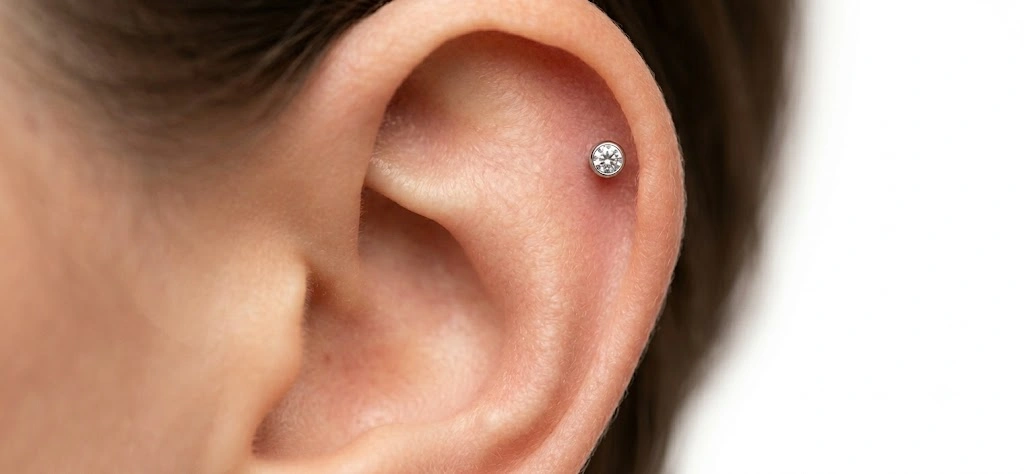
A single helix piercing is one piercing placed anywhere along the outer curved rim of the upper ear — the helix. It is the most popular cartilage piercing in the world, the most widely recognized, and the natural starting point for anyone entering the cartilage piercing space. When someone says “I want a helix piercing” without specifying further, they almost always mean a single helix.
The appeal of the single helix is its combination of impact and simplicity. One carefully placed flat-back stud on the upper ear creates a clean, deliberate statement that works across every aesthetic — minimalist, editorial, professional, casual. It’s visible enough to be noticed, subtle enough to be appropriate in almost every context. It ages beautifully, pairs effortlessly with other ear piercings, and serves as the foundation from which double helixes, triple stacks, and full curated ear projects are built.
The single helix is also the most forgiving entry point into cartilage piercing. One wound heals far more efficiently than multiple simultaneous piercings, the aftercare demands are manageable for first-timers, and the timeline — 6–9 months with good care — is shorter than more complex configurations. It teaches you everything you need to know about helix aftercare, healing timelines, and jewelry choices before you commit to more advanced configurations.
Piercings: 1 on outer helix rim | Pain: 4/10 | Healing: 6–9 months | Cost US: $40–$100+ | Initial jewelry: Flat-back labret stud — implant-grade titanium | Gauge: 16g (most common) or 18g | Best for: First cartilage piercing, stacking foundation, minimalist aesthetic
Why the Single Helix Remains the #1 Cartilage Piercing in 2026
Despite the explosion in popularity of more complex configurations — double stacks, curated ears, forward helixes — the single helix has not been eclipsed. If anything, its dominance has increased. This is because the curated ear movement requires a starting point, and the single helix is that starting point for the overwhelming majority of people. Every double helix began as a single. Every triple stack was once one stud on the upper rim.
Beyond its role as a foundation, the single helix stands entirely on its own. A single, well-chosen piece of jewelry — a small opal flat-back in implant-grade titanium, or a prong-set CZ in solid 14k gold — on the upper ear is genuinely beautiful. It doesn’t need companions to make its case. The rise of “less is more” jewelry aesthetics in 2025–2026 has actually reinforced the single helix’s relevance rather than diminishing it.
Single Helix Placement: Every Position Explained
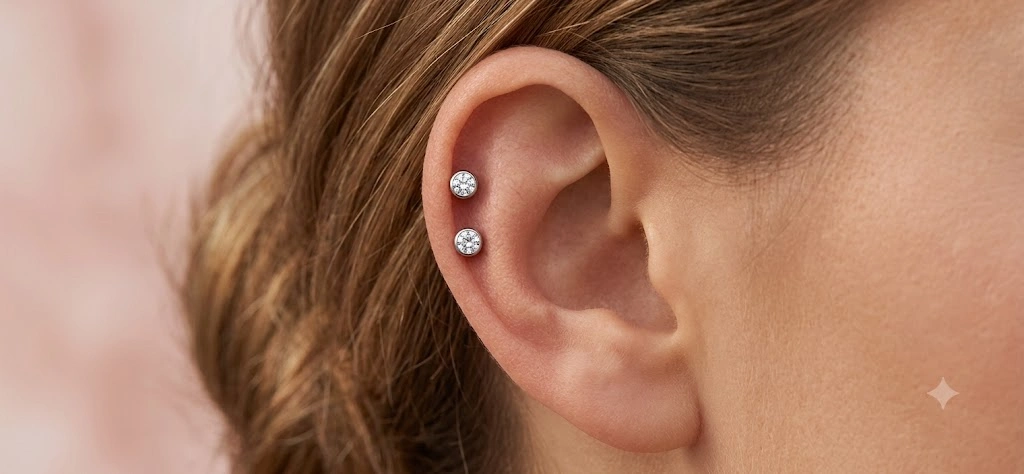
The helix rim spans the entire outer curved edge of the upper ear — from the crus of helix near the temple all the way around the top and partway down the back edge. A single helix can technically be placed anywhere along this entire length, giving you more placement flexibility than almost any other ear piercing. Understanding the positions and what each looks like helps you make a deliberate, well-informed choice.
The Three Main Single Helix Positions
Position Comparison: What Each Offers
| Position | Visibility | Best For | Future Stacking |
|---|---|---|---|
| Upper helix | Excellent — most visible from side | Classic solo look, traditional aesthetic | Room below for additions |
| Mid-upper helix | Very good — clear side visibility | Strategic solo — best for future stacking | Room above and below — most flexible |
| Lower helix | Good — lower on rim, less prominent | Planned stacks, unique solo look | Room above — suited for building upward |
Planning Ahead: If You Might Stack Later
If there’s any chance you’ll want a double or triple helix in the future — even if you’re not sure right now — placement planning matters. The mid-upper helix is the most strategic solo position because it leaves room above and below for precisely spaced additions. Getting a single helix placed at the very top of the rim leaves no room above and limits the natural visual range for future additions below. Think of your first helix as the foundation of a potential larger project, even if you ultimately decide to keep it as a solo piece.
When you sit down for your marking appointment, tell your piercer whether you’re thinking about adding more piercings in the future. A good piercer will mark your single helix position with future additions in mind — preserving correctly spaced positions above and below your chosen spot. This costs nothing and makes a significant difference if you ever decide to add to your ear.
The Marking Stage: Your Most Important Moment
Before any needle is used, your piercer marks the position with a surgical skin-safe marker and shows you in a mirror. Even for a single piercing, take this seriously:
Check the profile view (how most people see your ear daily), the slight front-facing angle, and directly from the side. The mark should look right from all angles you care about.
The marker dot is smaller than your jewelry end. Visualize a 4–5mm flat-back stud at the marked position — does it sit where you want it on the rim? Does it look right at that height?
Consider how your hair normally falls — does this position get easily hidden by your hair, or does it stay visible the way you want? Does your glasses arm or headphone band sit near this position?
Moving the mark up, down, or around the rim by a few millimeters costs nothing. Never proceed with a position that doesn’t feel exactly right — a good piercer will adjust without hesitation.
The Single Helix Piercing Procedure: What Actually Happens
Understanding exactly what happens during the procedure removes anxiety and helps you prepare correctly. A single helix at a professional studio is a brief, clean process — the entire active piercing takes under a minute from needle to jewelry placement.
Step-by-Step: What to Expect
Your piercer examines your ear anatomy, discusses placement options, and confirms the type of piercing. A good piercer asks about your lifestyle, future piercing plans, and any known metal sensitivities. This usually takes 5–10 minutes.
The piercer cleans the area and marks the position with a surgical marker. You review it in a mirror from multiple angles and approve or request adjustments. Never rush this stage.
You are seated or reclined comfortably. The piercer stabilizes your ear — usually with a receiving tube or clamp held behind the rim at the mark — to create a clean, precise needle path.
A single-use, sterile, hollow needle passes through the cartilage at the marked position. You feel a sharp pinch followed by a brief, distinct pressure and a crunching sensation as the needle moves through cartilage. The entire transit is under one second. Brief throbbing begins immediately — this is normal.
The flat-back labret stud is threaded through the fresh channel while the needle is withdrawn. The flat back is positioned against the inside of the rim; the decorative end is secured at the front. Takes 15–30 seconds.
Your piercer cleans the area, confirms the jewelry is correctly placed, and provides aftercare instructions — ideally written. You review the piercing in a mirror. You’re done.
Some studios — particularly budget chains and mall kiosks — pierce cartilage with a piercing gun. This is genuinely problematic for helix piercings specifically. Guns work by forcing blunt jewelry through tissue with blunt-force trauma rather than a clean needle cut. In cartilage, this causes significantly more tissue damage, higher rates of irritation bumps, higher infection rates, and longer healing times. A hollow needle at a professional studio is categorically better for helix cartilage piercings. If a studio uses a gun on cartilage, find a different studio.
Gun vs Needle: Side-by-Side
| Factor | Hollow Needle (Professional) | Piercing Gun (Budget Studio) |
|---|---|---|
| Tissue trauma | Clean cut — minimal damage | Blunt force — significant tissue damage |
| Healing time | 6–9 months with good aftercare | Often 12+ months, frequently complicated |
| Bump/infection rate | Low with correct aftercare | Significantly higher |
| Initial jewelry quality | Implant-grade titanium or gold | Typically low-grade mystery metal |
| Appropriate for cartilage? | ✅ Yes — standard of care | ❌ No — not safe for cartilage |
Single Helix Piercing Pain Level: Honest Breakdown
4 out of 10
The single helix consistently and reliably rates 4/10 across piercing community surveys, professional piercer assessments, and first-hand accounts — making it one of the most manageable cartilage piercings available. The vast majority of people who get a helix piercing describe the experience as “less than I expected.”
The sensation has two distinct components: a sharp, brief pinch as the needle enters (lasting under half a second), followed by a distinct pressure and crunching quality as the needle moves through cartilage resistance. The crunch is not painful — it’s simply the feel of dense tissue being displaced. The entire needle transit is under one second. After the needle, mild throbbing begins and typically fades within 2–6 hours. A small amount of soreness at the site for 24–48 hours is normal.
Why 4/10? — The Anatomy Behind the Rating
The outer helix rim has a moderate density of sensory nerve endings — enough to register the needle clearly, not enough to produce intense pain. The cartilage itself has no direct blood supply, which means no blood-borne pain mediators flood the site immediately. The procedure is also extremely brief — the faster the needle moves through the tissue, the less the pain receptor window. A skilled piercer with a sharp, correctly sized needle produces a genuinely fast, clean pierce that keeps the experience at the lower end of its natural range.
Pain Comparison Table
| Piercing | Pain | vs Single Helix |
|---|---|---|
| Lobe piercing | 2/10 | Less painful |
| Single Helix | 4/10 | — |
| Tragus | 4/10 | Same |
| Double / Triple Helix (each) | 4/10 | Same per piercing |
| Flat / Mid helix | 4/10 | Same |
| Hidden helix | 5/10 | Slightly more |
| Forward helix | 6/10 | More painful |
| Conch | 5–6/10 | More painful |
| Rook | 6/10 | More painful |
| Industrial | 6/10 | More painful |
Pain Reduction Tips
- ✅ Eat a full meal 1–2 hours before — low blood sugar is the most consistent pain amplifier. Non-negotiable.
- ✅ Stay well hydrated — dehydration elevates body-wide pain sensitivity
- ✅ Avoid caffeine on piercing day — constricts blood vessels, heightens sensory sensitivity
- ✅ Use the exhale technique — breathe in deeply, exhale slowly and steadily as the needle goes through. Most people find this significantly reduces the perceived intensity.
- ✅ Choose a skilled APP-certified piercer — piercer skill and needle sharpness genuinely impact the experience. A skilled piercer can reduce the felt pain by 1–2 points compared to an unskilled one.
- ✅ Don’t over-research the pain — the anticipation of pain is often worse than the pain itself for a helix. Reading too many worst-case accounts raises anxiety without changing the actual experience.
- ❌ Avoid aspirin and alcohol for 24 hours before — both thin blood, increase bleeding and bruising
- ❌ Don’t apply numbing cream without checking with your piercer — some topical anaesthetics change tissue texture in ways that complicate the piercing process
Single Helix Healing Timeline: Week by Week
Understanding each healing stage — what is completely normal at each phase, and what signals a problem — is the single most important knowledge you can have for a smooth helix healing journey. Most complications happen not because people don’t care, but because they don’t know what’s normal.
6–9 Month Full Healing Timeline
Days 1–5: Acute Inflammation Phase
The piercing site is a fresh wound. Expect: redness and mild swelling directly at the piercing (not spreading — confined to the immediate area), clear-to-slightly-white lymph fluid weeping from both entry and exit points, mild-to-moderate tenderness when touched or when jewelry is moved, and slight warmth at the site. All of this is completely normal — it is the body’s standard inflammatory response to a new wound. Clean twice daily with sterile saline from day one. Begin using a travel pillow from the very first night.
Week 1–3: Initial Settling
Swelling reduces progressively over the first 2 weeks. Lymph fluid production settles into a predictable daily pattern — mostly overnight, drying to white or off-white crust by morning. Tenderness when touched is still present but decreasing. The piercing may itch occasionally — this is a sign of tissue repair, not infection. Week 6 milestone: book a downsize appointment. The initial 8–10mm bar was intentionally long for swelling; once swelling resolves, the excess bar length catches on hair, clothing, and pillowcases — creating mechanical trauma that is the most common source of helix complications. Get it downsized to a correctly fitting 6–7mm bar.
Month 2–4: The False Heal Phase — The Most Dangerous Period
Between months 2–4, the surface of the piercing heals over. Crust production stops or nearly stops. Tenderness fades significantly. The piercing feels and looks completely healed. It is not. This is the false heal phase — the external fistula has formed but the internal cartilage fistula channel is still fragile, immature tissue that tears easily if disturbed. Changing jewelry during this phase is the single most common cause of serious helix complications — sudden return of discharge, bumps, soreness, and sometimes infection in a piercing that seemed to be doing well. Do not change jewelry during this phase under any circumstances.
Month 5–9: Deep Healing and Full Maturation
The internal cartilage fistula continues maturing through months 5–9. By month 6 with consistent correct aftercare, most single helix piercings are ready for a professional first jewelry change — but confirm with your piercer against the 5 healing signs rather than relying on the calendar alone. Full internal healing — where the fistula channel is fully mature, stable, and can tolerate jewelry changes without disturbance — is typically complete between months 6 and 9.
The 5 Signs Your Helix Is Fully Healed
A fully healed helix should feel no different from any other part of your ear when gentle pressure is applied to the jewelry or surrounding tissue. Not just comfortable at rest — genuinely non-tender with deliberate light pressure.
Completely zero production of white crust or any fluid, consistently, for over a month. A few days of no crust followed by a return of crust means the piercing is still actively healing.
When you very gently move the jewelry (one test — not a habit), it glides with zero resistance, zero sticking, and zero sensation. Any drag, sticking, or slight feeling of pulling means the fistula is still maturing.
No redness, no raised tissue, no discoloration around the entry or exit points. The piercing holes should look like neat, settled openings with no visible difference from surrounding ear skin.
All four signs above must be true simultaneously and consistently for at least one month. Healing piercings go through good phases — true healing is sustained stability over time, not a temporary quiet period.
The false heal — where a helix looks and feels healed between months 2–4 but isn’t — is responsible for the majority of helix complications that appear “out of nowhere.” Piercees change jewelry because everything seems fine, the fragile internal fistula tears during the change, and the piercing suddenly regresses significantly. This is entirely preventable: wait for all 5 healing signs to be consistently present, and have your first jewelry change done by your piercer, not yourself.
Single Helix Jewelry: From Healing Through Styling
The single helix is one of the most jewelry-versatile piercings available — once healed, it accommodates everything from understated minimalist studs to bold hoops and elaborate decorative pieces. The right jewelry choice at every stage makes a meaningful difference to both healing outcomes and aesthetic results.
Healing Jewelry: The Exact Specification
The piercing must wear a flat-back labret stud in ASTM F136 implant-grade titanium throughout healing. This is not optional or a preference — it is the specification that produces the best healing outcomes for helix cartilage piercings. Exact spec:
- Material: ASTM F136 implant-grade titanium — completely biocompatible, zero nickel, very lightweight, non-reactive throughout the full healing period
- Style: Flat-back labret stud — threadless push-pin or internally threaded. Flat disc back (sits flush against inside of rim), straight rigid post, decorative end at front.
- Gauge: 16g (1.2mm) — the APP standard for cartilage piercings. Some studios use 18g (1.0mm) for a finer aesthetic. Know your gauge before buying any replacement jewelry.
- Initial bar length: 8–10mm to accommodate first-week swelling. Downsized to 6–7mm at week 6–8 by your piercer.
- Decorative end: 3–5mm. Choose something you genuinely like — you’ll wear it for 6–9 months during healing.
After Healing: Your Full Styling Options
Hoop vs Stud After Healing
After full healing, the choice between a hoop and a stud is entirely personal and aesthetic. Both are equally safe for a fully healed single helix. A few practical considerations:
- Studs have lower snag risk, are more professional-setting-friendly, and work better with over-ear headphones or glasses frames that pass near the helix
- Hoops create a different visual — more dimensional, circular, immediately recognizable as a “piercing look” — and are easier to show off in hair-back styles
- Many people alternate — stud for daily/professional settings, hoop for evenings or when they want a different look. This is entirely fine for a fully healed piercing.
Materials Ranked
| Material | Healing | Healed | Notes |
|---|---|---|---|
| ASTM F136 Implant Titanium | ✅ Best | ✅ Excellent | Zero nickel, biocompatible, lightweight. First choice for healing. |
| Solid 14k/18k Gold | ✅ Excellent | ✅ Premium | Beautiful, biocompatible. Best post-healing upgrade. Avoid gold-plated. |
| ASTM F138 Implant Steel | ✅ Good | ✅ Good | Trace nickel — avoid if nickel-sensitive. |
| Niobium | ✅ Good | ✅ Good | Nickel-free, anodizable. Slightly heavier than titanium. |
| 316L Surgical Steel | ❌ Avoid | ⚠️ Acceptable | 12–14% nickel. Not for healing piercings. |
| Silver / Plated metals | ❌ Never | ⚠️ Caution | Tarnishes, reacts. Never during healing. |
Single Helix Aftercare: The Complete Daily Routine
Aftercare for a single helix is straightforward when you understand the principles behind it: keep the wound clean, keep it undisturbed, and eliminate every source of mechanical trauma. The routine is simple. The discipline is the challenge.
Complete Daily Routine
Before touching anything near the piercing. Every single time, without exception. Your hands introduce the most bacteria to healing piercings.
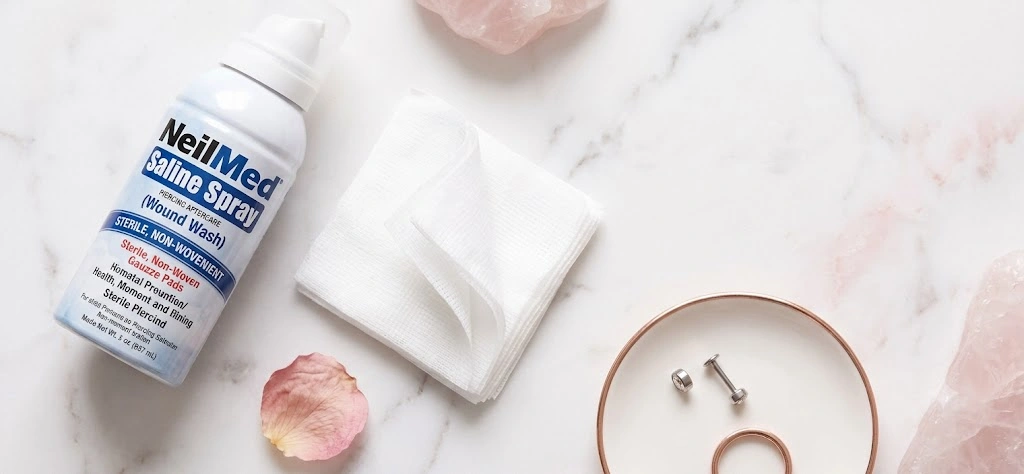
NeilMed Wound Wash or equivalent 0.9% preservative-free sterile saline. Spray generously onto both the front (decorative end side) and back (flat disc side) of the piercing. Let it soak for 20–30 seconds to soften any dried crust.
Light pressure only — softened crust releases easily without any force. Never use cotton wool or cotton buds (fibres catch on jewelry). Non-woven gauze or folded clean kitchen paper work well.
No touching, no rotating, no adjusting, no checking between cleaning sessions. Maximum undisturbed healing time is what the cartilage fistula needs to form correctly.
Frequency: Exactly twice per day — morning and evening. Not more (over-cleaning disrupts the wound environment), not less.
The Golden Rules — What to Do and What Not to Do
| ✅ DO | ❌ DON’T |
|---|---|
| Use a travel/donut pillow every night from day one | Sleep on the piercing — even one bad night causes setback |
| Tie hair back during healing (especially long hair) | Let hair snag on the jewelry repeatedly throughout the day |
| Use sterile 0.9% saline only for cleaning | Use hydrogen peroxide, Dettol, alcohol, or tea tree oil |
| Pat dry completely after cleaning | Leave the area wet or damp after cleaning |
| Keep hair products, sprays, and makeup away from the area | Let product residue build up around the jewelry |
| Switch to in-ear earphones during healing | Wear over-ear headphones — they press directly on the healing cartilage |
| Change pillowcase 2–3 times per week | Leave pillowcase unchanged — it accumulates bacteria quickly |
| Get a professional downsize at 6–8 weeks | Skip the downsize — the long bar is a major snagging hazard |
| Have first jewelry change done by your piercer | Change jewelry yourself before the 6-month minimum |
Sleeping on the side of the helix piercing — even occasionally — is the single most common cause of helix complications. Hours of sustained pressure on the healing jewelry every night compresses the forming fistula tissue and shifts the jewelry angle within the healing channel. The result is almost always an irritation bump. A travel neck pillow or a purpose-built donut pillow (with a hole for the ear) eliminates this risk entirely. Use one from night one.
Single Helix Problems: What to Watch For
The vast majority of helix complications are completely preventable and fully treatable. Understanding the most common problems — what they are, why they happen, and how to address them — gives you everything you need to navigate any issue that arises.
Irritation Bump — The Most Common Complication
An irritation bump is a small, raised lump at the piercing entry or exit point caused by repeated mechanical stress to the healing fistula. It is the most common helix complication by a very large margin — and the most commonly misidentified as a keloid (which it almost certainly isn’t).
Irritation bumps are soft, skin-toned or slightly pink, located directly at the jewelry entry or exit point, and caused by a specific, identifiable mechanical trigger. The most common triggers are: sleeping on the piercing (the #1 cause), bar too long and snagging, wrong jewelry material, over-ear headphones, and over-cleaning with inappropriate products.
Treatment: Identify and eliminate the specific cause. Return to strict twice-daily saline. Visit your piercer for a jewelry material and fit check. Get a downsize if the bar is still long. Allow 4–10 weeks with the cause fully removed. Most irritation bumps resolve completely with this protocol.
Keloid vs Irritation Bump: How to Tell the Difference
True keloids are rare. Most helix bumps — estimated 90–95% — are irritation bumps, not keloids. The key differences:
- Irritation bump: Small (2–5mm), soft, skin-toned, located at the hole, responds to correct aftercare in 4–10 weeks
- True keloid: Firm/rubbery, often darker than surrounding skin, grows beyond the piercing site into healthy tissue, develops over months, requires medical treatment (steroid injections, laser)
If your bump has been present for months, is growing outward beyond the hole, is very firm, or is progressively darkening — see a dermatologist. If it appeared recently, is soft, and is directly at the entry or exit point — it’s almost certainly an irritation bump. See your piercer first.
Infection Signs — When to Worry
Normal healing signs (white crust, mild redness at hole, mild tenderness) are not infection. Infection signs that require attention are specifically:
- Yellow-green thick pus — not white crust (which is dried lymph fluid, normal)
- Redness spreading beyond the immediate piercing site outward
- Increasing tenderness, not decreasing
- Significant swelling and warmth beyond the piercing site
- Fever or feeling generally unwell
Mild localized signs (slight yellowish discharge, minor redness at hole only, no spreading): improve aftercare and monitor for 48–72 hours. Moderate-to-severe signs or anything spreading: see a doctor promptly. Never remove jewelry during an active infection — this traps the infection inside and can cause an abscess.
Prolonged Soreness After Months
Persistent soreness months into healing almost always has an identifiable mechanical cause. The most common: sleeping on the ear (worse in mornings), bar still too long (recurring snagging), wrong jewelry material (chronic low-level chemical irritation), over-ear headphones (daily pressure trauma), or hair consistently catching on the jewelry end. Identify which applies — the pattern of the soreness usually gives it away — and eliminate the cause. See your piercer if no mechanical cause can be identified after 2 weeks of corrected aftercare.
See your piercer: Bump developing; soreness after months; unsure if normal healing or early problem; jewelry may need changing; any healing question. See a doctor: Yellow-green pus with spreading redness; significant swelling; fever; skin hot to touch beyond immediate piercing area; condition worsening despite improved aftercare for 48+ hours.
Single Helix Piercing Cost 2026: Complete Breakdown
| Region / Studio Type | Cost Range (Piercing + Initial Jewelry) |
|---|---|
| US — Budget / chain studio | $25–$45 |
| US — Mid-range APP studio | $50–$80 |
| US — High-end / luxury APP studio | $80–$150+ |
| UK — Mid-range APP studio | £40–£70 |
| UK — High-end studio | £70–£120+ |
| Australia — Mid-range APP studio | AUD $65–$110 |
| Canada — Mid-range APP studio | CAD $55–$90 |
| Europe (major cities) — Mid-range | €50–€80 |
Full Year-One Budget (US, Mid-Range APP Studio)
| Cost Item | Estimated Cost |
|---|---|
| Piercing + initial implant-grade titanium jewelry | $50–$80 |
| Aftercare saline (9 months — approx 3–4 bottles) | $30–$50 |
| Non-woven gauze pack | $8–$12 |
| Travel/donut pillow | $10–$20 |
| Downsize appointment (week 6–8) | $15–$30 |
| First jewelry change (by piercer) | $10–$25 |
| Post-healing jewelry upgrade (optional) | $20–$200+ |
| Total year-one estimate | $143–$417+ |
What Does the Price Include?
At most studios, the quoted price includes both the piercing procedure fee and the initial jewelry. The critical difference between price points is the quality of that initial jewelry — and this matters far more than most first-time clients realize:
- Budget studios ($25–$45): Procedure + low-grade jewelry of uncertain material (often marketed as “surgical steel” or “titanium” without ASTM F136 certification). May use gun on cartilage. Minimal aftercare guidance. Higher complication rate.
- Mid-range APP studios ($50–$80): Procedure + verified implant-grade titanium or steel initial jewelry. Hollow needle technique. Written aftercare instructions. Downsize often included or at minimal charge. Best value combination.
- High-end APP studios ($80–$150+): Procedure + premium initial jewelry from verified suppliers (Anatometal, NeoMetal, BVLA). Full anatomy consultation. Experienced APP-certified piercer. Best healing outcomes.
The $25–$30 saving between a budget and mid-range studio is very rarely worth it for a helix piercing. A single complication — an irritation bump requiring multiple follow-up appointments, a jewelry reaction forcing a premature change, an infection requiring medical treatment — routinely costs more in time, money, and emotional energy than the entire price difference. The studio most likely to produce a complication-free result the first time is almost always the best value, regardless of upfront price.
Single Helix Piercing FAQ
Ready to Get Your Helix Piercing?
Read our complete Aftercare & Cleaning guide — know exactly what to do from day one.
Aftercare Guide →