Double Helix Piercing Complete Guide 2026
Two-stud stack: placement & spacing, at-once vs staged, honest 4/10 pain, 9–12 month healing, jewelry styling, aftercare routine, and full 2026 cost breakdown.

Double Helix Piercing: The Complete 2026 Guide
Jump to a section:
What Is a Double Helix Piercing?
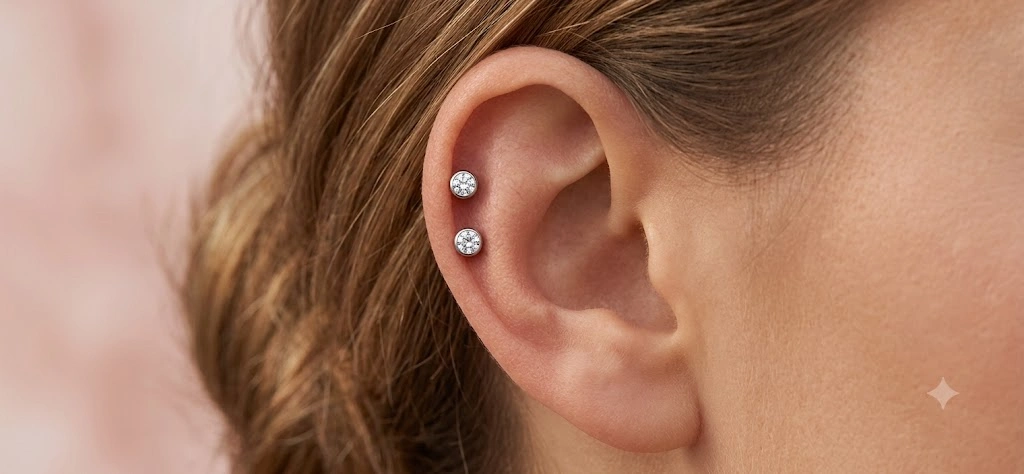
A double helix piercing consists of two helix piercings placed vertically along the same section of the outer cartilage rim, typically spaced 7–10mm apart center-to-center. It is one of the most popular and sought-after curated ear configurations in modern piercing culture — striking enough to command instant attention while remaining clean and wearable across professional, social, and casual settings.
Where a single helix makes a subtle statement, the double helix makes a composed statement. Two coordinated jewelry pieces stacked along the upper ear create a deliberate, intentional visual effect that reads as curated rather than coincidental. This quality is precisely what the curated ear aesthetic prizes — and why the double helix sits at the center of so many planned ear projects. The visual “stack” of two matching flat-back studs, or a carefully paired stud-and-hoop combination, creates an editorial upper-ear look that single-piercing configurations simply cannot replicate.
The double helix is also one of the most versatile post-healing styling canvases in ear piercing. Two coordinated jewelry positions offer enormous creative potential: matched solitaires, graduated sizes, seasonal swaps, stud-plus-hoop combinations, or a full solid gold upgrade — the double helix rewards jewelry investment with genuinely beautiful results that evolve with your tastes over time.
One important clarification: a double helix is not the same as a double forward helix. A double helix sits on the outer curved rim facing sideways. A double forward helix sits at the crus of helix near the temple, facing forward. Both involve two piercings in the helix zone, but their positions, pain profiles, healing demands, and jewelry options are meaningfully different. This guide covers the outer rim double helix specifically.
Piercings: 2 on outer helix rim | Spacing: 7–10mm between centers | Pain: 4/10 each (4.5–5/10 for 2nd if same session) | Healing: 9–12 months (same session); 6–9 months each (staged) | Best approach: Staged | Cost US: $80–$160+ | Initial jewelry: Two flat-back labret studs — implant-grade titanium
Why the Double Helix Is So Popular in 2026
The double helix occupies a uniquely desirable position in the 2026 piercing landscape. The curated ear movement has matured from its experimental early phase into mainstream fashion culture — and the double helix is the gateway configuration. It’s complex enough to look intentional and styled, accessible enough for anyone who’s had or is getting their first cartilage piercing. It photographs beautifully from the profile angle, reads as current and fashionable, and provides the immediate visual upgrade of two coordinated jewelry pieces without requiring the full complexity of a triple stack.
Search data consistently places “double helix piercing” among the top five most searched body piercing queries globally. APP studio reports across the US, UK, and Australia consistently list the double helix among the three most requested cartilage piercing configurations — reflecting genuine mass appeal that has only grown through 2025 and 2026.
Double Helix Placement & Spacing: Everything That Matters
Correct placement and spacing is the single most important factor determining whether a double helix looks beautiful and heals well, or looks awkward and develops complications. Understanding the principles behind the recommendations — not just following rules — makes you a better-informed client and helps you collaborate effectively with your piercer.
The 7–10mm Rule: Why It Matters
The correct spacing between the centers of each piercing is 7–10mm. This range exists for two reasons — one aesthetic and one biological.
Aesthetically: Less than 5mm between piercing centers and the jewelry ends crowd each other — they overlap or nearly touch, the skin between them appears compressed, and the composition reads as two piercings trying to be one rather than a deliberate two-piece stack. More than 14mm and the visual connection dissolves — two unrelated single helixes rather than a coordinated double.
Biologically: Two healing cartilage wounds placed less than 5mm apart compete for the same limited nutrient supply available through diffusion in avascular tissue. Each wound’s inflammatory response affects the other — every flare-up at one site sends inflammatory mediators through the shared cartilage tissue to disturb the adjacent wound. This mutual interference reliably produces longer healing times and higher complication rates for both piercings.
Common Double Helix Configurations
The Marking Stage: Your Most Critical Moment
Before any needle is used, your piercer marks both positions with a surgical skin-safe marker and shows you in a mirror. This marking stage — not the piercing itself — is the most important moment of the appointment. Here is what you should do:
Turn your head left and right, tilt slightly. The profile view (how most people see your helix daily) can look quite different from the face-on view. Approve from both.
The marker dot is smaller than your jewelry end. Visualize 4–5mm flat-back gem studs at each position — do they work at this spacing with this size?
If you might want a third helix later, does the current double leave room above or below with correct spacing? Plan ahead now — it costs nothing at the marker stage.
Adjusting the marker costs nothing and takes seconds. Adjusting the piercing after the needle is impossible. Never rush this stage — a good piercer will never pressure you to hurry through it.
If a studio marks your double helix with less than 6mm between the two positions, raise it. Under-5mm spacing is genuinely insufficient for healthy adjacent cartilage wound healing. A studio that pushes back on spacing guidance is not following professional standards — get a second opinion from an APP-certified studio before proceeding.
Double Helix: At Once vs Staged — The Complete Honest Answer
This is the question almost every double helix client asks first — and it deserves a thorough honest answer rather than a simple one. Both approaches are legitimate. Neither is universally right. The correct choice depends on your specific situation, experience level, and aftercare commitment.
Getting Both at Once: What It Really Involves
You experience two cartilage piercing events in one session. First piercing: baseline 4/10. Second piercing minutes later: 4.5–5/10 because the ear is already in early inflammatory state — tissue sensitized, initial immune response beginning, adrenaline dynamics shifting. You leave with two simultaneously healing cartilage wounds. Every aftercare failure affects both simultaneously. Every snagging event at one piercing creates mechanical stress that ripples through shared cartilage to the adjacent wound. Healing time: 9–12 months.
Getting Them Staged: What It Really Involves
First helix healed fully (6–9 months, all 5 healing signs consistently met). Second helix added at a separate appointment. Each piercing heals independently on its own 6–9 month timeline with its own full immune and repair resource allocation. Aftercare failures only affect one healing wound. Snagging events are isolated. Pain at second session: back to baseline 4/10 — no compounding from an adjacent fresh wound. Total project: 12–18 months from first to second fully healed.
Side-by-Side Comparison
| Factor | Both at Once | Staged (Recommended) |
|---|---|---|
| Studio visits | One | Two minimum |
| Immediate appearance | Both piercings from day one | One, then second added later |
| Pain in session | 4/10 first, 4.5–5/10 second | 4/10 each at separate sessions |
| Healing burden | High — two simultaneous wounds | Low — one at a time |
| Complication rate | Meaningfully higher | Significantly lower |
| Total healing time | 9–12 months for both | 6–9 months each, sequentially |
| Spacing precision | Both marked together — easier | Good piercer re-marks accurately second visit |
| Cost | Higher upfront; possible discount | Spread across two visits |
| Best for | Experienced piercees, excellent aftercare history | Most people — especially first cartilage piercees |
The majority of experienced APP-certified piercers with significant curated ear experience recommend staging for most clients. The only scenario clearly favouring same-session is: an experienced piercee with a proven cartilage healing track record, excellent aftercare compliance history, and genuine practical constraints around two separate studio visits. For everyone else — especially first-time cartilage piercees — staging produces better outcomes with significantly less distress.
Double Helix Piercing Pain Level: Complete Breakdown
Each Piercing: 4 out of 10
Each individual helix piercing rates 4/10 — the standard helix rating regardless of whether it’s the first or the second in a double configuration done at separate sessions. The sensation is the well-documented helix experience: sharp, brief pinch with a distinct pressure and crunching quality as the needle moves through cartilage resistance. Under one second for the needle transit. Mild throbbing for 2–6 hours afterward.
Same-Session Second Piercing: 4.5–5/10
When both piercings are done in the same session, the second consistently rates slightly higher. Three physiological reasons:
- Tissue sensitization: The first piercing has triggered a local inflammatory response — nearby nerve endings now have a lower pain threshold for responding to new stimuli.
- Adrenaline dynamics: The analgesic adrenaline spike from the first piercing is beginning to wear off as the second needle approaches.
- Cumulative tissue response: The cartilage in the zone now has two inflammatory responses beginning simultaneously — the cumulative background “noise” the second needle pierces through is greater.
Net result: most same-session double helix piercees describe the second as “noticeably a bit more” — rarely dramatically more, but consistently present. 4.5–5/10 is the most common report.
Pain Comparison Table
| Piercing | Pain | vs Double Helix (each) |
|---|---|---|
| Lobe piercing | 2/10 | Much less painful |
| Single / Double Helix (each) | 4/10 | Same |
| Tragus | 4/10 | Same |
| Flat / Mid helix | 4/10 | Same |
| Hidden helix | 5/10 | Slightly more |
| Forward helix | 6/10 | More painful |
| Conch | 5–6/10 | More painful |
| Rook | 6/10 | More painful |
| Industrial | 6/10 | More painful (denser anatomy) |
Pain Reduction Tips for Double Helix
- ✅ Eat a full meal 1–2 hours before — low blood sugar is the single biggest pain amplifier. Non-negotiable.
- ✅ Stay well hydrated — dehydration creates body-wide stress that elevates pain sensitivity
- ✅ Avoid caffeine on piercing day — constricts blood vessels, heightens sensory sensitivity
- ✅ Use the exhale technique — breathe in deeply, exhale slowly as each needle goes through
- ✅ Choose a skilled APP-certified piercer — skill and needle sharpness can reduce experience by 1–2 points
- ✅ Consider staging — each at separate sessions means both experienced at their individual 4/10 baseline
- ❌ Avoid aspirin and alcohol for 24 hours before — both thin blood, increase bleeding and bruising
Double Helix Healing Timeline: Week by Week
Understanding each healing stage helps you manage the process correctly, identify what’s normal vs concerning, and avoid the mistakes that cause most double helix complications.
Same-Session Double Helix: 9–12 Month Timeline
Days 1–5: Double Acute Inflammation
Two simultaneously inflamed cartilage wounds produce more pronounced initial inflammation than a single helix. Expect more noticeable swelling across the upper ear zone, redness potentially connecting the two sites, and more sustained initial tenderness. Both piercings produce clear-to-white lymph discharge from day one. Clean both twice daily without exception. Use a travel pillow every single night starting tonight — sleeping on two healing piercings simultaneously is double the pressure trauma risk.
Week 1–3: Initial Settling
Swelling resolves progressively. By week 2, most acute swelling has reduced significantly. Daily crust at both sites settles into a predictable pattern. Week 6 milestone: book a downsize consultation for both piercings simultaneously. Two over-long healing bars snagging on hair and pillowcases is double the mechanical irritation — get both downsized at the same visit to address both sources of potential trauma at once.
Month 2–5: The Long Middle
The piercings settle into routine. Between months 3–5, both piercings will likely enter the false heal phase — looking and feeling completely healed while internal cartilage fistulas are still maturing. Both will seem ready for a jewelry change. They are not. Never change either piece of jewelry during this phase, regardless of how healed either looks or feels.
Month 6–12: Deep Healing and Full Maturation
By month 6 with good aftercare, a professional jewelry change is typically safe — but have your piercer confirm each piercing’s healing status individually. It’s completely normal for one to be ahead of the other. Don’t rush the slower-healing piercing just because the faster-healing one is ready. Change each when it is independently confirmed as fully healed.
Staged Double Helix: Each Piercing 6–9 Months
When staged, each piercing follows its own complete 6–9 month healing timeline independently. No interaction between healing processes. No shared complication risk. Each healing period is as straightforward as a single helix would be. Total project: 12–18 months from first needle to both fully healed — but each individual phase is dramatically more manageable.
Healing Timeline Comparison
| Milestone | Same Session | Staged |
|---|---|---|
| Both piercings visible | Day 1 | After second session (month 6–9+) |
| False heal phase | Month 3–5 (both piercings) | Month 2–4 for each individually |
| First safe jewelry change | Month 6–9 (piercer-confirmed each) | Month 6–9 after each respective piercing |
| Both fully healed | Month 9–12 | Month 12–18 from first piercing |
| Total healing complexity | High — two simultaneous wounds | Low — one at a time |
It is very common for one piercing in a same-session double to heal noticeably faster than the other. Different cartilage density at different rim positions, different exposure to snagging from sleeping position or hair contact, and subtle differences in blood diffusion patterns all contribute. Always assess each piercing independently against the 5 healing signs — never treat the double as a single unit when evaluating healing readiness.
Double Helix Jewelry: From Healing Through Styling
The double helix offers the richest jewelry styling potential of any standard outer-rim helix configuration. Two coordinated positions provide creative opportunities that a single helix simply cannot. Here is the complete jewelry guide for every phase.
Healing Jewelry: The Exact Specification
Both piercings must wear flat-back labret studs in ASTM F136 implant-grade titanium throughout healing. Exact spec:
- Material: ASTM F136 implant-grade titanium — biocompatible, zero nickel, lightweight, non-reactive
- Style: Flat-back labret stud — threadless push-pin or internally threaded. Flat disc back, straight rigid post, decorative end at front.
- Gauge: 16g (1.2mm) standard; 18g (1.0mm) if your piercer uses finer gauge. Both piercings same gauge.
- Initial bar length: 8mm to accommodate swelling. Downsized to 6mm at week 6–8 for both piercings simultaneously.
- Decorative end: 3–5mm. Choose something you genuinely like — you’ll wear it for 9+ months.
After Healing: 6 Beautiful Styling Approaches
Materials Ranked
| Material | Healing | Healed | Notes |
|---|---|---|---|
| ASTM F136 Implant Titanium | ✅ Best | ✅ Excellent | Zero nickel, biocompatible, lightweight. First choice. |
| Solid 14k/18k Gold | ✅ Excellent | ✅ Premium choice | Beautiful, biocompatible. Avoid gold-plated. |
| ASTM F138 Implant Steel | ✅ Good | ✅ Good | Trace nickel — avoid if nickel-sensitive. |
| Niobium | ✅ Good | ✅ Good | Nickel-free, anodizable. Slightly heavier than Ti. |
| 316L Surgical Steel | ❌ Avoid | ⚠️ Acceptable | 12–14% nickel. Not for healing piercings. |
| Silver / Plated metals | ❌ Never | ⚠️ Caution | Tarnishes, reacts. Never during healing. |
Double Helix Aftercare: Caring for Two Piercings
The aftercare principle for a double helix is identical to a single helix — sterile saline twice daily, leave it alone otherwise — with the additional complexity of two piercing sites to care for simultaneously.
Complete Daily Routine
Before touching anything near either piercing. Non-negotiable, every single time.
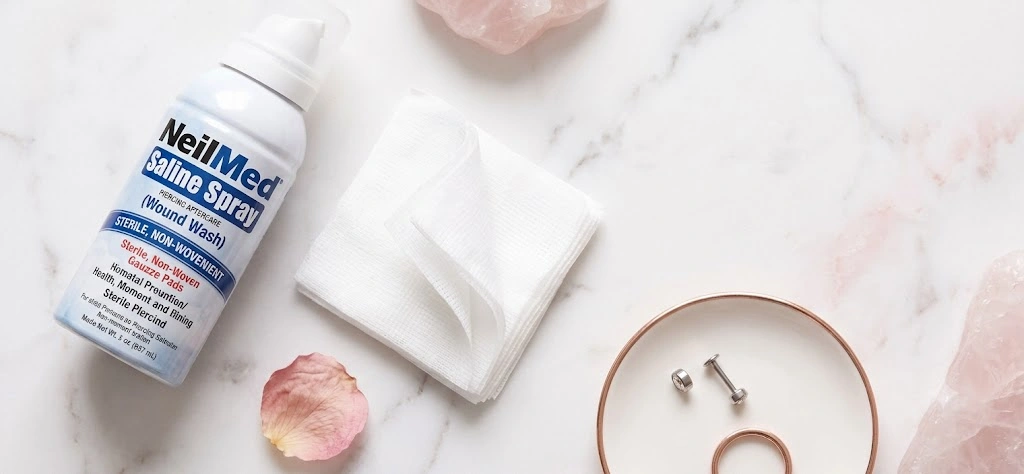
Front and back of both piercings — four application points total. NeilMed Wound Wash or equivalent 0.9% preservative-free saline. Saturate each generously. Let soak 20–30 seconds for both.
Use a separate piece of gauze per piercing if either shows discharge. Prevents cross-contamination. Light pressure only — softened crust releases easily.
Moisture trapped between two adjacent healing wounds creates a bacterial environment affecting both. Dry the full upper ear zone thoroughly.
No touching, rotating, or adjusting either piece between cleaning sessions. Maximum undisturbed healing time for both wounds.
Double Helix Specific Aftercare Considerations
| Situation | Double-Specific Guidance |
|---|---|
| Sleeping | Travel/donut pillow essential — both bars can catch on pillow in different ways. Non-negotiable for side-sleepers with a double. |
| Hair management | Two jewelry ends on upper ear = double snagging opportunities. Tie hair back more consistently than for a single helix, especially in the first 6 months. |
| Headphones | Over-ear headphones pressing on two adjacent healing piercings simultaneously is a significant complication trigger. Switch to in-ear for the full healing period of both. |
| Monitoring | Assess each piercing independently. One may develop a bump or more discharge while the other progresses normally — each requires its own diagnosis and response. |
| Downsize appointments | Get both bars downsized at the same appointment (week 6–8) — efficient, and ensures both sources of snagging risk are eliminated simultaneously. |
| Swimming | Avoid pools and open water for a minimum of 4 months. With two healing cartilage wounds, bacterial exposure risk is effectively doubled. |
Double Helix Problems: What to Watch For
The double helix carries a somewhat higher complication rate than a single helix — primarily because two healing wounds in proximity create twice the opportunities for the mechanical and aftercare failures that drive most helix complications. Knowing what to watch for in both piercings — and how adjacency affects the healing of each — helps you respond quickly and correctly.
Irritation Bumps — The Most Common Problem
Irritation bumps can develop at either or both piercings. With a double helix, one particularly common trigger pattern is sleeping on the ear — even a week of sleeping on the wrong side can produce bumps at both piercings simultaneously, since both are on the same ear and both experience the same pillow pressure. Other common triggers: either bar still too long, hair snagging on either jewelry end, wrong material in either piece.
If a bump develops at one piercing but not the other, the cause is typically specific to that piercing — a longer bar in that one, or positioning that makes that jewelry more susceptible to a particular snagging trigger. Investigate each independently.
Treatment: Identify and eliminate the specific cause. Return to strict twice-daily saline for both piercings. Downsize assessment for both bars. Implant-grade titanium check for both pieces. Allow 4–10 weeks with cause fully eliminated.
Shared Inflammation: When One Affects the Other
A significant trauma at one piercing (hard snag, sleeping accident pulling the jewelry) can trigger a sympathetic inflammatory response in the adjacent healing piercing — even if the adjacent one wasn’t directly affected. Inflammatory mediators released at the trauma site diffuse through shared cartilage tissue. Signs: one piercing suddenly becomes more sore or produces more discharge shortly after the adjacent piercing experiences trauma, with no independent cause at the newly symptomatic site. Treat the original trauma’s cause and enhance aftercare for both.
Infection Signs — Assess Each Piercing Separately
Infection at one double helix piercing doesn’t automatically mean the other is infected — but proximity means both should be monitored closely if signs appear at either. Signs requiring attention: yellow-green thick pus (not white crust), spreading redness beyond the piercing site, increasing swelling, warmth spreading outward, or fever. See your piercer first; see a doctor if infection signs are moderate-to-severe. Never remove jewelry during an infection.
See your piercer: Bumps developing at either site; one healing faster than the other; soreness after months; unsure if normal healing or early problem. See a doctor: Yellow-green pus with spreading redness; significant swelling; fever; skin hot to touch beyond immediate piercing area; condition worsening despite improved aftercare for 48+ hours.
Double Helix Piercing Cost 2026: Complete Breakdown
| Region / Studio | Same Session Double | Per Visit (Staged) |
|---|---|---|
| US — Budget studio | $50–$80 | $25–$45 per visit |
| US — Mid APP studio | $80–$140 | $50–$80 per visit |
| US — High-end / luxury | $140–$250+ | $80–$150+ per visit |
| UK — Mid APP studio | £65–£120 | £40–£70 per visit |
| Australia — Mid APP | AUD $110–$190 | AUD $65–$110 per visit |
Full Year-One Budget (US, Mid-Range APP Studio)
| Cost Item | Same Session | Staged (Year One) |
|---|---|---|
| Piercing(s) + initial jewelry | $80–$140 | $50–$80 (first piercing) |
| Aftercare saline (12 months) | $50–$60 | $50–$60 |
| Non-woven gauze | $10–$15 | $10–$15 |
| Travel pillow | $10–$20 | $10–$20 |
| Downsize appointments | $20–$50 (both) | $15–$30 (one) |
| First jewelry changes | $20–$50 (both) | $15–$25 (first piercing) |
| Post-healing jewelry upgrade | $40–$200+ per piece | $40–$200+ (first piece) |
| Total year-one estimate | $230–$535+ | $190–$430+ |
Yes — particularly for a double helix. The skill required to precisely mark and execute two spaced piercings, the quality of initial jewelry, and the aftercare guidance all have measurable impact on healing outcomes. Complications from a budget studio — bumps requiring multiple follow-up visits, jewelry reactions forcing premature changes — typically cost more in total than the price difference between budget and mid-range quality would have been.
Double Helix Piercing FAQ
Ready to Get Your Double Helix?
Read our complete Aftercare & Cleaning guide — know exactly what to do from day one.
Aftercare Guide →