Helix Piercing Aftercare & Cleaning
The complete APP-recommended aftercare routine — daily cleaning steps, how to use saline correctly, sea salt soaks, dos and don’ts, and everything you must avoid.

Helix Piercing Aftercare & Cleaning: The Complete Guide
Jump to a section:
Why Helix Piercing Aftercare Matters More Than Anything Else
Of all the factors that determine how well and how quickly your helix piercing heals, aftercare quality ranks alongside jewelry material as the two most controllable variables. Your piercer’s skill determines the quality of the initial wound. The jewelry material determines the wound environment. But your daily aftercare determines everything that happens over the next 6–12 months.
A helix piercing is a wound through avascular cartilage — tissue with almost no direct blood supply. This means the healing process is slow, sensitive, and completely intolerant of disruption. While a lobe piercing can absorb casual aftercare and still heal fine, a helix piercing will respond to every aftercare mistake with setbacks that can add weeks or months to the healing timeline. Getting aftercare right from day one — and maintaining it consistently throughout the entire healing period — is the single most impactful thing you can do for your piercing.
The Association of Professional Piercers (APP) — the global professional body for piercing safety — recommends a beautifully simple aftercare protocol: sterile saline wound wash, twice daily, leave it alone the rest of the time. No antiseptics, no soaking, no rotating, no extra products. The simplicity is intentional — less interference means more consistent, undisturbed healing.
The Most Common Aftercare Mistakes
| Mistake | Why It Causes Problems | How Common |
|---|---|---|
| Rotating / twisting jewelry | Tears fistula tissue, introduces bacteria from hands | Extremely common — widely but wrongly recommended |
| Using antiseptics (H2O2, alcohol, tea tree) | Kills healing cells alongside bacteria — net negative | Very common — people assume more = better |
| Over-cleaning (3+ times daily) | Over-disrupts the wound environment; dries healing tissue | Common |
| Changing jewelry too early | Tears immature fistula — triggers late-stage complications | Extremely common — false heal fools everyone |
| Sleeping on piercing | Hours of pressure trauma nightly — biggest bump cause | Very common — requires conscious effort to avoid |
| Using cotton wool or buds | Leaves fibres in wound channel causing irritation | Common — intuitive but wrong tool |
| Ignoring downsize appointment | Long bar snags constantly — perpetuates soreness and bumps | Very common — people don’t know downsize exists |
Helix Piercing Aftercare Routine: Step-by-Step Daily Guide
The correct helix aftercare routine is straightforward once you understand the underlying principles. The entire active cleaning process takes about 2 minutes twice a day — the discipline is in doing it consistently, every single day, for the full 6–12 month healing period.
Morning Routine (After Shower)
Before touching anything near the piercing, wash your hands with soap and water for a minimum of 20 seconds. Your hands carry bacteria even when they appear clean — this step is non-negotiable and takes less than a minute. Never touch your piercing with unwashed hands, even just to “check it’s still there.”
The best time for morning aftercare is after a warm shower. The shower’s steam naturally softens any overnight crust buildup — making removal easier and gentler. If you shower in the morning, do your aftercare immediately after stepping out rather than before showering.
Hold the saline spray nozzle 2–3cm from the piercing. Spray a generous burst directly onto the entry point on the front of the helix, then reach behind the ear and spray onto the exit point. Both sides need to be saturated. Let the saline sit in contact with the piercing for 20–30 seconds — this gives it time to soften any crust and rinse the wound channel.
Using a clean piece of non-woven gauze (not cotton wool, not cotton buds), gently dab the softened crust away from both piercing points. Use light pressure — the softened crust should release easily. If any crust resists, apply more saline and wait rather than forcing it. Never rub — always dab with the lightest effective pressure.
Use a fresh piece of gauze or a single-use paper towel to gently pat the piercing area completely dry. Pay particular attention to the helix rim fold — moisture trapped in the fold creates an environment that encourages bacterial growth. Never use cloth towels (harbor bacteria, can snag jewelry).
Once clean and dry, do not touch the piercing again until your evening clean. Do not check it, adjust it, rotate it, or fuss with it. The healing process is undisturbed by hands-off periods — interference disrupts it. Your job for the rest of the morning is to forget it’s there.
Evening Routine (Before Bed)
The evening clean follows the same process as the morning: wash hands → spray saline on both sides → wait 20–30 seconds → gently dab with gauze → pat dry. The evening clean is particularly important because you’re about to spend 6–8 hours with your head on a surface. Even with a travel pillow, keeping the piercing clean before that extended still period reduces bacterial load significantly.
When to Adjust the Routine
| Situation | Adjustment |
|---|---|
| After gym / sweating heavily | Rinse with clean water, then do a full saline clean — counts as one of your two daily cleans |
| After swimming (if unavoidable) | Rinse immediately with clean water, then full saline clean — monitor for 48 hours |
| After hair dye / bleach exposure | Rinse ear thoroughly with clean water immediately, then full saline clean |
| After months 6+, piercing healing well | Can reduce to once daily if zero crust and no symptoms, but never skip entirely until fully healed |
| During illness or immune stress | Maintain strict twice-daily or increase vigilance — immune function affects healing |
How to Clean a Helix Piercing: The Correct Technique
There is a right way and several wrong ways to clean a helix piercing. Many healing setbacks happen not because people are skipping cleaning, but because they’re cleaning incorrectly — too aggressively, with the wrong tools, or with products that damage healing tissue. Here is the complete guide to correct cleaning technique.
The Right Tools for Cleaning
Step-by-Step Cleaning: The Correct Method
Soap and water. Non-negotiable. Do this every single time, without exception.
Hold nozzle 2–3cm away. Short, generous burst. Saturate the area.
Reach around the ear. Both sides need direct saline contact for effective cleaning.
Let the saline work. This softening time prevents micro-tearing when you remove crust.
Light pressure. Softened crust releases easily. If anything resists, spray more saline — don’t force it.
Include the rim fold — moisture trapped there encourages bacterial growth.
Do not touch, adjust, rotate, or check the jewelry between cleans. Leave it completely alone.
Saline for Helix Piercing: The Complete Guide
Saline is the only cleaning agent you need for a healing helix piercing — and understanding exactly what type to use, why concentration matters, and which products to trust makes your aftercare significantly more effective.
What Saline Is and Why It Works
Saline solution is sodium chloride (salt) dissolved in water. Sterile wound wash saline is formulated at 0.9% sodium chloride — a concentration called isotonic because it matches the natural salinity of human body fluids. This matching concentration is critical: it means the saline neither draws moisture out of the wound cells (which would damage them) nor pushes extra fluid into them (which would cause swelling). It cleans the wound surface while maintaining the natural fluid environment that healing cells need.
Best Saline Products for Helix Piercing (2026)
| Product | Type | Why It’s Good | Price |
|---|---|---|---|
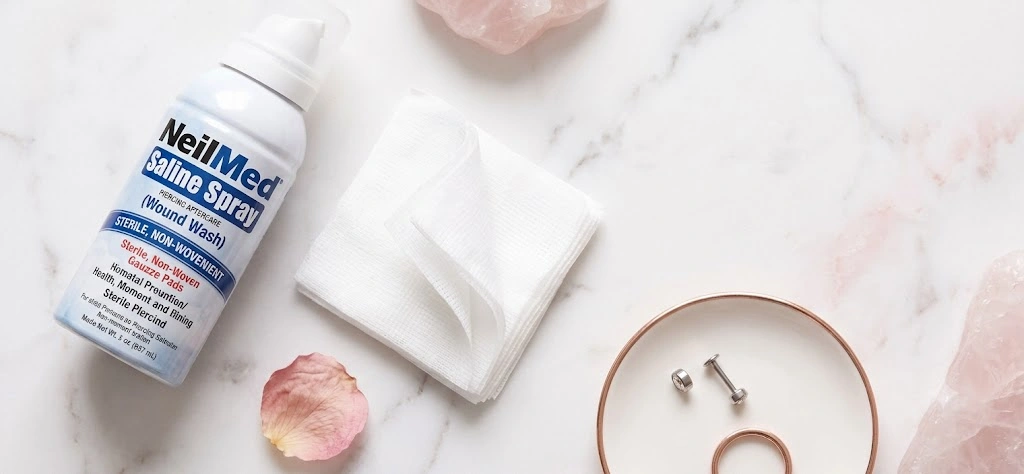
| NeilMed Wound Wash | Sterile saline spray | APP’s most recommended product. Preservative-free, 0.9%, fine mist nozzle, widely available | ~$8–10 |
| Briotech Topical Saline Spray | Hypochlorous acid saline | Mild antimicrobial action + saline. Increasingly popular in professional piercing studios | ~$12–15 |
| NeilMed NasoFlo | Sterile saline | Same 0.9% preservative-free formula as Wound Wash — alternative spray option | ~$8 |
| Sterile 0.9% saline pods (single-use ampoules) | Single-use sterile saline | Most sterile option possible — no contamination risk from repeated use of same bottle | ~$15–20 per pack |
| DIY sea salt solution | Homemade saline | Can work but concentration is inconsistent — see Sea Salt section below | Very low |
What NOT to Use as “Saline”
- ❌ Contact lens saline: Contains preservatives (benzalkonium chloride) that irritate wound tissue
- ❌ Saline nasal sprays with additives: Many contain decongestants or other active ingredients not appropriate for wounds
- ❌ Regular table salt in tap water: Table salt is iodized (iodine irritates healing tissue); tap water is not sterile and contains chlorine and minerals
- ❌ Sports electrolyte drinks: Multiple additives, wrong concentration, not appropriate for wound care
- ❌ Homemade salt water that’s “too salty”: Hypertonic (over-concentrated) saline draws moisture out of healing cells, causing dryness and delayed healing
How to Use Saline Spray Correctly
The spray application method is more effective than soaking for helix piercings because it delivers saline directly to both piercing entry points simultaneously without requiring you to submerge your ear. The fine mist from a quality wound wash spray penetrates the immediate wound area without diluting as much as a soak would.
Key points: hold the nozzle 2–3cm away (not pressed against the skin); spray a generous burst rather than a tiny amount; let it dwell for 20–30 seconds before removing crust; use at room temperature or slightly warm (cold saline can shock sensitive healing tissue).
Helix Piercing Sea Salt Soak: Should You Do It?
Sea salt soaks (SSS) were the dominant aftercare recommendation in piercing communities for many years before bottled sterile saline became widely available and affordable. They remain popular in some communities — but understanding both the potential benefit and the significant limitations helps you use them correctly if you choose to.
What Is a Sea Salt Soak?
A sea salt soak involves dissolving non-iodized sea salt in clean water and either submerging the piercing in the solution or applying it via a soaked gauze pad held against the piercing. The idea is to provide a saline environment that loosens crust and provides antimicrobial benefit.
The Problem with Sea Salt Soaks
The APP’s official position is that sterile saline wound wash is preferable to sea salt soaks for several reasons:
- Concentration inconsistency: Homemade sea salt soaks are very difficult to make at exactly 0.9%. Most people make them either too strong (hypertonic — draws moisture out of healing cells, causes irritation) or too weak (hypotonic — less effective). The pre-made sterile saline spray is always the correct concentration.
- Sterility: Sea salt dissolved in tap water is not sterile. Tap water contains chlorine, minerals, and potentially bacteria that are harmless to drink but can cause irritation at a healing wound site.
- Practical application: Submerging your ear in a cup of liquid is awkward and risks introducing more surface bacteria from the cup or your skin. A spray application is cleaner and more targeted.
- Over-soaking risk: Extended soaks (more than 5 minutes) can over-hydrate and soften the forming fistula tissue, weakening it rather than helping it.
If You Want to Use Sea Salt Soaks
If access to bottled sterile saline is difficult, or you want to use sea salt soaks as a supplementary treatment, here is the correct method:
Iodine in regular table salt is irritating to healing tissue. Look for “non-iodized sea salt” or “pure sea salt” — no added iodine, no anti-caking agents.
This produces approximately 0.9% saline. Do not use more — stronger is not better. Use less salt, not more, if in doubt about concentration.
Distilled water or water boiled and cooled to body temperature is significantly purer than tap water. Removes chlorine, minerals, and most bacterial contamination.
Soak a piece of non-woven gauze in the solution and hold it gently against the piercing for 3–5 minutes. This is cleaner than submerging the ear in a cup.
Do not leave residual solution in contact with the piercing after your soak time. Pat dry thoroughly with clean gauze.
Do not store sea salt solution for later use. Make a fresh batch for each application. Stored solution can develop bacterial growth.
If sterile saline wound wash spray (NeilMed etc.) is accessible to you, use it — it is more effective, more consistent, and more convenient than sea salt soaks. Sea salt soaks are an acceptable fallback when bottled sterile saline isn’t available. Never use soaks more than twice daily, and always use correct concentration and water quality.
10 Expert Helix Piercing Aftercare Tips
Beyond the basic cleaning routine, these ten tips address the most common real-world challenges that come up during helix aftercare — from sleep management to hair care to swimming situations.
The initial healing bar is longer than necessary to accommodate first-week swelling. Once swelling resolves, that extra length becomes a constant snagging hazard. Visit your piercer at 6–8 weeks for a bar downsize to the correct length. This single appointment prevents a disproportionate amount of prolonged soreness, bump formation, and extended healing times. Many people who struggle with their helix healing see dramatic improvement after a proper downsize.
The travel/donut neck pillow (the U-shaped kind) creates a gap that your ear rests in without touching the pillow surface. Your head contacts the pillow; your ear floats in the gap. This is the most practical and consistently effective solution for side-sleepers. Keep the pillow on your bed at all times during the healing period — not as something you occasionally remember to use, but as a permanent fixture of your sleeping setup for 6+ months.
Even with a travel pillow reducing direct contact, pillowcases accumulate bacteria, dead skin cells, and product residue overnight. During the first 3–4 months especially, change pillowcases every 2–3 days. A practical method: fold a clean t-shirt over the pillow and rotate it to a fresh face each night — four clean surfaces per shirt before washing is needed.
Over-ear headphones apply sustained pressure to the helix area for however many hours you wear them. If you use headphones for work, commuting, or gaming — switch to in-ear earphones or ear buds for the entire healing period. This eliminates one of the most common and underappreciated sources of daily mechanical irritation to healing helix piercings.
Long hair catching on jewelry creates micro-snagging events throughout the day that are often too subtle to notice but accumulate into significant irritation over time. During the first 6 months, keep hair tied back away from the pierced ear — particularly during exercise, sleep, and when outdoors. When choosing a hair tie or clip, avoid anything that might contact or snag the jewelry itself.
Hairspray, dry shampoo, hair dye, styling mousse, perfume, and even heavy moisturizers near the ear can introduce chemicals, particulates, or allergens to the healing wound channel. Apply hair products before letting your hair fall near the piercing. Cover the piercing with your hand or a clean bandage during product application when possible. If products do contact the piercing, rinse immediately with clean water followed by saline.
Let clean warm water from the shower run over the piercing naturally — this provides a free daily rinse that helps remove surface bacteria and product residue. What you should not do: direct a high-pressure jet at the piercing; get shampoo, conditioner, or soap on the piercing site; submerge the ear in bath water. Shower water is fine; standing water or product contact is not.
The advice to rotate jewelry daily “to prevent sticking” is one of the most persistent myths in piercing aftercare. Rotation introduces bacteria from your hands into the wound channel and causes physical micro-tears in the forming fistula tissue every single time it’s done. This myth has caused countless helix complications. The fistula channel will not “stick” to the jewelry — new tissue forms around the jewelry as part of healing, and that tissue is not harmed by leaving it undisturbed. Leave the jewelry completely alone between cleans.
Your healing rate is directly connected to your immune function. During the healing period: prioritize sleep (7–9 hours consistently); maintain adequate nutrition (protein is particularly important for tissue repair); manage stress where possible; stay hydrated; and avoid immune-suppressing habits like excessive alcohol. You cannot control your genetics, but you can optimize the environment your body heals in. A well-supported immune system heals cartilage faster.
Your piercer is your most valuable resource during healing. If you develop a bump that isn’t resolving, if soreness persists or worsens, if discharge becomes unusual, or if you’re unsure whether something is normal — book an assessment appointment. Professional piercers see healing complications constantly and can identify issues (wrong jewelry fit, material problems, placement concerns) that are impossible to diagnose accurately from photos alone. Visit early — most issues are far easier to resolve when caught and addressed quickly.
Helix Piercing Dos and Don’ts: The Complete List
✅ Dos — Everything You Should Do
✅ Clean twice daily with sterile 0.9% saline wound wash
✅ Use non-woven gauze for cleaning and drying
✅ Wash hands thoroughly before every contact
✅ Pat dry completely after every clean — including the rim fold
✅ Use a travel/donut pillow every night
✅ Change pillowcase every 2–3 days
✅ Wear implant-grade titanium or solid gold jewelry
✅ Get a downsize appointment at 6–8 weeks
✅ Wear hair tied back away from the piercing
✅ Use in-ear earphones instead of over-ear headphones
✅ Let shower water run over the piercing naturally
✅ Eat well, sleep well, stay hydrated — support your immune system
✅ Visit your piercer if anything seems wrong
✅ Wait minimum 6 months before any jewelry change
✅ Have first jewelry change done by your piercer
✅ Cover the piercing with waterproof film if unavoidable water exposure
❌ Don’ts — Everything to Avoid
❌ Never rotate or twist the jewelry — ever
❌ Never touch with unwashed hands
❌ Never use hydrogen peroxide, alcohol, Dettol, tea tree oil, Bactine, or any antiseptic
❌ Never use cotton wool, cotton buds (Q-tips), or cloth towels
❌ Never clean more than twice daily — over-cleaning damages healing tissue
❌ Never pick dry crust off — always soften with saline first
❌ Never sleep directly on the piercing
❌ Never wear over-ear headphones during the healing period
❌ Never let hairspray, dry shampoo, perfume, or hair dye contact the piercing
❌ Never change jewelry before 6 months minimum
❌ Never change jewelry during the false heal phase (months 2–5) regardless of how healed it looks
❌ Never use non-implant-grade jewelry (mystery metals, silver, plated, acrylic)
❌ Never swim in pools, sea, or hot tubs for the first 3–6 months
❌ Never submerge the ear in bath water
❌ Never apply makeup, foundation, or concealer near the piercing
❌ Never use Neosporin, antibiotic ointments, or vaseline on the piercing
❌ Never attempt to drain a bump by squeezing or puncturing it
❌ Never remove jewelry during an active infection
Best Aftercare Products for Helix Piercing (2026)
With a market full of products marketed at piercing aftercare — many of which are ineffective or actively harmful — knowing which products are genuinely recommended helps you build a simple, effective aftercare kit without wasting money on anything unnecessary.
Essential Products (Must Have)
| Product | What It Is | Why You Need It |
|---|---|---|
| NeilMed Wound Wash | Sterile 0.9% saline spray | Primary cleaning agent — the single most important product |
| Non-woven gauze pads | Sterile gauze for dabbing and drying | Only appropriate tool for cleaning and drying — no fibres |
| Travel/donut neck pillow | U-shaped pillow for sleeping | Prevents nightly pressure trauma — essential for any side sleeper |
Recommended Optional Products
| Product | What It Is | When Useful |
|---|---|---|
| Briotech Topical Saline Spray | Hypochlorous acid + saline spray | Good alternative to NeilMed; mild additional antimicrobial action |
| Tegaderm waterproof film dressing | Waterproof adhesive film | Protect piercing during unavoidable water exposure (swimming, hair dyeing) |
| Sterile single-use saline ampoules | Single-use 0.9% saline pods | Maximum sterility for the first few weeks when infection risk is highest |
| Ibuprofen (standard pharmacy) | Anti-inflammatory painkiller | Managing post-piercing ache and inflammation — take as directed, after not before |
Products to Avoid (Common Temptations)
| Product | Why to Avoid It |
|---|---|
| H2Ocean Piercing Aftercare Spray | Contains lysozyme preservative — can cause reactions; bottled sterile saline is better |
| Tea tree oil (any brand) | Concentrated essential oil — causes chemical irritation and worsens bumps |
| Bactine / antiseptic sprays | Contains benzalkonium chloride — disrupts wound healing cells |
| Savlon cream / Neosporin | Oil-based antibiotic ointments — suffocate the wound and trap bacteria |
| “Piercing aftercare” products with multiple ingredients | Most contain unnecessary additives that irritate healing tissue — simpler is always better |
You genuinely only need three things: NeilMed Wound Wash (or equivalent sterile saline), non-woven gauze pads, and a travel pillow. Total cost: approximately $20–$25. Every other product on the market is either unnecessary or potentially harmful for a healing helix piercing. Resist the urge to buy elaborate aftercare kits — simplicity wins every time.
Aftercare & Cleaning FAQ
Healing Not Going as Expected?
Check our complete Problems & Infections guide — bumps, keloids, infections, and prolonged healing all diagnosed and treated.
Problems Guide →