Helix Piercing Comparisons
Six detailed side-by-side guides — helix vs forward helix, pain vs lobe, needle vs gun, keloid vs bump, infected vs healing, and Claire’s vs professional studio.

Helix Piercing Comparisons — 6 Side-by-Side Guides
Jump to a comparison:
1. Helix vs Forward Helix — Which Is Right for You?
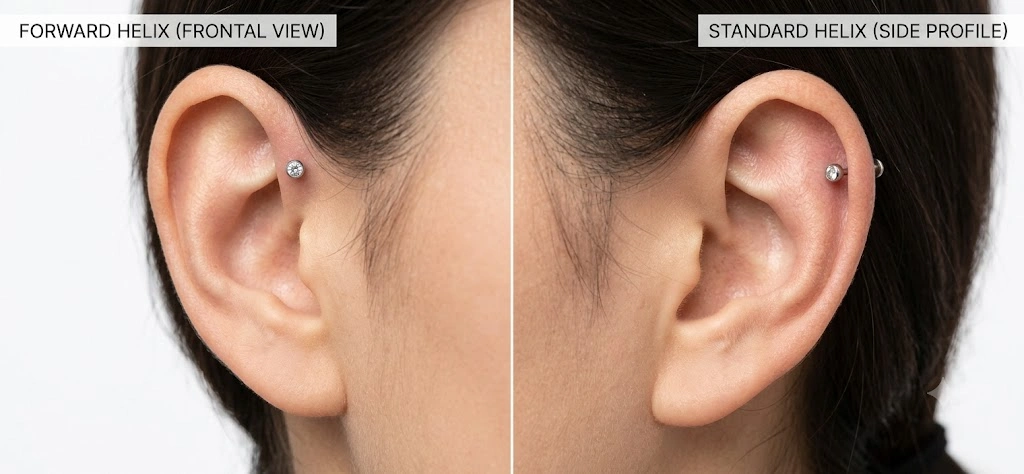
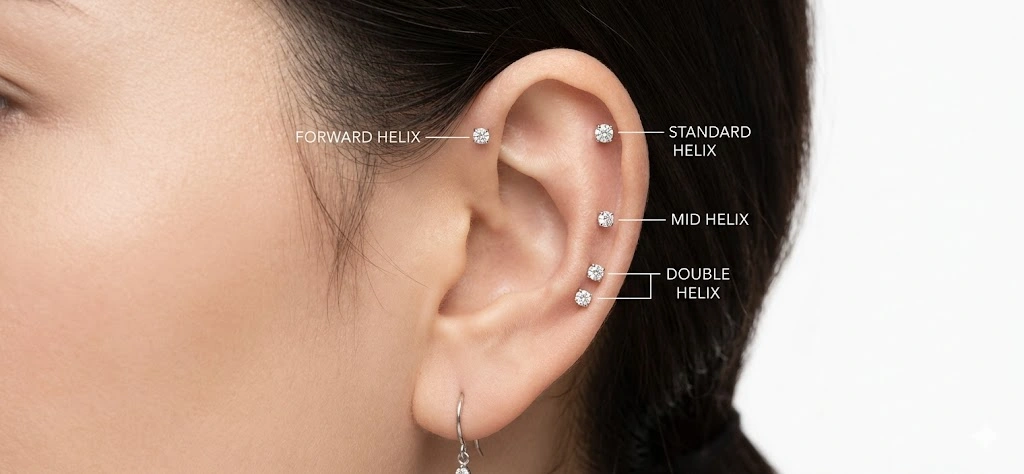
Two of the most popular ear cartilage piercings — often confused, genuinely different. Same helix rim, completely different positions, distinct pain profiles, and different visual effects. Here is the complete comparison.
💎 Standard Helix
- Outer curved rim of upper ear
- Most visible from the side / profile view
- Pain: 4/10
- Healing: 6–9 months
- Cartilage: standard rim density
- Jewelry: studs & hoops (healed)
- Snag risk: moderate
- Beginner-friendly: Yes ✅
- Works for curated ear: excellent anchor
- Shows in video calls: from the side
⬆️ Forward Helix
- Front of helix at crus — near temple
- Most visible from the front / face-on
- Pain: 6/10
- Healing: 9–12 months
- Cartilage: thicker, denser crus
- Jewelry: studs primarily, small hoops healed
- Snag risk: higher (near hairline)
- Beginner-friendly: After a healed helix ⚠️
- Works for curated ear: beautiful front accent
- Shows in video calls: clearly visible
Full Comparison Table
| Feature | Standard Helix | Forward Helix |
|---|---|---|
| Anatomical position | Outer upper rim (sideways-facing) | Crus of helix (forward-facing) |
| Visibility direction | Side and back view | Front / face-on view |
| Pain level | 4/10 | 6/10 |
| Why more/less pain | Outer rim — standard cartilage | Thicker crus + more nerve endings |
| Average healing time | 6–9 months | 9–12 months |
| Post-piercing ache | 2–6 hours | 24–72 hours |
| Hoop options (healed) | Wide range of hoop diameters | Small hoops only; sizing critical |
| Snagging risk during healing | Moderate | Higher — near hairline and glasses |
| Best starter cartilage? | Yes — ideal first cartilage | Better after standard helix experience |
| Best for video calls/frontal photos? | Less visible from front | Highly visible and face-framing |
⚖️ Verdict: Which Should You Get?
If this is your first cartilage piercing: standard helix. It’s more forgiving, easier to heal, and gives you foundational cartilage experience. If you already have a healed standard helix and want something more face-framing and front-facing: forward helix. If you’re planning a curated ear: consider both — they complement each other beautifully, with the forward helix providing front-facing presence and the standard helix providing side-profile depth.
2. Helix Piercing Pain vs Lobe Piercing — Honest Comparison
For most people, the lobe piercing is their pain reference point. Understanding exactly how helix pain differs — in both intensity and character — removes the unknown and helps set accurate expectations.
💎 Helix Piercing Pain
- Rating: 4/10 average
- Tissue: elastic cartilage (dense, avascular)
- Sensation: sharp pinch + crunching pressure
- Duration of sharp pain: under 1 second
- Post-pierce throb: 2–6 hours
- Next-day soreness: mild, manageable
- Healing pain: months of background tenderness
- Most painful moment: the needle transit
👂 Lobe Piercing Pain
- Rating: 2/10 average
- Tissue: soft fatty tissue (vascularized)
- Sensation: clean, fast snap — minimal
- Duration of sharp pain: under 0.5 seconds
- Post-pierce throb: minimal or absent
- Next-day soreness: usually none
- Healing pain: weeks, then nothing
- Most painful moment: initial snap
Why the Difference: The Biology
The lobe is soft, fatty tissue threaded with blood vessels — the needle passes through with almost no resistance in under half a second. The helix is firm cartilage with no direct blood supply — denser, more resistant, requiring slightly longer needle transit. Interestingly, cartilage actually has fewer nerve endings per unit volume than the well-vascularized lobe. But the mechanical resistance and the distinct crunching quality of passing through cartilage creates a more complex, more memorable sensation even if the raw neural signal isn’t dramatically stronger.
Pain Comparison: All Helix Types vs Lobe
| Piercing | Pain Level | vs Lobe |
|---|---|---|
| Lobe | 2/10 | Reference |
| Standard helix | 4/10 | About 2× the rating |
| Mid / flat helix | 4/10 | About 2× the rating |
| Hidden helix | 5/10 | About 2.5× |
| Forward helix | 6/10 | About 3× |
| Double forward helix (2nd) | 6.5–7/10 | About 3.5× |
⚖️ Verdict: How Much More Does It Hurt?
A standard helix rates about twice a lobe in numerical terms, but in practice the experience feels more like “noticeably more, different in quality” rather than “dramatically worse.” Most people who’ve had both describe the helix as a more complex, pressing sensation — not simply more painful. If a lobe piercing was a 2/10 for you, expect a 4/10 for a standard helix. Forward helix piercers should expect 6/10 — closer to 3× the lobe experience.
3. Needle vs Gun for Helix Piercing — The Definitive Comparison
This comparison has a clear outcome — but understanding why the needle wins on every metric helps you make a confident decision and push back if anyone tries to use a gun on your cartilage.
💉 Hollow Needle (Professional)
- Sharp bevelled tip cuts cleanly through tissue
- Removes small cylinder of tissue — clean wound
- Single-use, sterilized — zero cross-contamination
- Pain: 4/10 — sharp, brief, precise
- Cartilage trauma: minimal
- Healing: predictable, 6–9 months
- Infection risk: low with proper aftercare
- Bump/keloid risk: standard cartilage risk
- Available at: professional piercing studios only
- Endorsed by: APP and all professional bodies
🔫 Piercing Gun (Chain Stores)
- Blunt stud pushed by spring force — tissue torn
- Displaces tissue rather than removing it
- Cannot be autoclave-sterilized — cross-contamination risk
- Pain: 6–7/10 — blunt impact, more traumatic
- Cartilage trauma: can shatter cartilage microscopically
- Healing: slower, more complications
- Infection risk: significantly higher
- Bump/keloid risk: dramatically higher
- Available at: chain jewelry stores (Claire’s, etc.)
- Endorsed by: no professional body — condemned universally
Full Head-to-Head Comparison
| Factor | Hollow Needle | Piercing Gun |
|---|---|---|
| Mechanism | Sharp bevelled tip cuts clean channel | Blunt force displaces/crushes tissue |
| Wound type created | Clean, defined, minimal collateral damage | Torn, irregular, significant collateral damage |
| Pain at piercing moment | 4/10 — sharp, instantaneous | 6–7/10 — blunt thud, more intense |
| Post-procedure pain | Mild, hours | Significant, days to weeks |
| Sterilization | Single-use, autoclave-sterile packaging | Cannot be fully sterilized — surface clean only |
| Cross-contamination risk | Zero — single use | Present — residual biological material |
| Cartilage impact | Minimal — clean cut | Can fracture cartilage microscopically |
| Healing timeline | 6–9 months typical | Longer, more variable |
| Complication rate | Low with good aftercare | Significantly elevated |
| Irritation bump formation | Moderate (normal cartilage risk) | High — blunt trauma triggers excess healing response |
| Keloid/hypertrophic scar risk | Standard genetic risk only | Elevated — trauma amplifies scarring response |
| Professional endorsement | ✅ APP and all professional bodies | ❌ Condemned for cartilage universally |
Why Guns Cannot Be Properly Sterilized
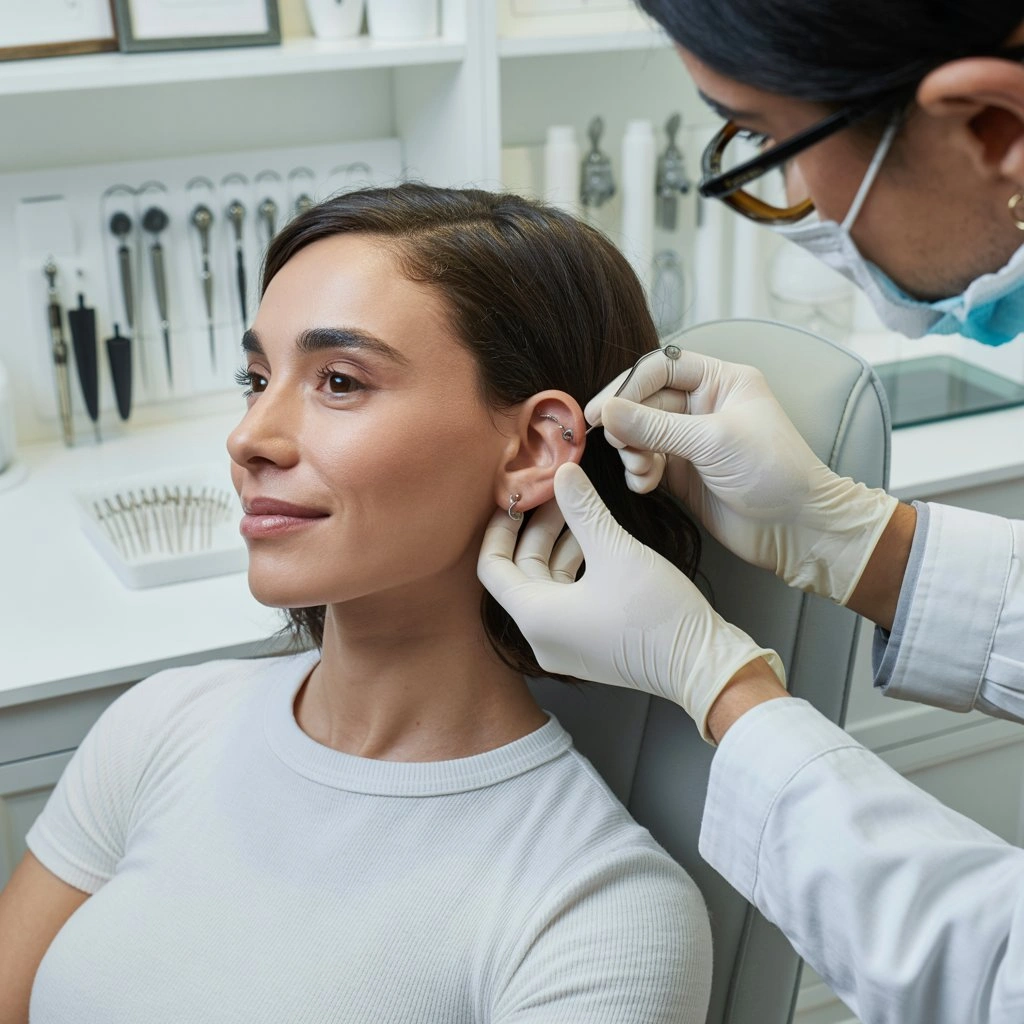
An autoclave — the medical-grade pressurized steam sterilizer used by professional piercing studios — reaches temperatures of 121–134°C (250–273°F) at high pressure. This kills all biological material including bacterial spores and viruses. Most piercing guns contain plastic components that melt or deform at autoclave temperatures. This means guns are cleaned with surface disinfectants — which reduce surface bacteria but do not achieve the sterilization standard required for instruments that penetrate human tissue. A hollow needle comes in a sealed sterile package, is opened in front of you, used once, and immediately disposed of. There is no comparison from a sterilization standpoint.
⚖️ Verdict: Always Choose the Needle
This is not a close comparison. A hollow needle is better in every single metric — pain, wound quality, sterilization, complication risk, and healing outcomes. There is no legitimate reason to choose a gun for a helix piercing. If you encounter a studio that only offers a gun for cartilage, leave and find an APP-certified professional studio. The needle costs marginally more. The outcomes are categorically better.
4. Helix Piercing Keloid vs Irritation Bump — How to Tell the Difference
A bump appearing near a helix piercing is one of the most anxiety-inducing common complications — particularly because many people immediately fear a keloid. Understanding the genuine differences between an irritation bump and a true keloid helps you respond correctly rather than catastrophizing or, worse, under-reacting to something that genuinely needs medical attention.
🩹 Irritation Bump
- Very common — most helix bumps are this
- Small (2–5mm), stays within piercing site
- Soft, moveable texture
- Skin-toned, pink, or slightly red
- Appears days to weeks after a trigger
- Stable size — does not grow
- Painless or mildly tender when pressed
- No genetic predisposition required
- Resolves fully with correct aftercare in 4–10 weeks
- Treatment: aftercare correction + cause removal
⚠️ True Keloid
- Rare — ~5–10% genetic predisposition
- Grows beyond wound boundaries
- Firm to rubbery texture — almost hard
- Often darker than surrounding skin
- Develops over months or years
- Continues growing after wound heals
- Often itchy or tender; sometimes painful
- Strong genetic / family history component
- Does NOT resolve with aftercare alone
- Treatment: dermatologist — steroids, laser, surgery
The Three Types of Helix Bumps — Complete Comparison
| Feature | Irritation Bump | Hypertrophic Scar | True Keloid |
|---|---|---|---|
| How common in helix piercings | Very common | Moderately common | Rare |
| Size | Small, at piercing site | Small–medium, at wound | Grows beyond wound |
| Texture | Soft, fluid-feeling | Firm, not hard | Rubbery, very firm |
| Color | Skin-toned / pink-red | Pink to red | Often darker, raised |
| Growth | Stable | Stable after forming | Continues to grow |
| Timeline | Days to weeks after trigger | Weeks to months | Months to years |
| Responds to aftercare? | Yes — fully resolves | Partially | No |
| Needs a doctor? | No | Possibly | Yes — dermatologist |
Self-Assessment: Do I Have a Keloid?
Answer these questions honestly. Multiple “yes” answers — particularly to the first two — suggest seeing a dermatologist:
- Is the bump growing beyond the piercing hole into surrounding healthy skin?
- Has the bump been present and actively growing for 3+ months?
- Is the bump very firm or rubbery — not soft or fluid-feeling?
- Is the bump darker than your surrounding ear skin?
- Do you or close family members have a history of keloid scarring?
- Has the bump shown zero improvement after 8–10 weeks of correct aftercare?
⚖️ Verdict: What You Almost Certainly Have
If your bump appeared within weeks of an identifiable trigger (sleeping on it, snagging, bad jewelry material), is soft, stays within the piercing site, and is skin-toned or mildly pink — you almost certainly have an irritation bump. Identify and eliminate the cause, return to strict saline aftercare, and switch to implant-grade titanium. Give it 4–10 weeks. A true keloid that requires a dermatologist is rare, specific in its characteristics, and typically appears in people with a known genetic predisposition. Don’t assume the worst before applying basic cause-elimination and correct aftercare.
5. Helix Piercing Infected vs Still Healing — How to Tell
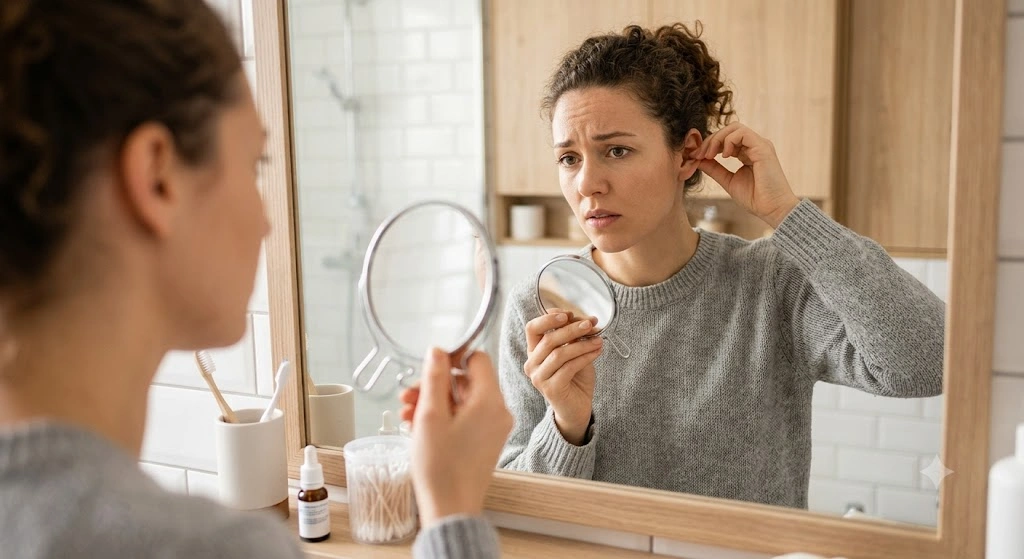
This is one of the most critical distinctions in helix piercing care. Getting it wrong in either direction has real consequences: treating a healing piercing as infected (and reaching for antiseptics) damages healing tissue; dismissing a real infection as “just healing” allows it to progress to a serious complication.
✅ Normal Healing Signs
- White / off-white crust (dried lymph fluid)
- Clear or slightly pale yellow fluid when fresh
- Mild localized pink at piercing entry/exit
- Occasional tenderness when touched
- Mild swelling in first 1–2 weeks only
- Slight warmth in first week only
- Gradual improvement over time ↗️
- No fever, no systemic symptoms
- Responds to improved aftercare
- No spreading redness
⚠️ Infection Warning Signs
- Yellow-green, grey, or dark pus — thick, opaque
- Foul or noticeably unpleasant smell
- Spreading redness beyond piercing site
- Increasing tenderness — throbbing at rest
- Significant, increasing swelling
- Skin hot to touch beyond piercing site
- Worsening despite correct aftercare ↘️
- Possible fever, feeling unwell
- Does not respond to saline alone
- Redness spreading outward over hours/days
The Complete Symptom-by-Symptom Guide
| Symptom | Normal Healing | Infection |
|---|---|---|
| Discharge color | Clear to white / pale yellow — dries to white crust | Bright yellow, yellow-green, or grey-green |
| Discharge texture | Thin; dries to chalky crust | Thick, opaque, possibly creamy or viscous |
| Discharge smell | Mild or neutral | Noticeably unpleasant or foul |
| Discharge amount | Small; predictable; mostly overnight | Increasing; copious; present throughout day |
| Redness | Mild pink at jewelry entry/exit points only | Deeper red; spreading outward from site |
| Tenderness | When touched or snagged — reduces over weeks | Throbbing at rest; increasing; waking you up |
| Swelling | Mild, first 1–2 weeks, then resolving | Significant; increasing; jewelry feels tighter |
| Warmth | Slight, first week only, localized | Hot to touch; spreading beyond site |
| Direction of change | Improving gradually with aftercare ↗️ | Worsening despite aftercare ↘️ |
| Systemic symptoms | None | Fever, swollen lymph nodes, feeling unwell |
| Action needed | Continue correct aftercare | See doctor if not improving in 48h or worsening |
Three Severity Levels of Infection
Slight redness confined to piercing site. Small yellowish discharge. Mild tenderness. No fever. No spreading. Treat with improved saline aftercare. Monitor for 48–72 hours. If improving, continue. If not, escalate.
Redness starting to spread slightly. Yellow-green discharge. Increasing tenderness. Mild swelling. Not improving with 48h of correct aftercare. Visit piercer and GP — antibiotics may be needed.
Spreading redness 1cm+ beyond site. Significant swelling. Green/grey pus with smell. Hot to touch. Fever. Feeling unwell. Go to urgent care or A&E today — possible perichondritis requiring IV antibiotics.
⚖️ Verdict: The Golden Rule
Normal healing improves over time with consistent aftercare. Infection worsens over time even with aftercare. This single directional test resolves most uncertainty. If you’ve maintained correct aftercare for 48–72 hours and things are getting better — you’re healing. If they’re staying the same or getting worse — you need professional assessment. When genuinely uncertain, photograph the piercing daily for 48 hours and compare honestly. Still unsure — see your piercer or a doctor rather than self-diagnosing.
6. Helix Piercing at Claire’s vs Professional Studio — The Honest Comparison
This comparison comes up constantly — usually from people weighing cost against convenience. The answer, when you examine every factor, is unambiguous. But understanding the specific reasons helps you make the argument confidently and explain the issue to friends or family who might suggest the cheaper option.
🏪 Claire’s / Chain Store
- Piercing method: gun on cartilage
- Staff: retail employees, brief training
- Sterilization: surface disinfectant only
- Jewelry: low-grade, often nickel-containing
- Anatomy assessment: none / minimal
- Aftercare guidance: basic / inadequate
- Consultation: minimal to none
- Cost: $25–$45 typically
- Complication rate: significantly elevated
- Professional endorsement: none — condemned
🏆 APP Professional Studio
- Piercing method: hollow needle — always
- Staff: trained, certified, experienced piercers
- Sterilization: autoclave — medical grade
- Jewelry: verified implant-grade titanium or gold
- Anatomy assessment: full consultation
- Aftercare guidance: detailed, written
- Consultation: thorough, personalised
- Cost: $50–$150+
- Complication rate: significantly lower
- Professional endorsement: APP standard
Complete Factor-by-Factor Comparison
| Factor | Claire’s / Chain Store | APP Professional Studio |
|---|---|---|
| Piercing instrument | Blunt spring-loaded gun | Sharp single-use hollow needle |
| Safe for cartilage? | ❌ No — condemned by all professional bodies | ✅ Yes — the only appropriate method |
| Sterilization standard | Surface disinfectant — not true sterilization | Autoclave — kills all biological material |
| Needle reuse risk | Present — guns contact multiple clients | Zero — each needle single-use, sealed package |
| Initial jewelry grade | Unknown alloy / fashion jewelry | Implant-grade titanium or solid gold |
| Nickel in jewelry? | Often significant — common allergen | None (titanium) or minimal (implant-grade steel) |
| Piercer training | Hours to days retail training | Months to years of specialist apprenticeship |
| Anatomy assessment | None — same placement every time | Full ear anatomy evaluation per client |
| Placement accuracy | Inconsistent — gun position less controllable | Marked, approved, precisely placed |
| Aftercare guidance quality | Basic or inadequate | Detailed, written, evidence-based |
| Follow-up support | None | Available — downsize appointments, check-ins |
| Cartilage fracture risk | Real — gun blunt force can fracture | Zero — clean needle cut |
| Infection risk | Significantly elevated | Low with correct aftercare |
| Irritation bump risk | High | Standard cartilage risk |
| Price difference | $25–$45 cheaper | $25–$100 more |
| True total cost (including complications) | Often higher — complications cost more | Often lower — fewer complications |
The Financial Argument: Claire’s Is Not Actually Cheaper
The upfront price difference between Claire’s ($25–$45) and a professional APP studio ($60–$120) seems significant. But consider the realistic total cost when complications occur — which they do at a statistically higher rate with gun-pierced cartilage:
- Dermatology visit for a keloid: $150–$400+ for steroid injections, multiple sessions
- GP visit + antibiotics for infection: $75–$200 depending on healthcare system
- Retiring a poorly placed piercing and re-piercing at a professional studio: Cost of re-piercing + healing time lost + potential scarring
- Extended aftercare supplies from prolonged healing: Additional months of saline spray
- Time and distress of managing complications: Not quantifiable financially but genuinely significant
When you add up a realistic complication scenario, the “savings” from choosing Claire’s often turn into a net loss — both financially and in terms of healing outcomes and experience quality.
⚖️ Verdict: There Is No Genuine Comparison
For a helix piercing specifically — which requires passing through cartilage with a hollow needle — Claire’s and similar chain stores are categorically not appropriate. This is not about snobbery or preference: it’s about the fact that guns cannot safely pierce cartilage, their jewelry causes more reactions, their sterilization is inadequate, and their staff are not trained in cartilage anatomy or complication management. Spend the extra $25–$50 on an APP-certified professional studio. It is not a luxury — it is the minimum safety standard for a cartilage piercing.
7. Helix vs Tragus Piercing — Full Comparison
Both are cartilage piercings, both hugely popular, both in the upper ear zone — but the helix and tragus have genuinely distinct placements, visual profiles, and healing characteristics. Here is everything you need to choose between them.
💎 Helix Piercing
- Outer curved cartilage rim — upper ear
- Most visible from side / profile view
- Pain: 4/10
- Healing: 6–9 months
- Jewelry: studs and hoops (healed)
- Multiple placement options available
- Very beginner-friendly ✅
- Great curated ear anchor piece
🔷 Tragus Piercing
- Small cartilage flap in front of ear canal
- Most visible from front — face-framing
- Pain: 4/10
- Healing: 6–12 months
- Jewelry: flat-back labret studs primarily
- Single placement only (limited anatomy)
- Beginner-friendly ✅
- Perfect front-ear complement to helix
| Feature | Helix | Tragus |
|---|---|---|
| Location | Outer upper cartilage rim | Small flap at ear canal entrance |
| Visibility direction | Side and back | Front — face-on visibility |
| Pain | 4/10 | 4/10 |
| Healing | 6–9 months | 6–12 months |
| Earphone compatibility | Over-ear during healing; in-ear OK healed | In-ear earphones incompatible during healing |
| Jewelry variety | Studs, hoops, clickers, seamless rings | Mainly flat-back labret studs |
| Multiple placements? | Yes — double, triple, forward, mid | No — single placement only |
| Curated ear role | Upper ear anchor — vertical dimension | Front accent — horizontal frame |
⚖️ Verdict
Neither is objectively better — they serve different aesthetic roles. The helix provides upper ear height and side-profile depth; the tragus provides front-facing presence. They are natural companions in a curated ear stack. If choosing just one: helix for versatility and stacking options; tragus for a distinct front-facing focal point.
8. Helix vs Conch Piercing — Full Comparison
The helix sits on the outer rim; the conch sits in the inner bowl. Same ear, very different positions — the conch is bolder, more painful, and demands more aftercare discipline than the helix.
💎 Helix Piercing
- Outer curved cartilage rim
- Pain: 4/10
- Healing: 6–9 months
- Wide jewelry variety after healing
- Moderate snagging risk
- Very beginner-friendly ✅
- Multiple placements possible
🔵 Conch Piercing
- Large inner cartilage bowl of the ear
- Pain: 5/10
- Healing: 9–12 months
- Large studs or outer conch hoops
- Recessed — lower snag risk
- Better after helix experience ⚠️
- Single placement per conch type
| Feature | Helix | Conch |
|---|---|---|
| Location | Outer curved rim | Inner cartilage bowl (cymba or cavum) |
| Pain | 4/10 | 5/10 |
| Healing | 6–9 months | 9–12 months |
| Visual impact | Elegant rim jewelry | Bold inner-ear statement |
| Hoop option? | Yes — after full healing | Outer conch hoop is very dramatic |
| Earphone impact? | Minimal | Both in-ear and over-ear affected during healing |
⚖️ Verdict
The helix is more accessible and versatile. The conch makes a bolder statement from its central inner-ear position. For a curated ear, both are often included: the helix forms the upper vertical axis while the conch provides inner-ear visual weight. Build cartilage aftercare experience with a helix first before attempting the conch.
9. Helix vs Industrial Piercing — Full Comparison
An industrial piercing is two helix positions connected by a single long barbell — the helix concept taken to its boldest extreme. Here is how the experience, healing, and lifestyle impact differ.
💎 Single Helix
- One cartilage hole
- Pain: 4/10
- Healing: 6–9 months
- Wide jewelry variety after healing
- Easy to maintain and clean
- Subtle to bold depending on jewelry
- Beginner-friendly ✅
⚙️ Industrial Piercing
- Two helix holes + connecting barbell
- Pain: 6/10 (two piercings)
- Healing: 9–12 months
- Limited to industrial barbell style
- More complex to clean (two holes + bar)
- Always bold and architectural
- Experience recommended ⚠️
| Feature | Helix | Industrial |
|---|---|---|
| Number of holes | One | Two (connected by barbell) |
| Pain | 4/10 | 6/10 (two piercing events) |
| Healing | 6–9 months | 9–12 months |
| Anatomy requirement | Standard | Specific helix-to-helix geometry required |
| Jewelry style | Studs, hoops, variety | Industrial barbell — one style |
| Snag risk | Moderate | High — long exposed barbell |
| Visual impact | Subtle to moderate | Always bold and architectural |
⚖️ Verdict
The industrial is a dramatic commitment — two piercings, a long barbell, more healing complexity, and a bold aesthetic that doesn’t suit every context. A single helix is infinitely more versatile. If you love the industrial look but want to test first: get a double helix at the right positions — you can always add a connecting bar later if you want the industrial look.
10. Helix vs Daith Piercing — Full Comparison
The daith is one of the most discussed inner ear piercings — partly for its look, partly due to claimed (unproven) migraine benefits. Here is how it compares to the helix in every practical way.
💎 Helix Piercing
- Outer curved rim — accessible, visible
- Pain: 4/10
- Healing: 6–9 months
- Wide jewelry variety after healing
- Very beginner-friendly
- No anatomy barrier for most people
🌙 Daith Piercing
- Innermost cartilage fold above ear canal
- Pain: 5/10
- Healing: 9–12 months
- Mainly small hoops and curved barbells
- Partially hidden — intimate look
- Anatomy-dependent — not all ears viable
| Feature | Helix | Daith |
|---|---|---|
| Location | Outer upper cartilage rim | Innermost cartilage fold, above ear canal |
| Pain | 4/10 | 5/10 |
| Healing | 6–9 months | 9–12 months |
| Visibility | Clearly visible from side | Partially recessed — subtle sparkle |
| Anatomy requirement | Most ears viable | Requires defined innermost cartilage fold |
| Migraine claims | No claims | Anecdotally popular; no clinical evidence |
| Beginner-friendly? | Ideal first cartilage | Better as second/third cartilage piercing |
⚖️ Verdict
The helix is the more accessible choice. The daith has a more intimate, partially-hidden aesthetic. On migraine relief claims: there is no peer-reviewed clinical evidence supporting daith piercings as a migraine treatment. If you want it for the look, great — but consult a neurologist rather than a piercer for migraine treatment decisions.
11. Single vs Double Helix Piercing — Which Should You Get?
This is one of the most common helix decisions. The trade-offs in healing, aesthetics, and commitment are real — here is the complete guide to making the right call for your situation.
💎 Single Helix
- One piercing — clean, minimal
- Pain: 4/10
- Healing: 6–9 months
- Lower aftercare burden
- More jewelry variety per piece
- Ideal foundation for future additions
- Lower cost upfront
✨ Double Helix
- Two stacked piercings — curated look
- Pain: 4/10 each (4.5 if both at once)
- Healing: 6–12 months
- Higher aftercare burden
- Jewelry coordination required
- Stronger immediate visual statement
- Higher cost or two studio visits
| Factor | Both at Once | Staged (3–6 months apart) |
|---|---|---|
| Studio visits | One | Two |
| Healing difficulty | Higher — two wounds simultaneously | Lower — one wound at a time |
| Complication risk | Higher | Significantly lower |
| Recommended for? | Experienced piercees, excellent aftercare | Beginners and most people |
⚖️ Verdict
First cartilage piercing? Start single, get experience, then add the second once fully healed. Already have healed cartilage experience? Getting both together is viable with excellent aftercare — just plan for a longer healing period. Staging always produces better healing outcomes for both piercings.
12. Forward Helix vs Tragus — The Front-Ear Comparison
Both face forward, both are front-facing, and they’re often paired in curated ears. Here is how they differ in pain, healing, jewelry, and visual role.
⬆️ Forward Helix
- Crus of helix — near temple
- Faces forward and slightly upward
- Pain: 6/10
- Healing: 9–12 months
- Can be doubled or tripled
- Sits above and behind the tragus
- Slightly higher snag risk
🔷 Tragus
- Small flap over ear canal opening
- Faces directly forward
- Pain: 4/10
- Healing: 6–12 months
- Single placement only
- Sits lower and in front of forward helix
- More protected position
| Feature | Forward Helix | Tragus |
|---|---|---|
| Pain | 6/10 | 4/10 |
| Healing | 9–12 months | 6–12 months |
| Multiple placements? | Yes — double forward helix possible | No |
| In-ear earphone impact? | Minimal during healing | Incompatible with in-ear buds during healing |
| Complementary pairing? | Yes — one of the most popular front-ear combinations in 2026 | |
⚖️ Verdict
The tragus is less painful (4/10 vs 6/10) and generally easier to heal — the better starting point for the front-ear look. The forward helix allows multiple placements (double forward helix is stunning) and sits higher on the ear. The most popular 2026 combination is forward helix + tragus together — they frame the front of the ear beautifully at two distinct heights. If choosing one: tragus is easier; forward helix gives more stacking potential.
Ready to Get Pierced?
Read our full piercing guide before booking — make sure your piercer meets every safety standard.
Read the Guide →